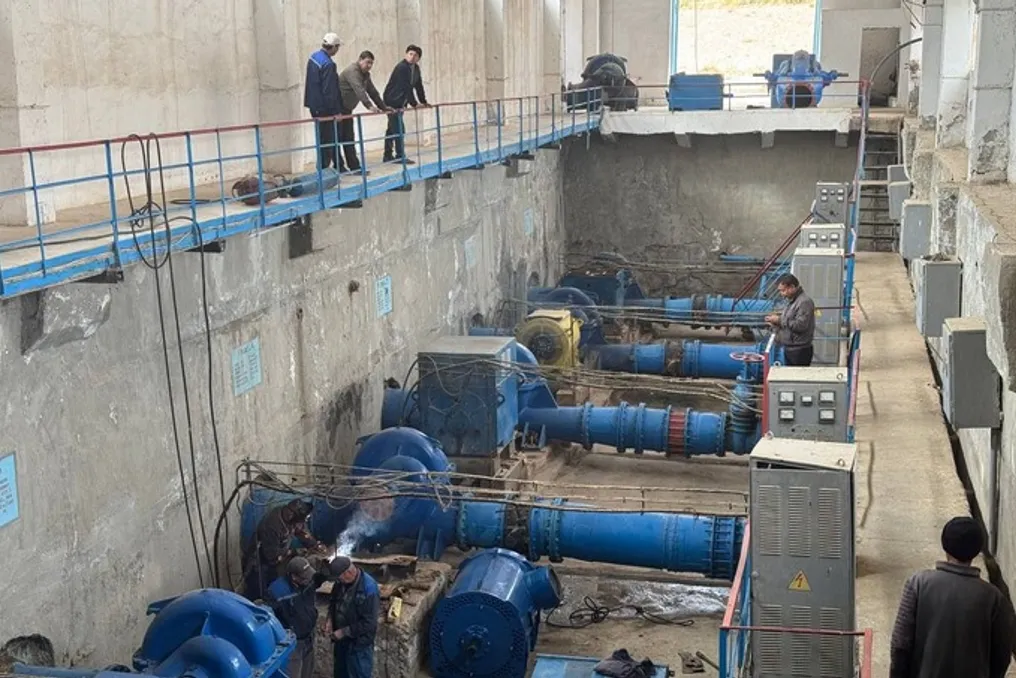
Uzbekistan has decided to abandon the initial financing scheme for the project to modernize 95 pumping stations, which was caused by the imposition of sanctions against Russia and the increase in the cost of credit products. The Minister of Water Resources, Shavkat Khamraev, announced this situation on November 11 during the 'Government Hour' in the Legislative Chamber of the Oliy Majlis.
During the session, a deputy from the People's Democratic Party of Uzbekistan, Imnomnazar Tursunov, raised the issue of the slowdown in the implementation of several departmental investment programs. He specifically noted the modernization of 95 pumping stations, valued at $37 million, emphasizing that no monetary equivalent has yet been utilized for these projects.
When asked about the reasons for the delay and the measures being taken, Shavkat Khamraev explained that the change in the financing scheme is directly related to the sanctions imposed on Russia, as well as the rise in interest rates. The Minister stated that instead of implementing the project with Russia, it will be carried out with a new bank at a rate of 4%, and this will happen next year, postponing the project's implementation until 2027.
The project was initially planned with the participation of VEB.RF
Initially, the financing for the modernization of 95 pumping stations in five regions of Uzbekistan was intended with the support of the Russian state development corporation VEB.RF. On July 29, 2021, President Shavkat Mirziyoyev approved Decree (PP-5201) concerning these projects in Bukhara, Navoi, Kashkadarya, Samarkand, and Surkhandarya regions.
This document provided for the renewal of three groups of facilities: 29 pumping stations in Kashkadarya and Surkhandarya regions; 24 pumping stations in Bukhara, Navoi, and Samarkand regions; and 42 pumping stations in Surkhandarya and Kashkadarya regions. The total cost of these three projects amounted to 213.5 million euros. Of this amount, 146 million euros were to be obtained as a loan from VEB.RF, and the remaining 67.5 million euros were covered by Uzbekistan's contribution, which included 33.7 million euros in the form of VAT coverage from the republican budget and exemption from customs duties.
According to the decree, the Russian financing had the following terms: an annual interest rate of 2%, a loan term of two years, and repayment over 10 years. Additionally, a one-time commission of 0.1% and an obligation commission of 0.15% per annum were provided for. The Ministry of Finance acted as the borrower on behalf of Uzbekistan, and the Ministry of Water Resources was appointed as the responsible executor. All expenses, including principal repayment, interest payments, and commissions, were to be covered by the republican budget.
In September 2021, VEB.RF and the Ministry of Finance of Uzbekistan concluded a loan agreement. At that time, it was reported that the modernization would improve water supply to 355 thousand hectares of agricultural land and also bring another 40 thousand hectares back into operation. The project also included the installation of 455 energy-efficient pumping units and automated control systems, with an expected annual electricity saving estimated at 40 million kWh.
The cancellation of the decree on financing through VEB.RF occurred in December 2022. The reason was the introduction of blocking sanctions against the Russian VEB.RF by the US Ministry of Finance on February 22, 2022, which limited its ability to conduct international financial operations. Several months later, on December 1, 2022, the President of Uzbekistan signed Decree (PP-434), which annulled the decision of July 29, 2021, regarding the modernization of 95 pumping stations with the participation of VEB.RF. The goal of this document was to improve the efficiency of managing foreign investment projects in the water sector.
Involvement of EBRD and EFRR in the project in 2026
On June 18, 2026, the Ministry of Water Resources of Uzbekistan, the Eurasian Development Bank (EDB), and the Eurasian Stabilization and Development Fund (ESDF) signed a memorandum of cooperation to prepare the project for modernizing water infrastructure. This document covers the same 95 pumping stations in the Bukhara, Navoi, Kashkadarya, Samarkand, and Surkhandarya regions as in the cancelled 2021 decree.
The memorandum was signed by Deputy Minister of Water Resources Utkir Sheraliyev, Deputy Chairman of the Board of EDB Alexey Skatin, and Executive Director of ESDF Yaroslav Mandron. The project involves the introduction of modern energy-efficient equipment, increasing the reliability of agricultural land water supply, and integrating real-time digital monitoring of pumping stations.
Furthermore, at the same meeting, the project for the modernization of 110 pumping stations with the participation of the European Bank for Reconstruction and Development (EBRD) was discussed. In 2025, the EBRD approved providing Uzbekistan with a loan of up to $250 million for these needs. According to the minister, tender procedures for this project took place in November 2026, and the completion of work is planned for the period 2027–2028.
Significance of pumping stations for Uzbekistan
Pumping stations are critically important for the irrigation system of Uzbekistan's agricultural lands. Due to the terrain characteristics and uneven water distribution in various regions, water cannot reach the fields naturally, so it must be lifted and pumped using electric pumps.
According to World Bank data, about 2.4 million hectares, which accounts for 56% of the country's irrigated land, depends on pump irrigation. This makes water management one of the main consumers of electricity. According to the Ministry of Water Resources, the ministry oversees 1698 pumping stations with 5204 pumping units. In 2025, their electricity consumption reached 6.4 billion kWh, whereas in 2018 it was 8.3 billion kWh. According to World Bank estimates published in May 2025, pumping stations for irrigation consumed approximately 16% of the country's total electricity.
Most of the existing equipment has been in operation for many decades. In accordance with the Water Management Development Concept for 2020–2030, at the time of its adoption, 94% of pumping stations had already exceeded their service life. The use of outdated equipment leads to increased costs for repair, maintenance, and electricity. Therefore, the modernization of the stations is aimed not only at ensuring reliable agricultural water supply but also at reducing the burden on both the energy system and the state budget. It is planned that by 2030, the electricity consumption of state pumping stations will decrease to 6 billion kWh annually.