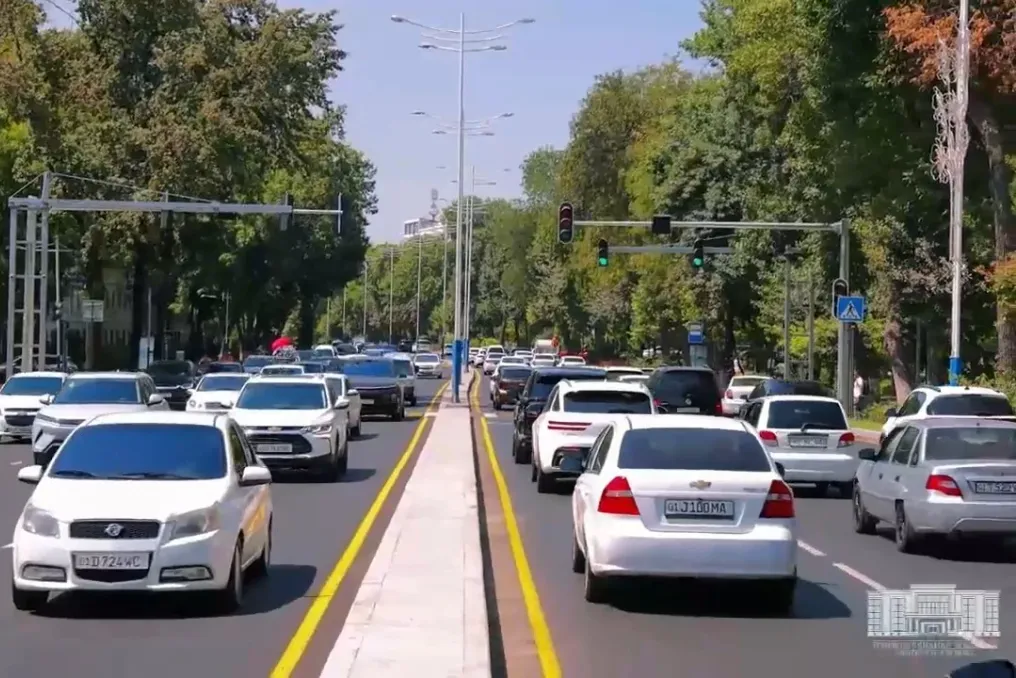
The city of Tashkent has put forward proposals for implementing digital technologies to solve the problem of road traffic jams. Estimates suggest that annual economic losses associated with transport collapse in Tashkent amount to 343 million US dollars, equivalent to 1.27% of the city's gross regional product.
Expert Jamshid Sharipov from the Center for Strategic Development proposed using digital methods to improve traffic management. The Traffic Management Center (TMC) reports that about 5.2 million people travel through Tashkent daily. Furthermore, 770,000 vehicles circulate daily on 81 main streets, while the total calculated capacity of these streets is only about 400,000.
The actual load on these streets is almost 1.9 times their calculated capacity. Sharipov notes that some delays can be minimized without building new roads by optimizing traffic light operation, coordinating road works, and utilizing digital data.
Transport Development
Uzbekistan's transport sector accounts for nearly 8% of the country's GDP and provides jobs for approximately one million people. In recent years, the country has improved its ranking in the World Bank's Logistics Performance Index, rising from 129th to 88th place.
The volume of transit freight transport reached 15.3 million tons in 2025 and is planned to increase to 18.5 million tons by 2030. Major infrastructure projects are also being implemented. The World Bank approved financing of 200 million US dollars for the reconstruction of the M41 highway, where the average speed is expected to increase from 65 to approximately 90 km/h.
A six-lane toll highway spanning 282 km between Tashkent and Samarkand is also under construction. Nevertheless, the World Bank predicts that Uzbekistan will need to increase road capacity by approximately 500% by 2030 to meet the expected growth in freight transport.
Traffic Light Adjustment Results
A significant step was the establishment of the Traffic Management Center in Tashkent. According to the presidential decree of December 4, 2025, the center was granted powers for digital traffic management, monitoring construction work, and enhancing road safety.
TMC reports that adaptive traffic lights are already operational at 271 intersections, and a macro-transport model of the capital has been developed. On Buyuk Ipak Yuli street, synchronizing 13 traffic lights using the 'green wave' system reduced travel time to the city center by 29%, decreasing it from 8.5 minutes to six minutes. Travel time in the opposite direction decreased by 20%.
On Mahtumkuli street, which serves about 90,000 vehicles daily, synchronizing 11 traffic lights increased the route's capacity by 12%, and travel time decreased by 10%. At the intersection of Firat and Haydar Aliyev streets, traffic flow analysis allowed for nearly doubling the duration of the green signal in the most congested direction, which was accompanied by a reduction in queues.
According to TMC data, on September 2, 2026, the first day of the academic year, traffic volume increased by 30%, but the center promptly adjusted the traffic light phases, keeping congestion at six points.
Main Causes of Congestion
Sharipov identifies three factors that reduce road capacity. The first is the growth of the vehicle fleet and traffic intensity, which outpaces infrastructure development. On the Tashkent–Samarkand highway, actual traffic reaches 45,000 vehicles per day against a calculated capacity of 32,000, which is 41% above the norm. Travel time can reach six hours. Approximately a quarter of international highways operate under heavy congestion.
The second factor is the mismatch between traffic light settings and actual traffic flows. Fixed cycles do not always account for differences in traffic intensity between main and secondary streets. This leads to the formation of queues on busy routes, while part of the green signal time on less busy roads is used inefficiently.
An INRIX study covering about 210,000 traffic lights in the United States showed that suboptimal settings are responsible for approximately 10% of all delays. The third factor is road construction work requiring lane closures. According to the US Federal Highway Administration, such work causes about 10% of all delays and approximately 24% of unplanned delays on highways.
Similar situations were observed in Uzbekistan at the Kamchik pass during the mass return after holidays, as well as in Tashkent during repairs near the Yunusabad ring road.
Predictability of travel time is also important for tourism and transit. In 2025, Uzbekistan welcomed 11.7 million foreign guests, 74% of whom arrived from Kyrgyzstan, Tajikistan, and Kazakhstan.
International Experience
In Pittsburgh, the pilot implementation of the Surtrac adaptive traffic management system reduced travel time by 25.8%, waiting time by 40.6%, and the number of stops by 31.3%.
The CRUISE system operating in Singapore combines dynamic optimization of traffic light cycles with AI-based video analytics for earlier detection of road accidents. London employs a lane rental mechanism where road operators pay for occupying the busiest sections, including peak hours. The fee can reach 2,500 pounds sterling per day.
According to Transport for London, after introducing this mechanism, the share of road work conducted outside peak hours increased from about 30% to over 92%. Serious delays on problematic sections decreased by more than a third. In the state of Indiana, USA, road work contracts considered not only costs but also project completion deadlines and the number of closed lanes. The repair of Interstate 70 was completed 55 days ahead of schedule.
The Work Zone Data Exchange (WZDx) standard is used to exchange information about road works, allowing the transmission of digital data about work zones, including to navigation services. In the Netherlands, about 340 drivers participated in the Spitsmijden experiment and received compensation of 3 to 7 euros for avoiding travel during the morning rush hour. The number of participants' trips during this time decreased by approximately 60%, as most drivers shifted their journeys to earlier or later times.
Three Directions for Reforms
Sharipov suggests transforming the TMC into a unified digital platform for traffic management. This platform should integrate data from adaptive traffic lights, video surveillance, navigation services, road work information, and incidents. The priority task must be setting traffic light cycles according to actual traffic not only on Tashkent's main streets but also on international and national highways, paying special attention to routes leading to the capital and the Tashkent–Samarkand–Bukhara corridor.
The next stage could be expanding adaptive traffic management. After accumulating sufficient data, the proposed system should include algorithms for predicting congestion. The second area concerns creating a digital registry of road works, which should cover urban, national, and international roads, coordinate project schedules, publish information on lane closures, and share data with navigation services. Additional measures may include differentiated payment for occupying lanes during peak hours, incentives for contractors who finish work ahead of schedule while meeting quality and safety requirements, and installing sensors to detect queues in work zones.
The third direction relates to managing transport demand and freight flows. The expert suggests considering providing incentives to shift trips out of peak hours, especially when lanes are temporarily closed. He also proposes improving advance planning for the arrival of freight vehicles at the busiest border crossing points. Carriers should receive up-to-date information on the condition of transport corridors and border crossings.
Implementation Requirements
To implement the proposed solutions, the powers of the TMC regarding international and national roads must be defined, or a joint mechanism must be created with the Road Committee. A legislative framework will also be required to establish fees for lane occupation, define maximum limits for traffic restrictions, and introduce mandatory traffic management plans for road works. Sharipov also suggests concluding agreements with navigation services to exchange anonymized aggregated data while complying with personal data protection requirements.
Initial steps include selecting pilot corridors, defining target indicators, and establishing an independent evaluation mechanism. Potential sources of sustainable funding may include revenue from lane occupation fees. The program is proposed to be implemented in stages: within the first six months, authorities must establish baseline indicators and select pilot areas. In the following 6–18 months, the proposed solutions can be tested and their effectiveness assessed. Effective measures are then scaled up over the next 18–36 months.
Results should be evaluated based on reductions in travel time and congestion, increased transport reliability, reduced road work durations, and a decrease in traffic accidents with casualties and injuries. However, international experience cannot be viewed as a ready-made model for direct copying; for example, the effect of the Dutch incentive program weakened after payments ceased. Furthermore, the TMC's stated reduction in travel time requires independent assessment and comparable measurements before and after changes. In Sharipov's opinion, the process must begin with accurate measurements, pilot projects, and transparent evaluation of results. More effective traffic management can immediately reduce some delays, although it will not replace the construction of new roads where necessary.