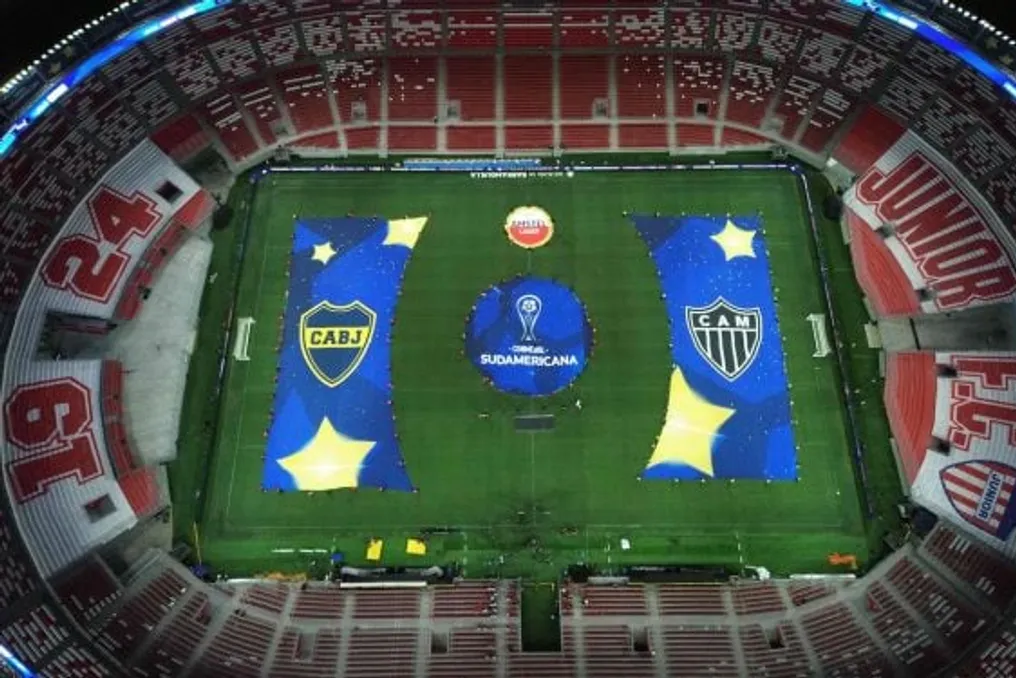
The South American Cup final between Atletico MG and Boca Juniors will take place this Saturday (21st) at 7:30 PM at the stadium in Barranquilla, Colombia. However, the logistical support for the fans proved to be a more complex challenge than the opponent itself.
Around 9,000 Atletico fans and 30,000 Boca supporters faced one problem when traveling from Belo Horizonte (MG) and Buenos Aires: reaching the match venue, which is only accessible from the southern regions of the continent via complicated connecting flights.
Only six international routes depart from the Colombian city, and none of them lead to Brazil or Argentina. This limited offering led to a sharp increase in prices and travel time.
To watch 90 minutes of football in Barranquilla, an Atletico fan had to spend up to $3,000 USD, which is about 17,800 Brazilian reais, and spend 26 hours traveling, using at least two layovers.
The Atletico squad itself flew on a charter flight, while the fans managed independently. The same applies to professionals, such as Henrique André, a reporter for Itatiaia radio covering the match on site. He described his route: Confins, Galeao, Bogota, Barranquilla. 'We left Confins at 9:30 AM, arrived in Galeao at 10:00 PM, left from there at 1:40 AM, arrived in Bogota at 7:30 AM, and here at 9:30 AM local time.'
The total time between the first departure and the last arrival was 26 hours, and this was just one possible trajectory. The journalist also noted that some traveled through Panama, or headed to Brasilia or Guarulhos before going to Lima before arriving in Colombia. 'There were also people who decided to go through the United States,' he reported, citing the most extreme example of a route.
Some even decided to cover the distance by ground transport: three Atletico players left Belo Horizonte on a Combi on November 2nd and arrived on Thursday (19th) after 17 days and over 7,000 kilometers.
Boca fans utilized the best connection between Buenos Aires and Colombia, filling direct flights to Bogota, from where they proceeded to Barranquilla. Nevertheless, the supply was insufficient: reports indicate that many Argentinians reached the final venue via Guarulhos.
Prices also reflected the chaos. The base ticket price for the final was $825 USD, but those who bought at the last minute paid significantly more. Henrique André stated: 'There were people who paid $3,000, and there were those who bought in advance and paid $1,500.'
Until 2018, the Copa Libertadores and South American Cup were decided in a home-and-away format at each finalist's home stadium. For the 2019 tournaments, CONMEBOL unanimously approved holding one match on neutral territory. Alejandro Domínguez, the organization's president, promised 'more than one match: a major sporting, cultural, and tourist event,' and provided about $2 million to each finalist without any organizational costs for the clubs. This model was taken from UEFA, which has held its main final in a single-match format since 1956.
However, there was strong and immediate criticism, as concerns were raised about the financial solvency of fans to cover travel expenses. There was a threat of losing the 'atmosphere of the cup' and, worse, having empty seats at the final match. And this happened: in 2022, the South American Cup final in Cordoba (Argentina) cost the fan between 5,000 and 9,000 reais just for the ticket and travel. A small 'Independiente del Valle' (Ecuador), the winner of that season, returned 12,500 tickets.
In the same year, Flamengo and Atletico PR determined the Libertadores winner in Guayaquil (Ecuador): shortly before the game, only 11,000 tickets were sold out of almost 60,000 available, and the stadium was filled by about half.
When the venue is accessible, the effect changes: in 2023, Fluminense and Boca Juniors met at a full Maracanã. In 2024, Atletico MG and Botafogo played in Buenos Aires, and even there, difficulties arose. One of the problems was solved by Marcelo Jabulas, editor of AutoPapo, who had to travel to Lima (Peru) to then reach the Argentine capital. Coincidence or not, the 'Atletico' fans could not sell all their tickets.
CONMEBOL drew inspiration from Europe, but the distances imposed on fans in Europe are significantly shorter—and they also charge less money, although the average income of their residents is higher. Barranquilla is 4,785 km from Belo Horizonte and 5,363 km from Buenos Aires in a straight line. In three European finals in May, no fan had to travel more than 2,604 km, for example, the section between Birmingham (UK) and Istanbul (Turkey). The shortest route, from London to Leipzig (Germany), was 863 km: 1 hour and 40 minutes by plane or ten hours by bus.
The cost of a flight ticket is about $800 USD in Europe and $825 USD here. But while the prices are equivalent, the deciding factor is time: 1 hour and 40 minutes on a direct flight versus 26 hours and two layovers. Europeans can still fly and return on the day of the match for $980 USD on a regular flight. Flying from Brazil is only possible on a three-day charter flight, which costs about $1,330 USD per person.