Serra Pelada History: The World's Largest Open Gold Mine
Read more
Super Abril
super.abril.com.br

Serra Pelada History: The World's Largest Open Gold Mine

Serra Pelada, one of the most significant events in the history of Brazil's mining industry, attracted a huge number of people between 1980 and 1992. The gold rush began in late 1979 after a gold nugget was discovered on the Três Barras farm. Within a few months, over 30,000 workers gathered at the site.

The territory was quickly seized and placed under strict control of the military regime led by Sebastião Rodrigues de Moura, known as Major Curio, who participated in suppressing the Araguaia Guerrilla War. In 1982, Curio was elected as a federal deputy, and in 1988, the town where Serra Pelada is located was named Curionópolis.

Workers used shovels, picks, and brute force to tear down a hill 150 meters high. Instead of a mound, a giant crater measuring 24,000 square meters was formed, which later turned into a 200-meter deep lake due to rainfall.

Companhia Vale do Rio Doce held the rights to mineral extraction in this area and received compensation from the federal government for the invasion. Although legislation required the transfer of mined ore to state treasuries, smuggling was actively taking place within the perimeter.

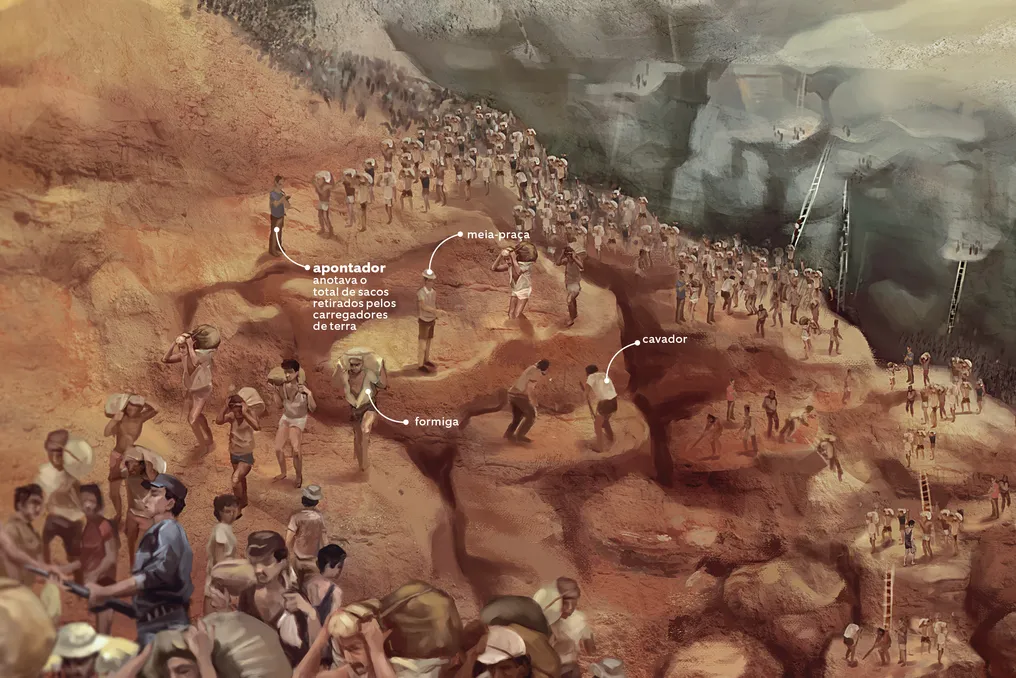
A rigid social structure existed inside the deposit. The territory was divided into 'barrancos'—plots measuring 2 by 3 meters, which were initially distributed by force and later assigned by lottery with documentation. The owners of these plots, called 'capitalists,' retained the majority of the profit.

Under the capitalist was the 'meia-prasa,' responsible for managing the work area and directing the efforts of others. For this leadership position, he received a commission ranging from 2% to 5% of all gold mined in his zone.

The basic part of the operation consisted of specialized functions: pointer, digger, counter, and 'formiga.' The latter dug the ground until stone, packed up up to 35 kilograms of sediment, and climbed shaky ladders known as 'adeus-mamae' to transport the material outside, receiving payment proportional to the transported weight.

At the mine base, the digger used picks to crush rock in search of nuggets, which often reached the size of a golf ball. Then the counter washed the earth using channels with liquid mercury—a chemical substance that binds with the precious metal. Final separation was done in a pan. After this, the amalgam was heated so that the mercury evaporated, leaving only pure gold for weighing.

Near the barrancos, Caixa Econômica Federal had an official point with scales for paying for the metal in cash. By law, this was the only authorized buyer, but it set prices that could be up to 60% lower than real market quotes, which stimulated the parallel market.

During the extraction, the Federal Police enforced strict rules: the consumption of alcohol, carrying weapons, and the presence of women at the mine were strictly prohibited. This situation led to the creation of Vila Trinta, a settlement located 30 kilometers from the mining site, on highway PA-175, which was full of bars and brothels, marked by frequent conflicts and daily murders.

At the peak of exploitation, between 1982 and 1986, about 100,000 people lived in the Curionópolis region. The Serra Pelada mining continued until 1992, when state intervention closed the operation after 56 tons of gold were obtained through official and underground channels. In 2002, mining activities at this site resumed under industrial and mechanized conditions.

Similar stories

Online sellers in the UAE are responsible for goods sold through third parties
Read more
www.khaleejtimes.com

Online sellers in the UAE are responsible for goods sold through third parties

According to amendments to the country's consumer protection regulations, online sellers in the United Arab Emirates (UAE) will now be responsible for goods and services sold through third parties on their electronic platforms. These changes have been approved by the Cabinet.

The Cabinet adopted Resolution No. 166 of 2026, which expanded the scope after amendments were made to Federal Decree-Law No. 14 of 2023. The revised Article 40 stipulates that the rules apply to goods and services traded through internet platforms, and their application is not limited to traditional sales channels.

It is stated that the supplier will be liable for any goods or services offered or sold through a third party via an electronic platform or any other modern technology. This does not negate the general liability norms provided for by current legislation.

The legal basis for this amendment is Federal Decree-Law No. 14 of 2023 on e-commerce, as well as laws on competition and combating commercial fraud.

The UAE has established a comprehensive consumer protection system to ensure fair business practices and protect consumers across the country. Federal Law No. 15 of 2020 on Consumer Protection, which was amended by Federal Decree-Law No. 5 of 2023, obligates businesses to provide quality goods and services, state accurate prices, provide correct product information, and protect consumers' personal data.

This legislation also protects consumers from misleading advertising, defective products, and unfair commercial practices, giving them the right to claim compensation for damages caused by faulty goods or inadequate services. The law applies throughout the UAE, including free zones and e-commerce enterprises registered in the country, with the Ministry of Economy and local economic departments responsible for receiving complaints and ensuring consumer rights compliance.

In accordance with the revised Article 41 of Cabinet Resolution No. 166 of 2026, the Cabinet shall issue a decree based on the proposal of the Minister of Economy and Tourism and in coordination with competent authorities, which will define violations and administrative penalties, including financial fines, for non-compliance with the law and its provisions. Until this decision is made, the existing list of violations and fines remains in effect if it does not contradict the new resolution. Fines do not affect other sanctions provided for by separate legislation.

The Resolution also rewrites Article 9, which allows the minister, jointly with a competent authority, to take temporary measures during a crisis or emergency circumstances causing unusual price increases or fluctuations. Such measures include setting prices for affected goods or services, banning the export of goods, allocating sales quotas, stimulating production or import from alternative sources, appointing specific structures for importing, and any other measures the minister deems necessary. Selling above set prices is prohibited, and any excess is considered an unjustified additional charge imposed on consumers.

The ministry or competent authority may assess the excess based on commercial records, invoices, accounting data, or other relevant means. Consumers retain the right to demand refunds or seek compensation.

Factors determining whether a price increase is anomalous include inflation rates, past prices, price levels in the UAE and neighboring countries, percentage increase, exchange rates, consumer complaints, delivery and insurance costs, energy prices, and the degree of competition or monopoly.

Popular