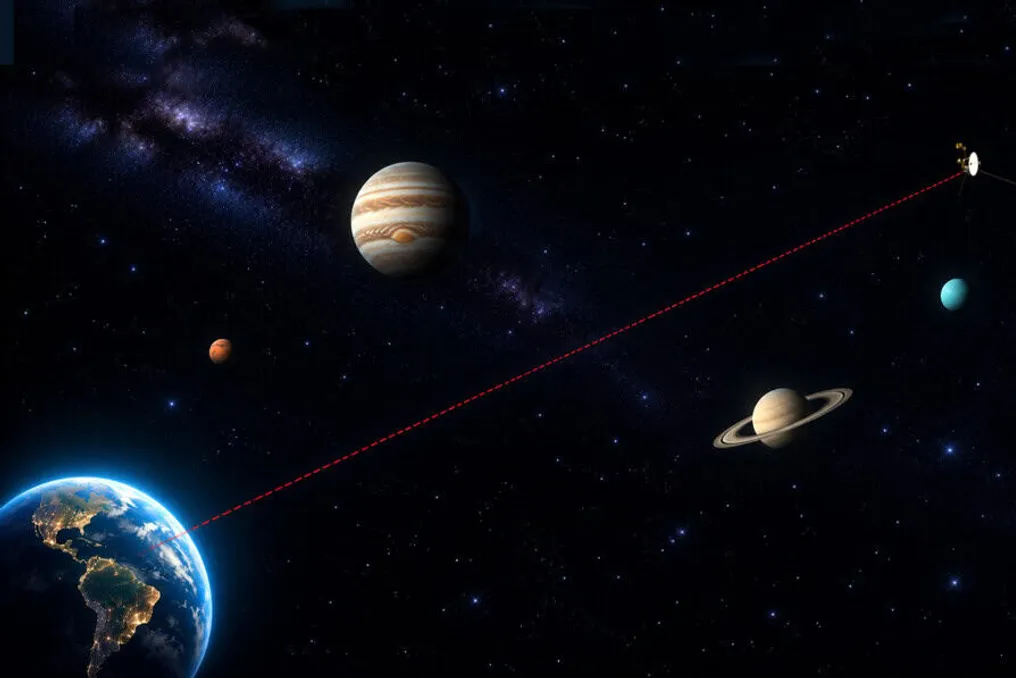
The spacecraft Voyager 1 recently reached a significant milestone in its journey through the Cosmos, achieving a distance of one light-day from Earth. This feat represents a distance of approximately 26 billion kilometers, which light takes a full day to travel, and which Voyager 1 took almost 50 years to reach. This measurement was only possible thanks to a study conducted 350 years ago, a period when the speed of light was measured for the first time.
Although previous attempts, such as Galileo Galilei's experiment with lanterns on distant mountains, were made, light was too fast to be captured by the instruments and methods of the time, leading many scientists to believe its speed was infinite.
However, on November 21, 1676, the Danish astronomer Ole Rømer presented the Royal Society of Sciences in Paris with the first scientific proof that light travels at a limited speed. Furthermore, he managed to make the first measurement of this speed, although it was initially imprecise, it revolutionized the way humanity views and understands the Universe.
Rømer based his work on an idea by Galileo, unrelated to the lanterns, but rather on the observation of the movement of moons around Jupiter. The eclipses of these moons occurred at regular intervals, serving as an astronomical clock that could be synchronized globally, which was crucial for determining longitudes on Earth.
By applying this method, Rømer measured the period between the eclipses of Io and noticed that the precision was not constant. Over the months, he observed that the eclipses showed progressive delays relative to the predicted time, followed by decreases in these delays, until the events began to occur earlier than expected.
Investigating the causes, he concluded that the eclipses occurred more quickly when the Earth approached Jupiter and took longer when it moved away. His deduction was that this could only happen if the light from Jupiter and its moons took longer to reach Earth when the planet was farther away, thus proving that the speed of light was not infinite and could be measured.
To illustrate, he compared this to a precise clock: if it were taken to a distance where light took five minutes to arrive, when observed remotely, it would appear delayed; upon returning, it would appear accelerated, correcting the original time. This is the phenomenon Rømer observed, using Galileo's astronomical system as his clock.
In September 1676, Rømer predicted that the next eclipse of Io would occur with about ten minutes of delay, and this prediction was confirmed on November 9. Two weeks later, on November 21, he presented his conclusions to the French Academy, estimating that light took approximately 22 minutes to cross the diameter of Earth's orbit.
At that time, Christiaan Huygens, a colleague of Rømer, had calculated the Earth-Sun distance with high precision. Using this measurement and Rømer's estimate, Huygens calculated the speed of light at 220,000 km/s, a value that, although 27% lower than current estimates, was surprisingly close for a first attempt.
The most relevant point was Rømer's demonstration that light required time to travel long distances. In subsequent centuries, other scientists refined these calculations. In 1849, Hippolyte Fizeau conducted an experiment with a toothed wheel and a distant mirror, and later, Léon Foucault improved the method with rotating mirrors. More advanced experiments led to the current value of 299,792 km/s in a vacuum.
This value has profound implications; for example, sunlight takes just over eight minutes to reach Earth, meaning we never see the Sun as it is in the present moment, but rather as it was eight minutes ago. Observing Jupiter, for instance, reveals its state tens of minutes prior.
This relationship between time and distance resulted in the creation of units such as the light-year, equivalent to about 9.46 trillion kilometers, the distance traveled by light in one year. Thus, when observing stars and galaxies millions of light-years away, we are literally viewing the past of the Universe.
The speed of light also imposes a fundamental limit on communication in space travel, as no information can travel faster than it. This requires rigorous planning in the control of distant spacecraft. In the case of Voyager 1, every exchange of information with Earth requires about two days, one for sending and one for return, even using radio signals that travel at the speed of light.
When observing the eclipses of Io, Ole Rømer probably did not anticipate all the consequences of his discovery. His initial goal was merely to calibrate his clock, but he paved the way for a new understanding of space and time, essential for the theory of relativity centuries later.
350 years ago, Ole Rømer proved that light does not arrive instantaneously. Today, a small human craft is so far away that even a message sent at the speed of light takes a full day to reach it. These are two narratives separated by centuries, but linked by the same discovery. As Voyager 1 advances, carrying a piece of human history beyond the Solar System, light continues to bring news from distant worlds, extinct stars, and galaxies of a young Universe. For when we look into space, we are not just contemplating the vastness of the Cosmos; we are traveling through time, reading the past stories of the Universe that light still tells us.