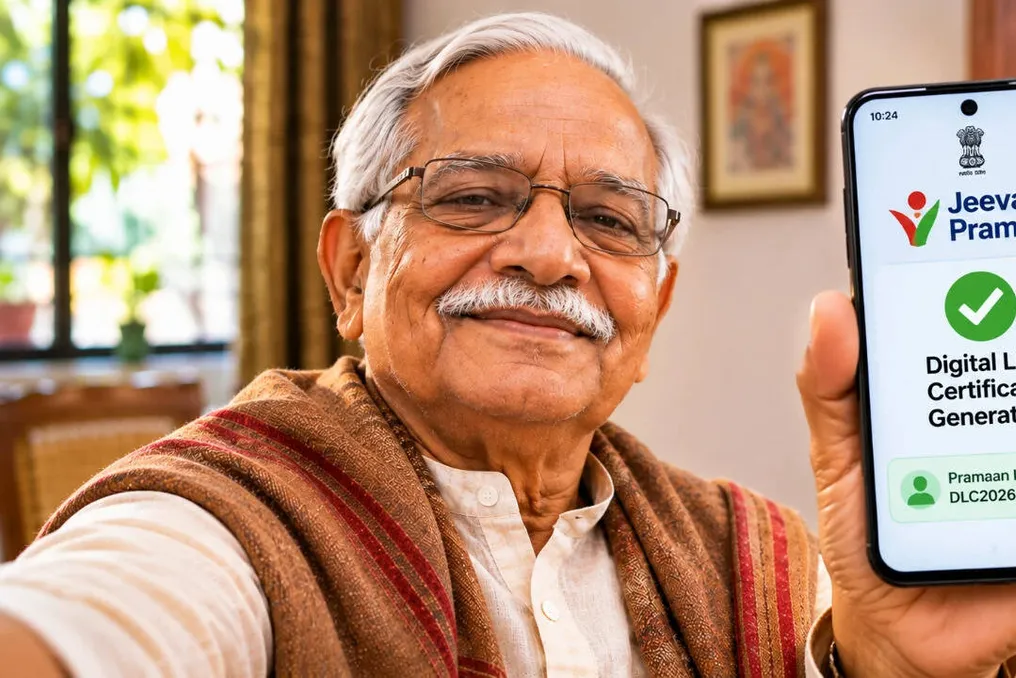
For millions of pensioners in India, the annual requirement to prove their viability for pension receipt may now only require a selfie. Thanks to the government-developed Jeevan Pramaan system, pensioners can use Aadhaar-based facial authentication to verify their identity and generate a Digital Life Certificate (DLC) from home, bypassing visits to banks or long queues.
The system captures a live facial image and matches it with the photograph linked to the Aadhaar number, allowing the certificate to be sent electronically to the authorized pension disbursing authority. This service is particularly important for the elderly, sick, and people with disabilities who find it difficult to travel to banks or pension institutions.
The government is actively promoting the wide adoption of this technology as part of the fifth nationwide Digital Life Certificate campaign, running from November 1 to November 30, 2026, aiming to process 2.30 crore certificates, including 1.50 crore via facial authentication.
The Digital Life Certificate is an electronic document confirming that the pensioner is alive and entitled to continue receiving pension payments. Government pensioners are required to periodically provide this certificate to the relevant pension disbursing authority. This requirement is in place to ensure that payments go only to eligible recipients and are not credited after the pensioner's death.
In the traditional system, pensioners usually had to appear in person at their bank or another authorized entity to confirm their life, after which the certificate was forwarded to the pension agency for processing. For elderly pensioners, especially those suffering from illnesses or mobility issues, annual trips to the bank or government office could be challenging.
The Reserve Bank of India (RBI), in a circular from December 2014, acknowledged that many pensioners faced difficulties in submitting certificates on time, despite the availability of this option in various branches of paying banks. To resolve this issue, the government launched Jeevan Pramaan on November 10, 2014, implementing the Aadhaar-based Digital Life Certificate system. This initiative, developed by the then Department of Electronics and Information Technology, aimed to eliminate the need for pensioners to physically visit the authorities disbursing their pensions.
The official Jeevan Pramaan portal describes this initiative as a way to solve the 'difficulty and unnecessary inconvenience' faced by elderly and sick pensioners who may be unable to appear in person before the authorities. Under the system, the certificate generated after successful biometric authentication is stored in a central repository and becomes available electronically to the pension agency.
The process is more complex than just taking a selfie and uploading it; it uses Aadhaar-based facial authentication to verify the pensioner's identity before generating the certificate. This technology was introduced to simplify the process, especially for elderly pensioners whose fingerprints might become hard to access with age.
To use the service, pensioners require two applications on their smartphones: the government's Jeevan Pramaan app and the UIDAI's AadhaarFaceRD app. The latter allows the phone camera to capture the pensioner's face for authentication. The official Jeevan Pramaan portal states that a separate device for fingerprint or iris scanning is not required for facial authentication.
The process begins with the pensioner entering details such as Aadhaar number, name, mobile number, and pension-related information, including the Pension Payment Order (PPO) number, bank account, and the disbursing authority. The user then completes the required operator authentication, which is a one-time process that can be done by the pensioner themselves. After giving consent, the pensioner takes a live facial image using the smartphone camera.
But how does the phone know that the person in front of the camera is the real pensioner? The captured image is sent for Aadhaar-based facial authentication, where UIDAI matches it with the photograph linked to the provided Aadhaar number. UIDAI describes this as a 1:1 matching process, meaning verifying the live image against the photograph associated with a specific Aadhaar number, rather than searching through a database of millions of faces. The authority also states that facial authentication is based on the consent of the Aadhaar holder.
After successful authentication, a Digital Life Certificate is generated with a unique identification number called Pramaan ID. The pensioner receives a notification on their registered mobile number, and the certificate is stored in the Jeevan Pramaan repository, becoming available electronically to the pension agency. This means the pensioner usually does not need to visit the bank to submit a printed copy.
The Jeevan Pramaan service is available to pensioners whose Pension Paying Authority (PSA) is registered on the platform. This includes eligible pensioners receiving pensions from central and state governments, as well as from other government organizations. The service is also available to eligible pensioners of the Employees' Pension Scheme (EPS-95), provided their pension agency is included in the system.
Central government pensioners must submit an annual life certificate in November to continue receiving payments. However, pensioners aged 80 and above are given an extended window and can submit their certificates starting October 1st each year. The Department of Pension and Pensioners confirmed these rules in a memo dated October 26, 2026.
It is important to note that not all pensioners follow the same submission schedule. For instance, EPS-95 pensioners can submit their certificates anytime during the year, and the subsequent certificate remains valid for one year from the date of the previous submission. Therefore, the November deadline applicable to central government pensioners should not be considered a universal deadline for all pension categories.
There are also certain restrictions. According to the official Jeevan Pramaan FAQ, pensioners who have been re-employed or married are not eligible to use the Digital Life Certificate service and must submit their certificates through traditional methods.
Although the Digital Life Certificate system is designed to simplify pension verification, certificate generation does not necessarily mean the process is complete. A pensioner's face may be successfully authenticated, and the certificate generated, but errors in pension data or selecting the wrong pension disbursing authority can prevent the information from being updated in bank records.
This issue was noted at the 35th meeting of the Standing Committee of Voluntary Agencies (SCOVA) held on March 10, 2026, under the Department of Pension and Pensioners. The meeting discussed complaints regarding delays and rejection of Digital Life Certificates submitted through Jeevan Pramaan, particularly concerning Bank of Baroda and Central Bank of India.
Central Bank of India reported that during the Digital Life Certificate campaign in November 2025, 79,905 certificates belonging to its pension account holders were uploaded to the Jeevan Pramaan portal. Of these, 60,637 were successfully updated in the bank's pension processing system, while the remaining 19,268 were rejected. This means that about 24 percent of the certificates uploaded to the portal were not updated in bank records.
The bank attributed the rejections mainly to pensioners entering incorrect pension account details. It also pointed to cases involving pensioners from defense and telecommunication services who had switched to the SPARSH and SAMPANN pension systems, respectively, but continued to select Central Bank of India as their pension disbursing authority when submitting certificates.
Bank of Baroda identified similar issues, including incorrect PPO numbers, account numbers, and selection of the wrong Pension Paying Authority. It also reported instances where pensioners submitted certificates both physically and digitally or generated multiple digital certificates, leading to processing complications. It is important to understand that successful facial authentication confirms identity, but the certificate must also reach the correct pension authority and be updated in its records. Therefore, pensioners should retain their Pramaan ID and check the certificate status, rather than assuming that successful scanning automatically completes the process.
Facial authentication does not always work. Poor lighting, incorrect face positioning, slow internet connection, or incorrect pension details can prevent certificate generation. The Chief General of Defence Accounts (CGDA) also highlighted blocked Aadhaar biometric data, incorrect PPO number, blurry facial image, and non-adherence to application instructions during scanning as possible reasons for failed submissions in its recommendations on Digital Life Certificates.
If a pensioner receives an SMS notification rejecting their Digital Life Certificate, the Jeevan Pramaan portal advises contacting their Pension Disbursing Authority (PDA), such as a bank or post office. The pensioner should verify the entered details upon submission and generate a new certificate with the correct information and biometric authentication. The certificate status can also be checked by uploading it from the official Jeevan Pramaan portal using the Pramaan ID.
For pensioners who do not have a smartphone or cannot perform facial scanning, the digital system is not the only option. They can visit a bank branch, post office, or an authorized Common Service Centre (CSC) to submit their life certificate through available biometric means. Banks also offer home banking services, where an agent can visit the pensioner's home to complete the process. India Post Payments Bank (IPPB) also provides the Digital Life Certificate service at home through postmen and Gramin Dak Sevaks. Under this service, an authorized postal representative visits the pensioner's home and completes the authentication process using available biometric means. The standard IPPB service costs 70 rupees, including applicable taxes, for successful certificate generation. However, eligible EPS-95 pensioners can avail of a separate free home service from EPFO-IPPB.
It is important to emphasize that submitting a Digital Life Certificate is an additional option, not a mandatory replacement for the traditional method. Pensioners who prefer physical submission can continue to provide their life certificates through authorized traditional channels. State Bank of India also confirms that physical life certificates will be accepted from pensioners who prefer this method.
Since the process involves Aadhaar-based biometric authentication, consent and data protection are crucial aspects. The Jeevan Pramaan app requires pensioners to give consent before their Aadhaar data and biometric information are used for authentication. According to the consent declaration displayed in the app, the Ministry of Electronics and Information Technology (MeitY) and the National Informatics Centre (NIC) state that...
2