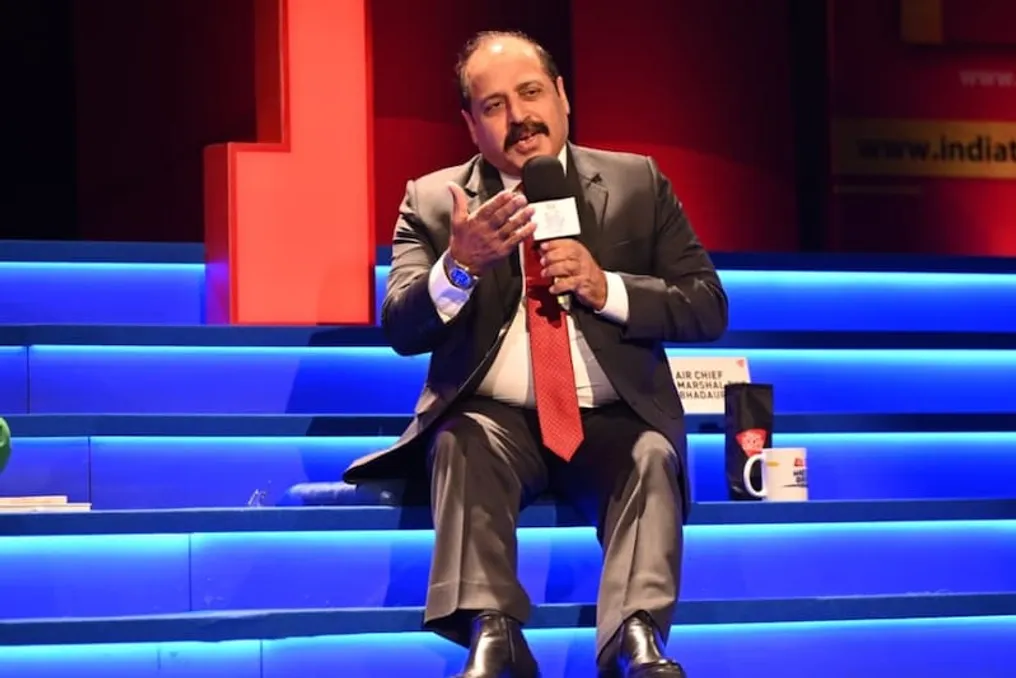
Former Air Force Commander Discusses Career Paths in the Defense Sector
Read more
Aaj Tak
www.aajtak.in

Former Air Force Commander Discusses Career Paths in the Defense Sector

The desire to serve the country in the uniform of the Army, Navy, or Air Force is a dream for millions of young people, but not everyone manages to achieve this opportunity. This raises the question of development paths and contributions to nation-building for those who cannot join defense structures for any reason or choose a different profession.

During the session 'What should a defender of the country be like?' as part of an Aajtak masterclass, former Air Force Commander RKS Bhadoria openly shared his views on various aspects of a career in the defense sector with Shweta Singh.

At the beginning of the session, he emphasized that he did not come to force or 'motivate' anyone, but merely to provide youth with accurate information and understanding so they could make such an important life decision independently. He noted that military service is a career that offers stability, excitement, responsibility, and broad opportunities for growth, especially in the Air Force, where the level of technology and competence is extremely high. Furthermore, he advised young people to definitely talk to their mothers before making such a decision.

Speaking about his journey, RKS Bhadoria mentioned that his father served in the Air Force, and he studied in Chandigarh. In the fifth or sixth grade, looking at MiG-21 aircraft flying over the school, he decided that he wanted to join the Air Force. In his opinion, the process of learning and self-improvement does not stop after a person becomes a pilot or a defense officer, but continues throughout life. He believes that in fields such as combat operations or piloting, not only theory but also performance demonstrated on the battlefield and in the air is important. The ability to make decisions in milliseconds and fractions of a second among high-speed aircraft is achieved through constant training, practical exercises, and the ability to adapt quickly.

During the session, a young accountant (CA) shared his experience, speaking about regretting the inability to serve in the army due to health reasons, and also raised questions about youth going abroad and patriotism. Regarding this, RKS Bhadoria replied that even if the dream of wearing a uniform does not come true, there is no need to despair. He added that one can make a significant contribution to the development of the country and the concept of 'Self-Reliant India' by working in the fields of finance, accounting, venture capital, startups, technology, and defense industry. Concerning issues of lack of patriotism, he stated that Indians' connection to the nation is deep, and under the changing ecosystem and the self-reliance initiative, great opportunities are opening up for the youth within the country.

When discussing the qualities of a true citizen and soldier, he noted that their core values—honesty, incorruptibility, moral and physical courage, and discipline—are similar. The difference lies only in the fact that in the defense sector, the ability to take risks, the strength of decision-making under pressure, and the role of teamwork become more decisive. When asked about concerns regarding death or family, he replied that risk is part of the nature of military service, but instead of fearing it, it is important to trust one's work and team. According to him, the culture of the armed forces and team spirit are such that in any difficult moment, comrades and the unit remain strongly together, like a family.

Various options for building a career in the defense sector were discussed in detail during the session. It was stated that after completing 12th grade, one can join the National Defence Academy (NDA) to receive a permanent commission in the three armed forces (knowledge of natural sciences is required for the Air Force and Navy, while students of any profile are suitable for the Army). Additionally, the Technical Entry Scheme is available after 12th grade. After university, there are the Combined Defence Services (CDS) exams, as well as opportunities in the Officer Training Academy of the Army (OTA), a direct graduation path for the Navy, and AFCAT for the Air Force, which offer chances for short-term service and other directions. Holders of the NCC 'C' certificate receive the advantage of a direct interview, followed by a written exam, SSB interview, and medical examination. Moreover, for those who want to wear a uniform while remaining employed in another profession, there is the option of the Territorial Army up to age 42, and at the soldier level, opportunities are offered through the Agniveer program.

Sharing his flight experience, RKS Bhadoria recounted that after training, the initial adaptation to the speed and pressure of piloting the MiG-21 was difficult, but over time, he began to understand the thrill of the job. He mentioned his experience flying Rafale and MiG-21 and noted that even in high positions, flying is necessary to maintain a connection with the real situation and sustain confidence in leadership. He also mentioned a very delicate incident in his career related to a mid-air collision of two Jaguar aircraft, which occurred despite damage and injuries.


Similar stories

Pilot Hana Mohsin Khan advises students on the possibility of changing careers at any age
Read more
www.aajtak.in

Pilot Hana Mohsin Khan advises students on the possibility of changing careers at any age

Commercial pilot Hana Mohsin Khan participated in the 'Career Flight' session as part of the Aajtak Masterclass program. During this event, she openly discussed her career path, the process of learning to fly, the participation of women in the aviation industry, and the challenges of this profession.

Hana shared that she started her career in journalism, then worked in event management, and only after that decided to become a pilot. Today, she flies herself and inspires other girls to join this field based on her experience.

Describing her journey, Hana Mohsin Khan mentioned that she first worked in journalism and then founded her own event organizing company. During one trip to Thiruvananthapuram, she met some pilots. Discussing flight experiences, she was greatly impressed. That night, around eleven o'clock, she called her mother and told her about her desire to become a pilot. Although her mother initially advised her to sleep because she had already changed professions, the idea of becoming a pilot did not leave her. As a result, she began studying this profession and made the decision to change careers.

Speaking about the process of becoming a pilot, Hana emphasized that it is necessary to have studied mathematics and physics in the 10th and 12th grades. If a student did not study these subjects in the 12th grade, they can complete them through an open course or another recognized system.

When asked how important medical fitness is for a pilot and whether people wearing glasses can choose this career, Hana replied that wearing glasses itself is not an obstacle to becoming a commercial pilot. During the medical examination, vision and other necessary health parameters are checked. She specified that the medical standards for commercial airline pilots and military pilots may differ. Therefore, every student should clarify their medical fitness according to the DGCA medical tests.

Hana recounted that she trained in piloting in Florida, USA. There, she was required to complete about 200 flight hours, and her training took approximately one year. According to her, piloting training can be undertaken in different countries around the world. It usually takes from six months to a year, but in India, this process can sometimes stretch to one and a half to two years. She added that initially, students are taught to fly small aircraft, such as the Cessna, and then, depending on experience and qualification, they move on to training on larger aircraft.

Hana noted that behind the glamorous appearance of a pilot's job lies immense hard work and responsibility. She warned that this profession should not be chosen solely for its glamour; a passion for flying is necessary. She mentioned that pilots sometimes have to wake up at two or three in the morning to perform flights. Despite lack of sleep and fatigue, they must remain completely alert, as they are responsible for the safety of hundreds of passengers on board.

In her opinion, a pilot must love all aspects of flying—from the sound of the engine to the actual process of flying in the air. This profession requires not only excitement but also a high degree of discipline and responsibility.

Quest Corp CEO Lohit Bhatia discusses five qualities companies look for in a resume instead of a diploma
Read more
www.aajtak.in

Quest Corp CEO Lohit Bhatia discusses five qualities companies look for in a resume instead of a diploma

After graduating from college, young people often face the question of how to find a job without experience and how to advance in their career, even with good qualifications. However, in addition to this, young professionals encounter issues with corporate policy, work-life balance, and low salaries.

During his participation in the India Today Masterclass program, Lohit explained that companies pay attention not only to candidates' diplomas or theoretical knowledge but also to their passion, attitude towards work, patience, and honesty. He also highlighted which sectors can offer new opportunities in the age of artificial intelligence and how freshers should structure their resumes.

When asked about corporate policy, he advised starting by ceasing to view the corporation as just a building. In his opinion, a company is formed by the people who work in it. If every employee focuses on their work and strives to improve daily, the work atmosphere can improve.

He emphasized that employees must decide whether they want to spend time discussing colleagues or finding solutions to problems. Sometimes people eat quickly during lunch breaks but spend the rest of the time gossiping about others. In such cases, they become part of the problem they complain about.

Lohit noted that in his company, over the past 19 years, no special training or lectures against corporate policy were required. The company focused on conveying the need to direct one's time and energy toward improving work through daily behavior.

During the conversation, Lohit stated that when selecting young professionals, companies primarily consider five aspects:

  • Passion for work: A candidate must clearly understand the field they enjoy working in, whether it is sales, finance, technology, or any other area.
  • Patience and ability to overcome difficulties: He added that not every day is good. Companies assess whether an employee returns to work the day after a bad day or failure, striving to achieve better results.
  • Honesty and ethics: It is extremely important how much responsibility an employee takes or how much they work, not only when a manager is present but also when they are not.
  • Understanding of company interests: It is also assessed how much the employee values the organization and its activities above personal gain.
  • Ability to learn and think: Lohit Bhatia further stated that simply memorizing or achieving high scores on exams is not enough. Companies look for people who know how to ask questions, think, and find solutions to problems.

He also stressed that when working in any organization, it is important to understand priorities: first the country, then the company, and only then personal interests. According to him, a person who always puts their own benefits first will find it difficult to develop long-term with the organization.

Regarding why companies do not find suitable candidates among the large number of college graduates, he touched upon changes in the education system. He noted that under the new educational policy, options such as gaining work experience outside of studies, undergoing training, and acquiring related skills and certifications are valued. Students can return to studying after gaining practical experience and utilize its advantages.

He particularly highlighted the importance of critical thinking, the ability to ask questions, and understanding problems, rather than just memorizing material. In his opinion, companies are interested not so much in where a candidate studied or how many points they scored, but in what contribution they can make to the organization.

The new generation of employees pays great attention to personal life, while many companies still expect long working hours from them. On this matter, Lohit stated that work-life balance is necessary, but this does not mean that an employee should only focus on their life and work when they have time.

Furthermore, he clarified that work-life balance does not imply that an employee must be forced to work every Sunday or ignore their need for a day off. Citing an example of his company, which manages approximately 5400 clients for 2600 clients, he mentioned that millions of people await salaries even during holidays like Diwali.

He concluded that it is important to spend time with family and participate in religious rituals during holidays, but at the same time, one must be aware of their work responsibilities. An employee can come to work early in the morning to complete tasks, and perform some work in the office and some from home.

Popular