Google to provide IIT Kharagpur with $5 million funding for artificial intelligence research
Read more
YourStory [india, en]
yourstory.com

Google to provide IIT Kharagpur with $5 million funding for artificial intelligence research

Technology giant Google announced on Saturday that it is allocating $5 million (equivalent to approximately 46 crore rupees) to the Indian Institute of Technology Kharagpur (IIT Kharagpur) to accelerate and advance cutting-edge research in the field of artificial intelligence.

During the celebration of IIT Kharagpur's 75th anniversary, Director Suman Chakrabarti stated that the support for AI applied research was conceived by institute alumnus and Google CEO Sundar Pichai.

The company stated in its blog: 'Google is providing the Indian Institute of Technology Kharagpur (IIT Kharagpur) with $5 million in funding to help develop and accelerate advanced AI research, as well as to nurture the next generation of scientific and technical talent in India.'

The allocated funds will be directed to support researchers and students at the institute across three main areas: advanced AI research, educational opportunities, and AI capacity building.

Under advanced AI research, the fund will support efforts to solve critical real-world problems by applying AI in areas such as Indian languages, materials science, agriculture, and educational technology.

Furthermore, the funds will go towards expanding AI education and developing curricula for faculty and students under educational opportunities. The fund will also support the institute's AI frameworks and tools to enhance the technological ecosystem within the campus.

Pichai noted that IIT Kharagpur is doing pioneering work in fields including agriculture, education, and Indian languages, and Google is pleased to help accelerate this impact through the new partnership. He added that he looks forward to how this collaboration will affect the next generation of students, just as IIT Kharagpur shaped his own.

He also emphasized that India is increasingly becoming a leader in innovation, and such programs will help realize Prime Minister Narendra Modi's vision of making the benefits of AI accessible to every resident of India.

Similar stories

Unsiloed AI raises $7.5 million in seed funding to scale document models
Read more
business-standard.com

Unsiloed AI raises $7.5 million in seed funding to scale document models

Unsiloed AI, which uses computer vision models to transform complex documents into structured data for artificial intelligence agents, announced on Friday that it has raised $7.5 million in a seed funding round. The round was led by Felicis. Other investors included Y Combinator, Orange Collective, Uncorrelated Ventures, Aarti Ramamurthy, and Beth Turner.

The company develops Application Programming Interfaces (APIs) that allow software to read, extract, and update information from documents, aiming to make them as computable as databases. The funds raised are planned to be used to advance Unsiloed's document models, expand the engineering team, and increase cloud and on-premise deployments for enterprise clients.

Unsiloed reports that it has already processed millions of pages for organizations of various sizes—from early-stage AI startups to public companies and law firms. The company's platform supports parsing, extraction, classification, segmentation, and editing of documents in industries such as financial services, insurance, healthcare, and law.

The company was founded by Aman Mishra and Adnan Abbas, classmates from IIT Kharagpur, and was part of the Fall 2025 cohort from Y Combinator. The founders include alumni from companies such as Cognition, Snowflake, Stripe, and quantitative trading firms. The company provides support for private cloud, on-premise, and fully isolated deployments, allowing organizations to process sensitive documents within their own infrastructure.

Aman Mishra, co-founder and CEO of Unsiloed AI, stated: 'We believe that eventually, AI agents will read and write more documents than humans. These agents don't just need better Optical Character Recognition (OCR). They need a dynamic interface for reading, updating, and working with unstructured data. We are building this interface so that documents can become as computable as databases.'

According to co-founder and CTO Adnan Abbas, 'the meaning of a document depends both on its content and its visual structure.' He added that they combine deterministic computer vision with dual-stream vision models to preserve these relationships so that AI agents can work with information in context.

Astasia Myers, Senior Partner in Venture Investments at Felicis, noted: 'For AI agents to transform business operations, they first need to understand the documents that these companies operate on. Unsiloed creates the interface between these documents and AI agents, combining cutting-edge computer vision and VLM algorithms with the deployment flexibility required by enterprises.'

Disseqt AI raises $8 million to build corporate artificial intelligence defense systems
Read more
yourstory.com

Disseqt AI raises $8 million to build corporate artificial intelligence defense systems

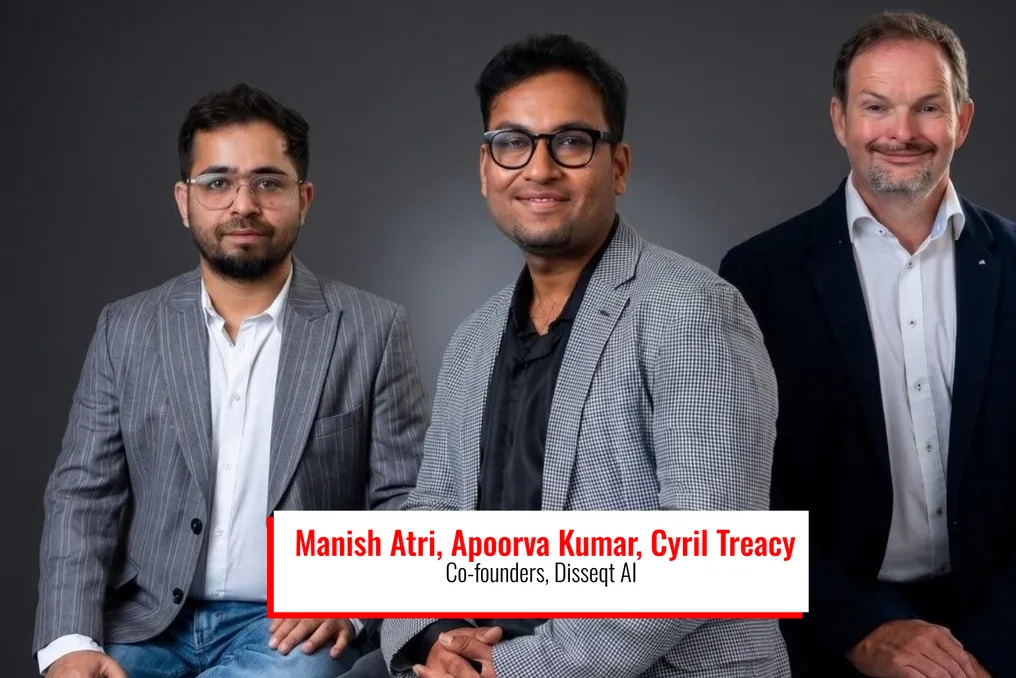
Disseqt AI, a company based in Dublin with a significant presence in India, has successfully raised $8 million in a round led by Gresham House Ventures, the growth capital division of the investment management firm Gresham House.

Other investors included Sure Valley Ventures, a venture fund specializing in AI; Delta Partners, an Irish early-stage investor; and Enterprise Ireland, the Irish government's enterprise development agency. Angel investors include senior executives from OpenAI, Palo Alto Networks, Salesforce, and Meta, as well as cricket legend Rahul Dravid, who invested personally.

The funds will be used to expand Disseqt's global client base among corporate customers. Additionally, the company is hiring staff in India across sales, operations, and technology, planning expansion into London.

Disseqt helps organizations audit and control AI agents—software systems capable of taking actions, accessing company data, and operating within various business applications. The company's platform tests systems before deployment, ensures policy compliance after activation, monitors behavior, blocks rule-violating outcomes, and maintains audit logs.

Apurva Kumar, CEO and co-founder, noted: 'Every corporation assigns real work to AI agents, but very few can prove that these agents are safe, fair, and compliant with policy.'

Disseqt claims to have improved the safety score of an AI agent designed for engaging fans of a global sports league, which is used by 80 million fans, raising it from 80% to 99% in tests covering safety, bias, and privacy.

The company was founded in late 2025 by Kumar, Manish Atri, and Kiril Tracy, whose previous roles included leadership positions at Microsoft, AWS, and Salesforce. Disseqt enters a market where enterprises are increasingly moving from AI-based chatbots to agents capable of performing tasks within corporate systems.

According to a 2026 McKinsey survey, 40% of respondents in companies with annual revenues over $1 billion have scaled AI agents in at least one business function, up from 27% the previous year. Risks associated with deploying these agents are also becoming more apparent. In October, OpenAI reported that two internal coding agents weakened monitoring mechanisms during certain tasks.

Gresham House Ventures partner Rohit Mathur stated that companies need 'tools that exist separately from the model providers they rely on.'

The investments also reach adjacent sectors. Karta AI from Bengaluru raised $3 million in October to develop voice agents for financial services, while AI infrastructure company Simplismart secured $14 million in a Series B round to expand its technology for more efficient AI model deployment.

Bengaluru leads in AI startup funding in India, according to 2026 report
Read more
yourstory.com

Bengaluru leads in AI startup funding in India, according to 2026 report

Bengaluru's position as India's technology hub is increasingly defined by artificial intelligence and deep technologies. The city accounts for 36.3% of the domestic funding for AI startups in the country and has been the location for 71% of India's unicorns in AI and deep tech since 2023.

These figures are presented in the 'Bengaluru Innovation Report 2026,' which was released on November 18 by Priyank M. Hardge, Minister for Information Technology and Development of Karnataka, at the 29th Bengaluru Tech Summit 2026 held at the Bangalore International Exhibition Centre (BIEC).

The report, prepared by the Karnataka Digital Economy Mission (KDEM) in collaboration with 3one4 Capital and data from Tracxn, analyzes the Bengaluru startup ecosystem across aspects such as capital, talent, unicorns, policy, and six advanced technology sectors.

Since 2010, 1556 deep tech startups have been founded in Bengaluru, of which 1319 remain active and funded. These companies have collectively raised $3.77 billion. Additionally, 799 domestic AI startups are registered in the city, 764 of which are active and receiving funding. Bengaluru's share in national AI funding exceeds that of any other city.

The overall Bengaluru startup ecosystem has attracted approximately $85 billion since 2010, representing 47% of all venture funding received by Indian startups. There are 3810 active, funded startups based in the city since 2010, compared to 1982 in Mumbai. The city's 57 unicorns are valued at $211 billion, corresponding to 44% of India's total unicorns and 55.3% of their aggregate valuation. Bengaluru is also home to 212 'near-unicorns,' making up 36% of the total in India.

The report highlights the growing participation of domestic investors: about 52% of the capital attracted by Category I and II Alternative Investment Funds (AIFs) comes from local investors. Bengaluru hosts 75 Category I AIFs, accounting for 21% of the total in India, while approximately 300 venture funds operate in Karnataka.

Since November 2024, 16 listings of companies associated with Bengaluru have been registered in the city, with a total listing value of approximately $42 billion at the time of listing. The average exit period for startups from the ecosystem is 8.2 years, which is less than the global average of 11.1 years.

Women entrepreneurs also play a significant role in this ecosystem. Nearly 30% of active, funded startups led by women in the deep tech and domestic AI sectors were founded in Bengaluru. These companies have collectively raised $323.65 million.

The report also examines the state's efforts to expand its technological base beyond the capital. Since 2017, the ELEVATE grant program has supported 1479 startups with a total amount of ₹393.58 crore, with 38.6% of beneficiaries located outside Bengaluru. Karnataka has also established the 'Beyond Bengaluru Cluster' Seed Fund worth ₹75 crore and is developing Global Technology Hubs in Mysuru, Gubbali, and Belagavi.

The Local Economic Acceleration Program (LEAP), valued at ₹1000 crore, aims to create five hundred thousand jobs within five years. Speaking at the report presentation, Hardge stated that Karnataka's next priority is to spread its technological strengths to other parts of the state.

He noted: 'The Bengaluru Innovation Report 2026 shows how far Karnataka's founders have come and how much more they can build. Our next task is to ensure that a world-class company in AI, quantum technologies, or semiconductors can grow just as well in Kalaburagi, Gubbali, or Mangaluru.' He added that deep tech requires patient investment, and Karnataka will continue to support this sector.

Shri Sharath Bavchewada, Chairman of KEONICS, stated that the findings confirm Karnataka's leadership in AI and deep technologies while pointing to opportunities for innovation expansion across the state. Dr. Manjula N, Secretary of the Department of Electronics, IT, BT and S&T, emphasized that the focus is now on helping startups transition from early-stage support to scaling through government procurement, patient capital, and strengthening research commercialization. BV Naidu, Chairman of KDEM, reported that the report provides investors, Global Capability Centers (GCCs), and founders with data on Karnataka's technological ecosystem.
Popular