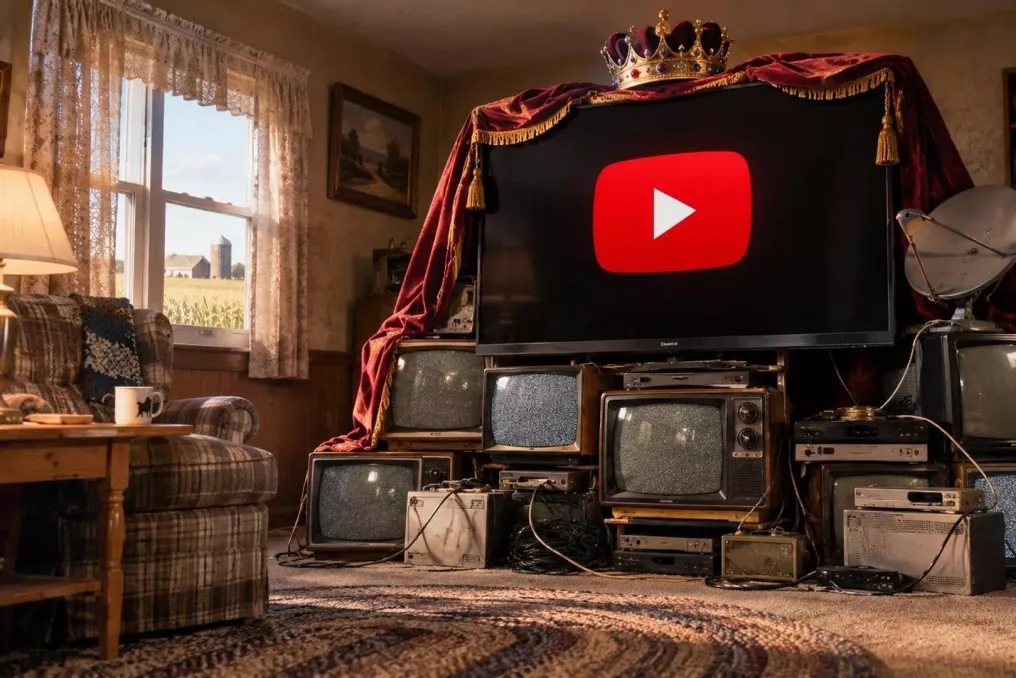
The latest statistics from the US, China, and Russia indicate that people are moving away from following television program schedules. In a film released in the USSR in 1979 during a period of high interest in television, the main character said: 'Nothing will change: there will be no cinema, no theater, no books, no newspapers—only television.'
Since then, the pace of life has changed significantly. Countless times it has been declared that television would end, but it has transformed, passing through VCRs, the internet, and online cinemas. When the UN declared November 21st World Television Day in 1996, broadcasters seemed almost unchanged: programs started at set times, families gathered in front of the TV, and advertisements interrupted the most exciting moments of films. Today, viewers choose both the story and the convenient time themselves, although most still spend their evenings in front of a large screen.
America: YouTube Has Taken Over the Living Room
In May 2025, a turning point occurred in the US: for the first time, online streaming surpassed television and cable viewing time, reaching 44.2% compared to 44.8%. Nielsen specifically noted this event in its monthly report. By August 2026, the share of internet platforms grew to 49.6%: traditional broadcasting accounted for 17.5%, and cable television for 18.9%. YouTube reached a record 15.8%, while Netflix was 7.7%. The service, which initially became a website for amateur videos, has turned into the biggest 'button' in the American living room.
Last summer's FIFA World Cup temporarily increased interest in live broadcasts. However, after the tournament ended, the use of TV screens decreased. Thus, major sporting events retain the ability to bring people together. The situation with news is more complex. According to a Pew Research Center survey, 63% of older Americans learn about events through television, but only 28% prefer this method of receiving information, which is lower than 34% the previous year. This indicates a gradual decline in the role of the primary source, despite the audience remaining large.
Box office revenues are also changing. Among Americans aged 18–49, streaming services account for 66.7% of time spent watching commercially supported television programs. Subscribers are available alongside free apps, attracting user attention. A unique historical cycle is emerging: commercial advertising is once again paying for entertainment, but now it can be tracked much more accurately.
China: Billion Users and Short-Form Series
It is too early to speak of the 'death of television' in China. An industry report published in November stated that the country has over a billion television viewers, and the number of internet video consumers reached 1.099 billion. Overlapping groups are also discussed: one person may simultaneously use cable, IPTV, and individual applications. By the end of 2025, there were about 207 million cable subscribers in China, over 400 million IPTV connections, and the average monthly active OTT audience was 285 million. By September 2026, the number of cable subscribers is expected to reach 204 million. Summing these figures is incorrect because the studies measure different types of connections, not unique users.
Chinese officials are also focused on a simple issue: usability. For several years, they have struggled with multi-level menus and complicated payment walls. It seems even high-tech industries sometimes need to solve the problem of a single button. The most interesting changes are happening in content. China has become a giant platform for mini-dramas: one episode lasts a few minutes, ends with a cliffhanger, and immediately moves to the next. Continuous storytelling thrives on smartphones, where every finger competes for attention.
According to Beijing Radio and Television data, the annual market for such projects in China will reach 100 billion yuan by 2025. Short stories have become so popular that they have even moved to a dedicated satellite channel. The national regulator notes the rapid expansion of its audience on large screens.
Russia: Habits Remain, Time Decreases
According to Mediascope, between September 2025 and August 2026, 97% of Russians aged four and older watched television at least once a month, 87% weekly, and 61% daily. Given this reach, speaking of an audience decline would be a serious exaggeration. However, people are spending less time in front of the TV. On average, this is three hours and 11 minutes, whereas in 2022, this figure was 37 minutes longer. This is a noticeable change, considering it applies to the entire population, including those who didn't watch anything on a given day.
Generational differences are even more apparent. Teenagers aged 12–17 watch regular channels for about one hour, young adults aged 18–24 watch slightly more, and the 25–34 age group spends about an hour and a half. After age 55, these figures rise sharply: for the 55–64 age group, it is nearly five hours, and for those over 65, six hours and forty minutes. For some, it is a daily ritual; for others, it is a way to pass time as needed.
Interestingly, the general opinion that viewing is determined by politics is refuted. Series account for 29%, comedy programs for 19%, news for 13%, films for 12%, and socio-political genres for 10%. Nevertheless, another market is growing. In the third quarter of this year, 53% of the urban population aged 16–55 used subscriptions to online cinemas, including free and trial options, according to the Institute of Cinematography (ISMR). 43% of them had paid access. The study covered 7,200 people; the results cannot be definitively generalized to all Russians. According to Telecom Daily, revenue from video services in the first half of the year reached 99.5 billion rubles, which is 31% more than in the same period in 2025. Traditional television broadcasters are also expanding into applications, placing their projects on digital platforms. The name of a channel no longer guarantees viewing from a normal distance.
Next comes advertising. ASAR Russia estimates the digital television market in 2025 at 8.9 billion rubles and forecasts $13.3 billion for 2026. These figures point to targeted advertising in the digital environment. The business model tracks the viewer's path: brands monitor who is in front of the screen and what content they consume.
_