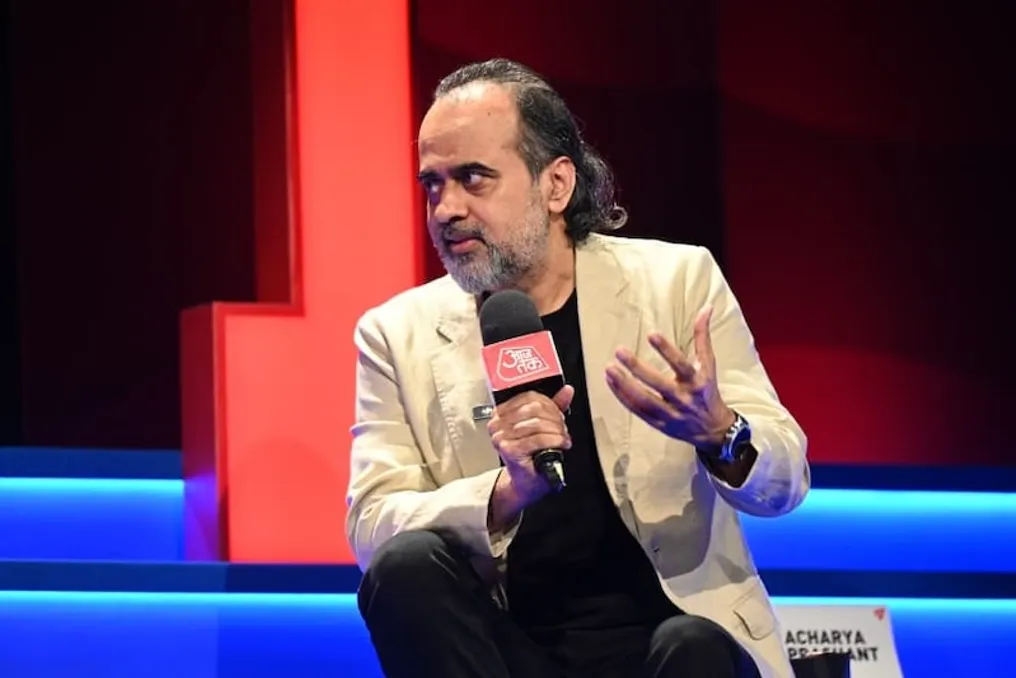
During a masterclass on Aajtak, philosopher and author Acharya Prashant posed a sharp question to the audience: 'There are 24 hours in a day; if you subtract eight to nine hours of sleep and hygiene procedures, 15 to 16 hours remain. If you spent only six of these hours on studying and extracurricular activities, where did the remaining nine hours go?' This question caused silence and deep reflection throughout the hall.
In answering the youth's questions about priorities, time management, preparation for state exams, and life decisions, Acharya Prashant noted that the problem is not a lack of time, but rather 'dark moments' when people waste time, forgetting themselves.
Regarding the dilemma of students who cannot find a balance between studying, hobbies, and other matters, Acharya Prashant pointed out that young people often imagine that they dedicate their entire day only to studying, the gym, or academic tasks, whereas reality is different.
He emphasized that there is a 'third activity that we secretly engage in and waste hours on: meaningless conversations, gossip, endless scrolling through news feeds (doom scrolling), long hours on Instagram at night.' According to him, there is something inside a person that feeds on these dark moments. If these moments are illuminated, one can discover that one day equals four days.
When asked about which path to choose after many years of unsuccessful attempts to pass state exams, Acharya Prashant advised not to ask what to do at the end, but to ask why this cycle started in the first place. He explained that a person does not stop if there is a justified internal reason behind the action. However, if youth are spent for the sake of the crowd, pressure, prestige, convenience, or false expectations, the result is disappointment.
In his opinion, one should avoid repeating the previous cycle that ended in failure. Instead, one must ask oneself: 'Do I know why I am doing what I am doing?'
Addressing the youth's concerns about developing diabetes at a young age, Acharya Prashant stated that the disease belongs to the body, but suffering is exacerbated when a person begins to identify themselves as a 'diabetic.' He reminded them that the body is a tool given by nature, and proper care for it is necessary, but equating the state of the body with one's entire being is a mistake.
To conclude the session, he drew attention to the main difficulty of the modern generation: the problem is not in acquiring, but in the ability to 'let go.' He said: 'Your main problem is that you are not ready to let go. Conduct an audit of what has accumulated inside, and continue to reject what seems useless. This is the meaning of youth.'