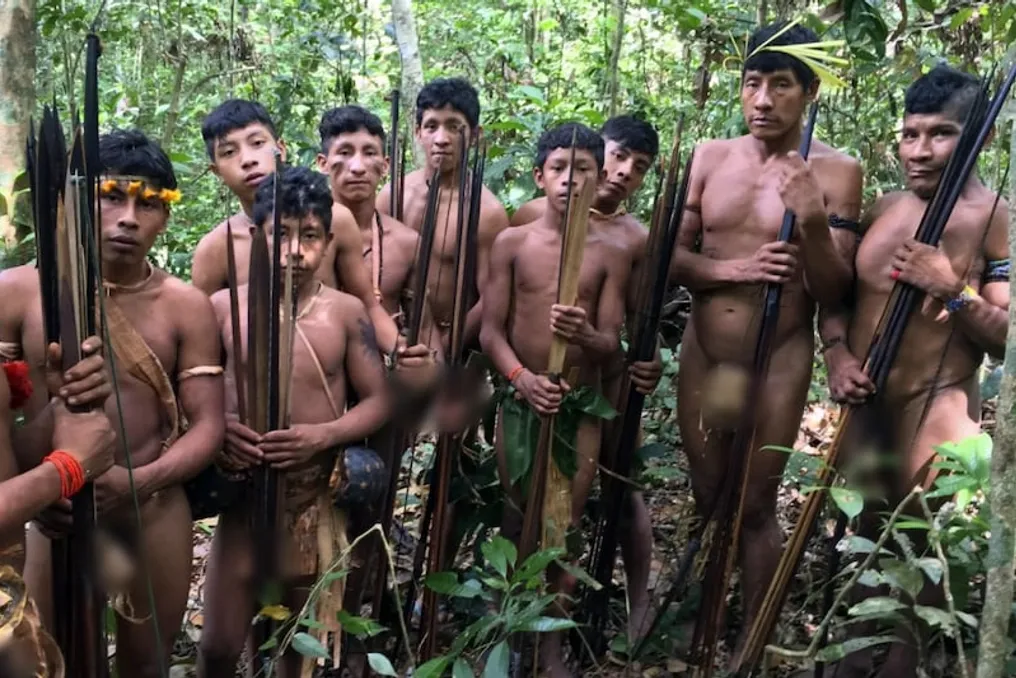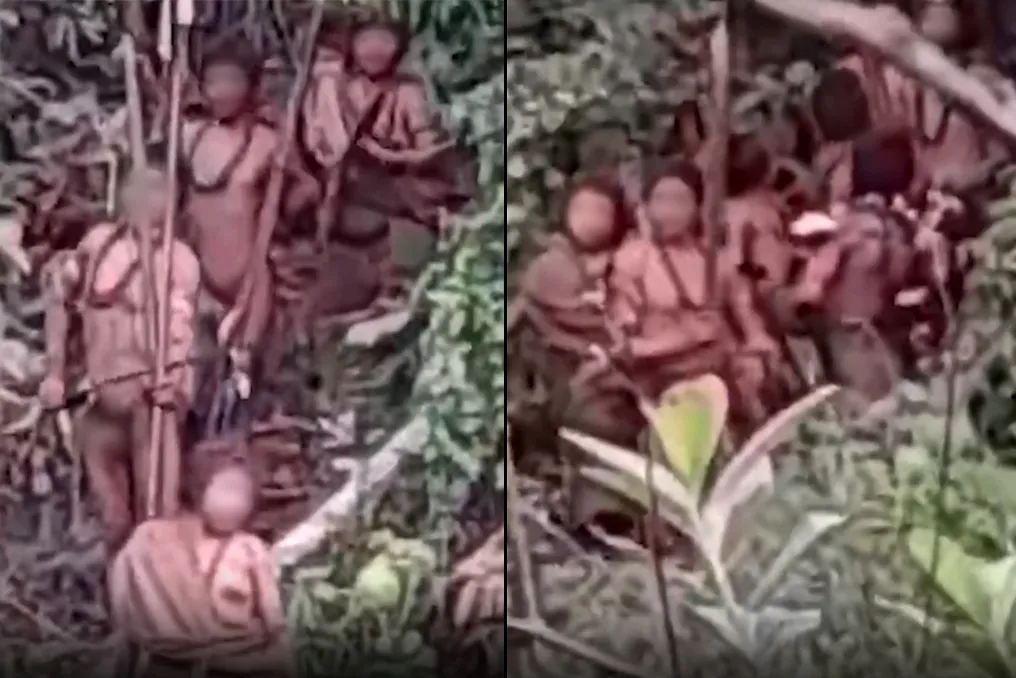
A group of approximately 15 isolated Awá-Guajá indigenous people living in the Amazon established contact with the neighboring Guajajara community in the Arariboia Indigenous Land, located in Maranhão, this Monday, the 16th. This encounter was captured on video, and there is no official confirmation yet regarding the exact reason for this approach.
The international organization Survival International released the footage and reported that, in addition to the contact with the Guajajara, the Awá-Guajá group was also seen near a post of the National Foundation of Indigenous Peoples (Funai) in the region, an event considered unprecedented recently.
Images recorded by residents of the Tawari village show Awá-Guajá adults and children standing still, while a member of the Guajajara community offered yams, and the group members approached to receive the food. The videos also show that some of the indigenous people were carrying bows and arrows and using ornaments made of feathers and necklaces.
Olímpio Santos Guajajara, president of the Association of Guardians of the Arariboia Land, informed that the indigenous people tried to communicate, but linguistic barriers between the two peoples prevented any understanding. After this first contact, the Awá-Guajá returned to the forest. However, on Tuesday morning, the 17th, they were sighted again in the vicinity of other indigenous communities. The Coordination of Organizations and Articulations of Indigenous Peoples of Maranhão (Coapima) added that the group had already been observed in the area on Sunday, the 15th.
Indigenous leaders express the belief that the progression of invaders in the forest, notably loggers and illegal hunters, may be impacting the areas used by the Awá-Guajá to obtain sustenance. According to Coapima, members of the Guajajara community reported that children and the elderly showed visible signs of severe thinness. Despite this, there is no confirmation of a malnutrition diagnosis or that the lack of natural resources was the direct cause of the search for food; these hypotheses require investigation by specialized teams, respecting the autonomy of the group.
Hunting plays a fundamental role in the structure of Awá-Guajá life. Due to their dependence on animal availability, they do not stay in one place, moving through the forest in search of resources and food. Funai defines as 'isolated' those indigenous groups that do not maintain constant contact with the national population. In Brazil, there are 114 records of isolated peoples, all located in the Amazon. Many of these peoples have knowledge of ways of life outside the forest but choose isolation due to the inherent risks of contact with other people.
The Awá are listed in the official registry of isolated indigenous peoples of Funai and are continuously monitored by the Awá Ethnoenvironmental Protection Front. The presence of these indigenous people is documented in several indigenous lands in Maranhão, including Arariboia, Caru, Awá, and Alto Turiaçu. Currently, Brazilian policy for the protection of isolated peoples is guided by the principle of non-contact, whose purpose is not to foster relationships, but rather to ensure the conditions for them to remain isolated, if that is their choice, without external interference and with full territorial protection.
It is crucial to note that the approach does not necessarily imply that the Awá have decided to abandon their state of isolation. The federal government has communicated that it is implementing protective measures for the Awá-Guajá, with indigenous health professionals already present in the region. Authorities have also activated a Situation Room to coordinate actions and assess potential contact and health risks for the indigenous people, as reported by the government in a note.
Health authorities express particular concern because, being isolated, the Awá likely have little or no immunity against common viruses and bacteria outside the forest, such as flu or Covid-19, which could trigger serious and even fatal outbreaks. For this reason, the current priority is to ensure the protection, health, and autonomy of the isolated Awá. The Commission of Chiefs and Leaders of the Arariboia Indigenous Land also expressed apprehension about the presence of a large number of police officers and members of protection teams in the reserve, warning that the movement of external people could frighten the isolated indigenous people and harm the communities.