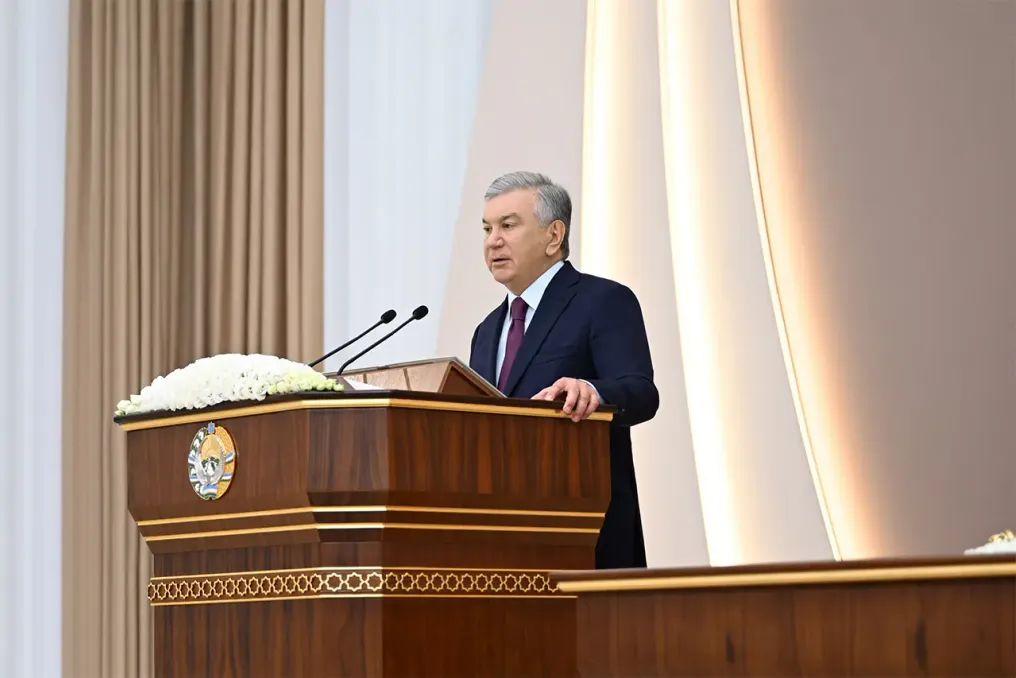
President Shavkat Mirziyoyev set ambitious tasks for the construction industry and the tourism sector of Uzbekistan during a meeting with entrepreneurs and investors in the Parkent district. The main focus was on increasing exports, attracting investments, and improving the quality of services provided.
During the meeting, the president reminded that a year ago, officials were tasked with creating a large tourist complex in Kumyshkan capable of competing with resorts in Bostanlyk and Zaamin. The principle of prioritizing local enterprises allowed local designers and builders to erect the 'Oltin Bel' complex on a 47-hectare site.
This complex includes four hotels, two restaurants, 51 chalets, an aqua park, an amphitheater, and other entertainment facilities designed to accommodate up to 6,000 people simultaneously and create 600 jobs. The International Tourism Academy conducted training courses for 300 specialists at this site. The use of local materials for 95% of the construction and equipment reduced the project cost by 20%. Based on this experience, proposals were put forward to create similar tourist complexes in Nanae, Khanabad, Chinonsoy, Muzbulak, Urgut, Ellikkale, and other districts.
The president emphasized that construction and tourism must develop as complementary sectors, creating new opportunities for each other.
Construction Industry and Export of Building Materials
Mirziyoyev also analyzed the state of the construction industry and its export potential. Over the last ten years, $12 billion USD has been invested in the sector, and over 5,000 modern enterprises have been ordered. By the end of the current year, production volume is expected to reach 65 trillion soms, compared to 7 trillion soms in 2016. Export growth is projected from $75 million USD to $1.5 billion USD.
Annual inflows of investment into Uzbekistan amounting to $50–55 billion USD form significant domestic demand for building materials. Furthermore, it is estimated that annual demand in neighboring countries and regions is about $50 billion USD. Officials believe that by increasing the production of high value-added goods, involving local builders in foreign tenders, and creating accessible logistics chains, exports could reach $5 billion USD in the coming years.
Nevertheless, Mirziyoyev noted the need to meet with entrepreneurs not once a year, but monthly if necessary, given the rapidly changing market. The president instructed ministers, industry leaders, and regional governors to fulfill specific tasks. One of the main priorities for building material producers is improving product quality, as well as its design and competitiveness.
Uzbekistan possesses sufficient production capacity to meet the domestic demand for 161 types of products, including ceramic tiles, basalt cladding materials, construction glass, and aerogel blocks. However, imports amount to $780 million USD annually due to deficiencies in product quality and brand development. For example, domestic ceramic tile production capacity is three times greater than domestic demand, yet the country spends $25 million USD per year on importing large-format tiles.
Imports of eight types of finished products, including paints and coatings, wallpaper, and energy-efficient glass, reached $280 million USD annually. Construction has begun in the Zangiata district on a paint and coating production plant worth $30 million USD in cooperation with the Turkish company Betek. The president ordered regional governors to carefully study consumer demand and international brand opportunities, and to propose initiatives for new projects.
Industrial Projects and Local Production
New goals were set to ensure the use of locally produced building materials in major strategic projects. The construction of the NPP in the Jizzakh region is expected to require $2.2 billion USD in construction materials. In this regard, a special industrial zone covering 200 hectares will be created in the Egizbelok mahalla area with special tax and customs conditions. This zone should produce 70 new types of products required for the power plant construction.
Officials were also instructed to assess the demand for substitute products and materials used in large projects and approve an industry schedule for projects totaling $20 billion USD. Starting next year, $200 million USD in financing will be allocated to projects producing new high value-added goods at an annual interest rate of 6% with a two-year grace period. A compensation mechanism will also be introduced for enterprises for 10% of the costs of energy-efficient equipment, up to a maximum of 1 billion soms.
Waste Reduction in Stone Industry
Special attention was paid to the integrated use of raw materials and waste recycling in the decorative stone industry. 155 enterprises in the country mine 1 million tons of raw materials annually, but 35–40% of this volume remains as industrial waste. Large accumulations of granite and marble sludge have formed near deposits in Nurabad, Gazgan, and Koshrabad. Mirziyoyev called for the widespread implementation of the zero-waste principle, drawing on the experience of developed countries. This waste can be used to produce composite flooring, artificial stone slabs, and marble powder.
Officials were instructed to attract entrepreneurs within a month and start projects worth at least $100 million USD near decorative stone deposits. In the future, new decorative stone deposits will be put up for auction provided that operators adhere to the zero-waste principle.
Construction Costs and Public Procurement
The meeting also discussed ways to reduce construction costs and use budgetary funds more effectively. Analysis showed that the cost of constructing one square meter of housing in the Jizzakh, Navoi, and Khorezm regions is less than 3.5 million soms. However, in Bukhara and Syrdarya regions, this cost exceeds 5 million soms. The cost of building administrative buildings also varies by 1.5–2 times between different regions. Officials attribute these differences to an excessive number of intermediaries and frequent changes in projects and estimates during construction.
Starting next year, construction projects funded by the state budget will be obliged to prioritize the use of domestic products. A separate trading platform for local building material producers will be created on the public procurement portal. This is expected to provide access to a market worth 15–20 trillion soms annually. This requirement will also apply to strategic enterprises and projects implemented under state guarantees. Strict control will be exercised over construction costs, the share of local products, and energy efficiency.
Support for New Tashkent and Product Testing
Additional measures were announced to support construction in New Tashkent and increase the competitiveness of domestic products. Within 10 days, a preferential credit line of $200 million USD will be opened to provide working capital to developers carrying out large-scale construction in New Tashkent. These funds can be used exclusively for purchasing local building materials.
The president noted that local producers are forced to compete with cheap imported products whose quality does not meet testing requirements. Furthermore, Uzbekistan lacks a sufficient number of laboratories to conduct the necessary tests. Therefore, three modern laboratories will be established in Tashkent, Fergana, and Samarkand to protect consumers from low-quality products that may pose a health threat. Officials were instructed to determine the locations for these laboratories within a month and ensure their operation begins next year.
Mirziyoyev also discussed the introduction of new building materials and innovative technologies. An exhibition held before the meeting demonstrated innovative products from local producers. One example was a waterproofing material known as 'concrete carpet,' which allows channels to be built twice as fast and 30% cheaper than traditional concreting methods. Mirziyoyev stated that 'our 31 design institutes need to change their mindset and adapt to modern requirements.' The president announced his readiness to consider proposals from investors present at the meeting if they are interested in managing these institutes and implementing modern technologies and advanced solutions.
Tourism Growth and Investment Targets
The meeting also reviewed tourism development and ways to improve service quality. Since the beginning of the current year, 11.6 million foreign tourists have visited Uzbekistan, and this figure is expected to exceed 15 million by the end of the year. Over the past two years, the average length of stay for visitors from outside the region has increased from 6.5 to eight days. The share of tourists with high purchasing power has grown from 14% to 21%, and the average spending of each such tourist has also increased by 21%.
Mirziyoyev emphasized that the tourism sector must now focus not only on attracting a larger number of visitors but also on improving service quality and extending the duration of tourists' stays in the country. He recalled the wide range of incentives introduced to encourage private investment in tourism. Hotel construction financing is available in national currency at an annual rate of 16%. Land and property tax benefits are extended until 2030, and subsidies for star-rated hotels are extended for another two years. Tour operators serving foreign tourists are exempt from VAT. Customs benefits for importing tourist transport are extended for one year, and the recycling fee has been abolished.
A tourism development strategy is expected to be adopted soon. Its goals include increasing the number of foreign tourists to 20 million, raising the share of tourism in the economy from the current 3.5% to 7%, and increasing the export of tourism services to $10 billion USD.
Land and Infrastructure for Tourism Projects
Tasks were set during the meeting to prepare land plots and develop infrastructure for new tourism projects. Previously, 1,200 hectares were reserved in the most favorable and scenic locations across all regions. Now, regional governors are tasked with preparing an additional 5,000 hectares for tourism projects. Two trillion soms have been allocated this year for the development of tourism infrastructure. The president stressed the need to turn these opportunities into new investment projects and jobs.
The first international tourism forum will take place in Tashkent from November 25 to 27. More than 100 major investors from over 25 countries are expected to participate. Regional leaders were instructed to thoroughly prepare for the forum and present the tourism potential of their cities and districts. Specific investment attraction targets have been set for each regional leader. They were also instructed to begin practical implementation within a month of tourism projects totaling $11 billion USD, developed in various regions. It is expected that more than 10 foreign investors and more than 100 local entrepreneurs attending the meeting will present proposals for large new projects.
The president emphasized that the main task is to transform the natural, historical, and economic potential of each city and district into tangible results, including increased investment, service development, and job creation.
Year-Round Tourism and International Events
Mirziyoyev called for expanding the range of services and entertainment options that would allow tourist destinations to operate throughout the year. The arrival of more than 5
3.5m