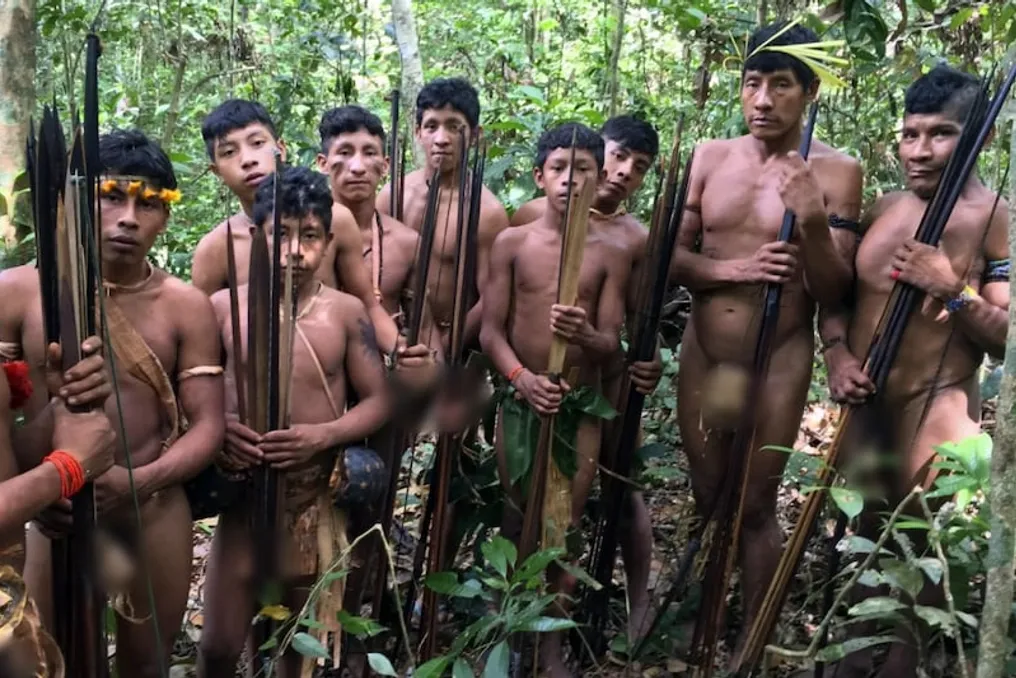
Approximately 20 members of the Ava community, which lives almost isolated from the outside world in the tropical forests of Brazil, suddenly emerged from the jungle on November 16. They headed to a government post and requested food. Photographs and videos of this Ava group, appearing after decades, caused a wide resonance.
These shots, taken in the Amazonian forests of Brazil, attracted worldwide attention. The photographs and videos show men, women, and children from the Ava community who have come out of the forest. Some men were seen with bows and long arrows. It is reported that the group of about 20 people reached the observation post and the village of Tavari within the Arariboia indigenous territory in the state of Maranhão, Brazil.
Some groups of the Ava community, who have appeared in public for the first time after decades, remain cut off from external society, meaning they have no regular contact with the outside world. They sustain their lives through hunting, fishing, and products gathered in the forest.
According to Survival International, this time the Ava group approached the government team and requested food. After receiving food, they returned to the forest. The organization called this contact an extremely rare event for the Ava people in recent decades.
One of the most interesting social features of Ava society is their marriage system. According to anthropological records, men and women in Ava/Guaja society can marry more than once in their lives. There is no mandatory or preferred system where one marriage must last a lifetime.
Furthermore, some anthropological studies have recorded cases where one woman had multiple husbands. This is called polyandry. This system does not apply to every member of the Ava community or every family. This is why the marriage customs of the Ava are considered very different and curious compared to other societies.
Another unique cultural belief documented regarding Ava society is related to the concept of multiple male contribution to child development. According to some studies, their traditional beliefs include the idea of multiple fatherhood. It is important to note that this does not mean the child has multiple biological fathers scientifically, but rather reflects their traditional cultural perception and social structure.
The Ava community also demonstrates an unusual connection with the forest animals. If a female monkey dies during a hunt, and her infant survives, the Ava family sometimes takes this infant in. Such a monkey infant is raised as a family member. Anthropological descriptions mention that Ava women care for monkey infants and even feed them breast milk. Thus, an orphaned animal infant found in the forest can become part of the family.
Ava people are also skilled at navigating the forest environment and recognizing animals by sound. Their traditional knowledge of hunting includes imitating animal calls. Hunters use various sounds to determine which animals are nearby. This knowledge is passed down from generation to generation. For them, the forest is not just a habitat; it is their food, path, home, and culture.
The main question of this situation is why they left the forest. Usually, the Ava avoid contact with outsiders. However, in recent years, there has been growing concern about the invasion of illegal loggers, hunters, and cattle ranchers into their forests. Human rights organizations believe that external pressure has affected their traditional territory, and perhaps this is why this group was forced to come out in search of food.
Nevertheless, authorities currently lack sufficient information to definitively establish the true reason for their departure. Some local residents have also expressed concern about the health condition of children and the elderly in the group.
Contact with the outside world is dangerous for isolated communities like the Ava. The risk of disease is very serious. The population of such communities previously had low contact with common infectious diseases from the outside world, so infection could lead to severe consequences.