Study indicates that exoplanet TOI-2535 b did not disappear, but had its orbit altered by gravitational interaction
Read more
Olhar Digital
olhardigital.com.br

Study indicates that exoplanet TOI-2535 b did not disappear, but had its orbit altered by gravitational interaction

An exoplanet monitored by astronomers over seven years appeared to have disappeared, but a new study published earlier this month in The Astrophysical Journal Letters offers a different explanation.

Researchers from UCLA (University of California, Los Angeles) discovered that the supposed 'disappearance' of TOI-2535 b likely occurred due to the gravitational influence of another planet in the system.

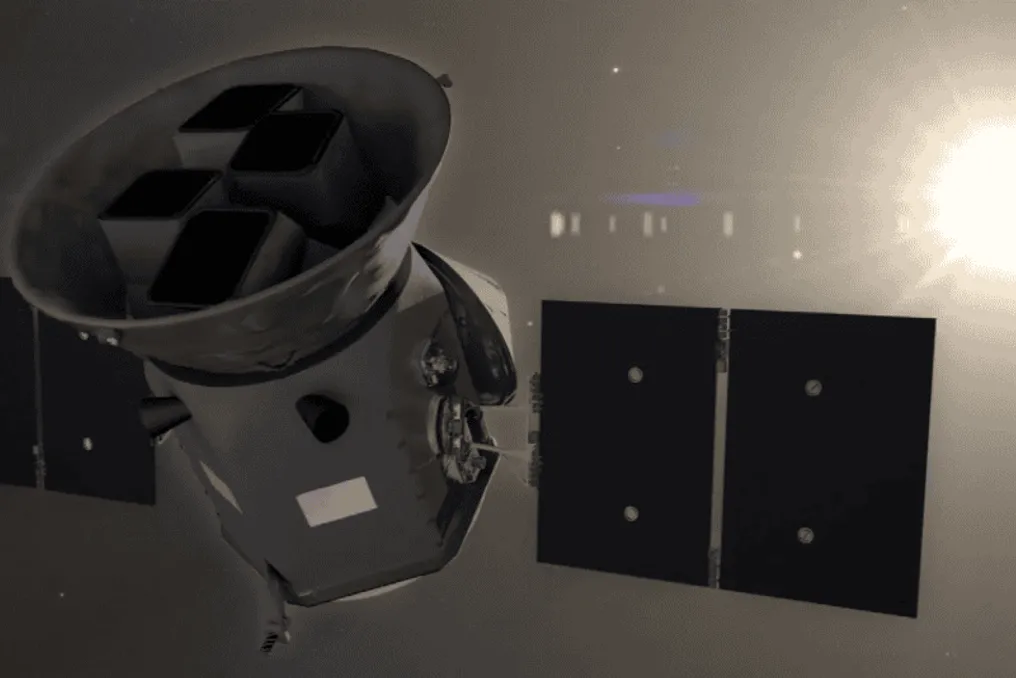
This gravitational force from another celestial body would have tilted the trajectory of TOI-2535 b, causing it to stop transiting in front of its star when viewed from Earth. Thus, the planet continues to orbit its host star but has moved out of the field of view of the NASA-operated TESS space telescope.

TOI-2535 b was detected in April 2019 through image sequences collected by TESS. This gas giant is classified as a 'hot Jupiter' because it orbits very close to its star. Its orbit is remarkably fast; while Mercury takes 88 days to orbit the Sun, TOI-2535 b completes its orbit in only eight days, ten times faster than the 'Fast Planet.'

Located approximately 1,000 light-years from Earth, the exoplanet is difficult to observe. The TESS satellite identifies planets by measuring tiny variations in stellar brightness caused by partial light blockage when a planet passes in front of the star. Although this technique allows for the discovery of distant planets, it is extremely sensitive to any alteration, which explains the apparent 'disappearance.'

The explanation lies in the gravitational interaction between TOI-2535 b and its neighbor. Astronomers inferred that this planetary companion is inclined relative to the orbit of TOI-2535 b and exerts a force on it. This interaction causes a slow oscillation in the orbit of TOI-2535 b, comparable to the movement of a top. Over time, its trajectory became progressively more inclined relative to our line of sight, preventing it from passing exactly between the star and Earth.

Consequently, TESS stopped registering the exoplanet after about seven years. Before completely losing the signal, researchers noticed signs of this change: the signals emitted by the exoplanet began or ended earlier or later than expected, in addition to becoming progressively shorter and less intense.

Therefore, TOI-2535 b never disappeared; only its orbital position relative to Earth was modified. The research suggests that already cataloged planets can fall out of observational range depending on how they move in their respective systems. Samuel Yee, one of the research leaders, commented: 'We think of the universe as something similar to a clockwork mechanism, where everything is regular, but that is not true. If there are multiple planets in a system, they can affect each other's orbits.'
Similar stories

NASA's Voyager 1 probe will reach the unprecedented one-light-day distance from Earth
Read more
super.abril.com.br

NASA's Voyager 1 probe will reach the unprecedented one-light-day distance from Earth

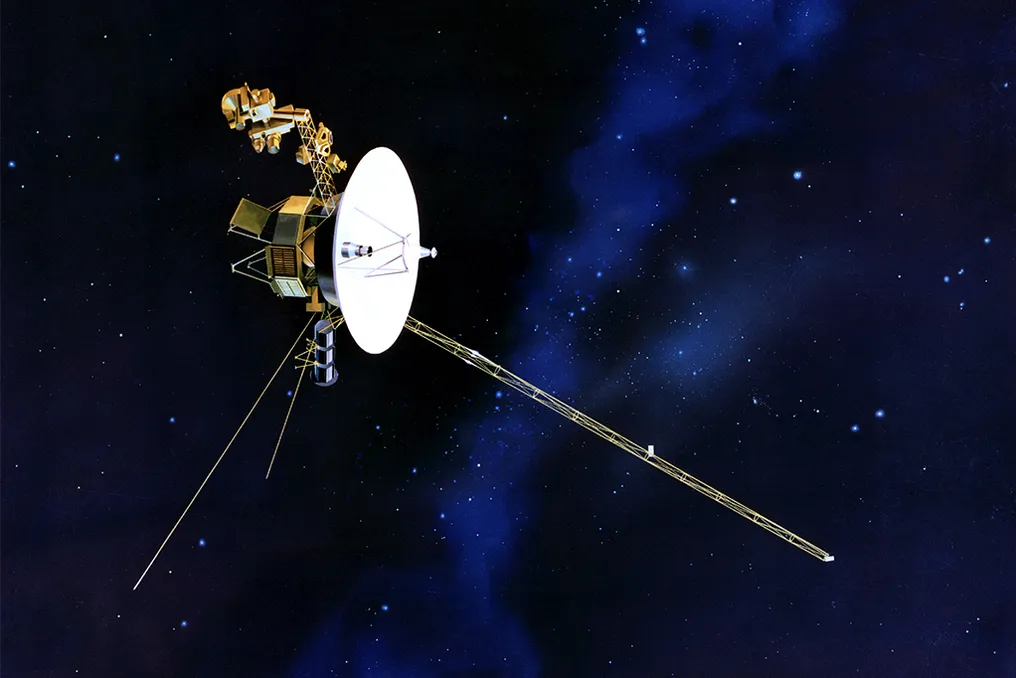
The Voyager 1 probe, launched by NASA on September 5, 1977, has the mission of exploring the most distant planets and moons of the Solar System. Although it is remarkably fast, its speed of 61 thousand km/h is insignificant when compared to the speed of light, which reaches almost 300 thousand kilometers per second.

Initially, the probe reached Jupiter, where it identified two unknown moons at the time. Later, in the 1980s, it began investigating Saturn, discovering five moons and transmitting countless information back to Earth.

Due to the success of the mission, NASA opted to expand it, directing Voyager 1 into interstellar space, the area situated between the stellar systems of the galaxy. In 2012, the probe crossed the heliopause, marking the first human-made object to enter this space.

Nearly fifty years after its launch, the spacecraft will continue its journey and achieve a new scientific feat: becoming the farthest object from Earth. Specifically, on November 18th at 7:16 AM (Brasília time), Voyager 1 will reach the unprecedented distance of one light-day, corresponding to approximately 26 billion kilometers, the distance light travels in one day.

After reaching such a distance, communication between NASA and the probe will face new challenges. Signals sent from Earth will take 24 hours to reach the destination, given that transmission occurs at the speed of light, and the probe's response will require another 24 hours, not counting the time needed for information processing.

Despite these logistical difficulties, the spacecraft's operation will not change, and it will continue collecting data, exploring, and maintaining contact with Earth. To celebrate this milestone, NASA will organize an activity on November 17th, allowing people to use their mobile devices to emit the sequence of letters VGR in Morse code, pointing their phones to the sky to create a symbolic wave of golden light around the planet.

Voyager 1 is on a collision course with the star AC +79 3888, also known as Gliese 445, which is more than 17 light-years away from Earth, and is expected to reach it in about 40 thousand years.

Additionally, NASA launched Voyager 2 shortly after the first probe. This reached interstellar space in 2018 and is scheduled to reach the one-light-day mark in 2035, while Voyager 1 headed into interstellar space, Voyager 2 continued investigating Uranus and Neptune.

Both probes contain a gold-plated copper disk, measuring 35 centimeters in diameter. This disk carries messages intended for potential extraterrestrial beings, including inscriptions about Earth's location, greetings in 55 languages, music (from Mozart to Chuck Berry), and recordings of sounds from terrestrial life, such as whale songs and laughter.

NASA's Voyager 1 probe approaches one light-day distance from Earth this week
Read more
olhardigital.com.br

NASA's Voyager 1 probe approaches one light-day distance from Earth this week

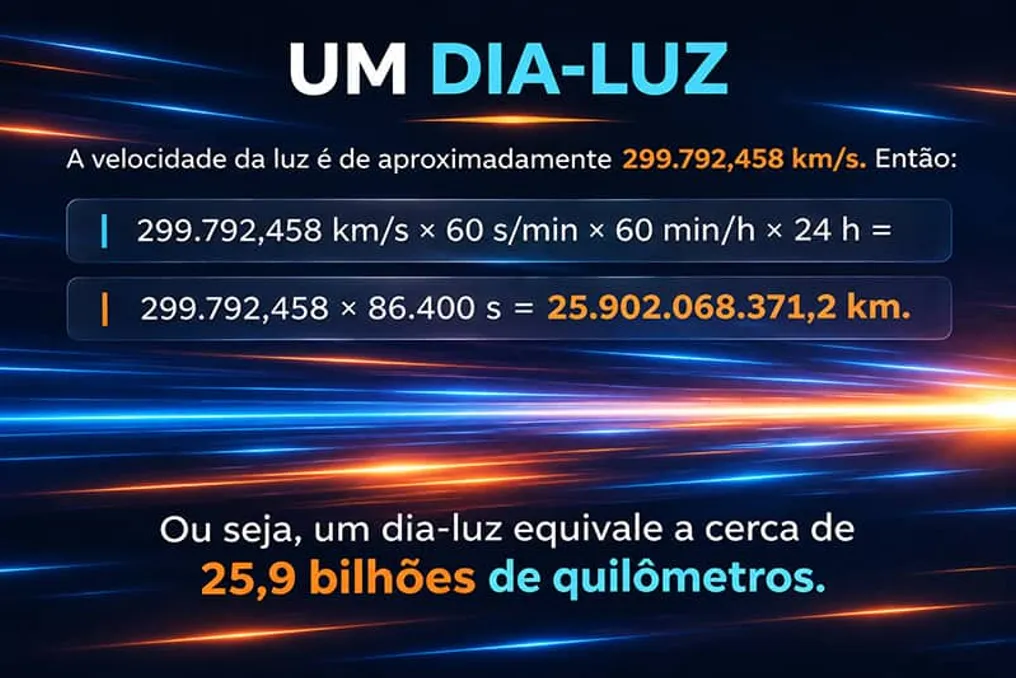
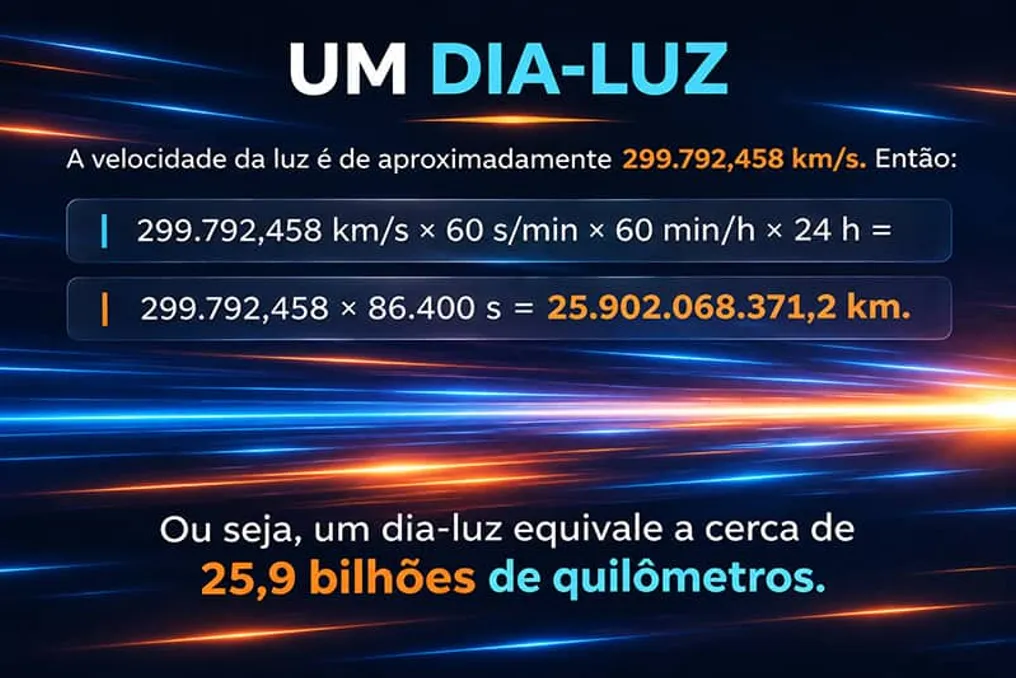
The Voyager 1 probe, launched by NASA in 1977, is about to reach an unprecedented milestone in space exploration: for the first time, a human-made artifact will be one light-day away from Earth, which is equivalent to approximately 25.9 billion kilometers. This event is expected to occur this week.

One light-day represents the distance light travels in a 24-hour period in a vacuum. This concept follows the same logic as the light-year, a well-established unit in astronomy that measures the path of light over the course of a year. Considering that light travels at about 300 thousand kilometers per second, one light-day corresponds to approximately 25.9 billion kilometers.

Since its launch, Voyager 1 has continuously explored the cosmos. In 2012, the probe achieved a historic feat by crossing the heliopause, which constitutes the boundary of the solar wind-dominated heliosphere, thus becoming the first human spacecraft to officially enter interstellar space.

Currently, the probe is located about 173 astronomical units (AU) from Earth. Since one astronomical unit corresponds to the average distance between our planet and the Sun, fixed at just over 149 million kilometers, the current location of the spacecraft exceeds 25.8 billion kilometers from here.

Even though it is billions of kilometers from Earth, Voyager 1 continues to transmit data to NASA. To do this, it uses a high-gain antenna that directs radio signals to the planet. Although these electromagnetic waves travel at the speed of light, they require almost 24 hours to cover the distance between the probe and Earth.

This implies that any instruction sent from Earth takes about a day to reach the probe, and a subsequent response requires a similar interval. Consequently, a complete round-trip communication can take almost 48 hours.

The reception of this data depends on large antennas installed on Earth, designed to receive extremely weak signals. The responsible equipment processes these transmissions to recover the scientific information sent by the spacecraft. The transit time of the signals also allows for the calculation of Voyager 1's distance, as NASA uses the transmission interval, knowing the speed of light, to determine the probe's position.

In 2012, upon crossing the heliopause, the boundary of the heliosphere formed by the influence of the solar wind, Voyager 1 became the first spacecraft to enter interstellar space. However, crossing this barrier does not necessarily mean abandoning the Solar System, as there is no single definition for the limit of the latter. One interpretation suggests that this limit extends to where the gravitational attraction of the Sun still exerts an effect on bodies.

From this perspective, the boundary is beyond the Oort Cloud, a distant region that houses frozen bodies. According to NASA, the Voyager probes will still take approximately 40 thousand years to reach this limit, covering a distance equivalent to about two light-years.

Voyager 1 probe will soon approach one light-day distance from Earth
Read more
olhardigital.com.br

Voyager 1 probe will soon approach one light-day distance from Earth

For the first time in history, a human-made artifact will reach a distance of one light-day from Earth. This pioneering feat will be accomplished by the Voyager 1 probe, which was launched almost fifty years ago and continues its advance through interstellar space.

To provide context, a light-day refers to the distance light travels in a 24-hour period, unlike light-years, which measure the distance light travels in a full year.

The Voyager 1 probe was dispatched by NASA on September 5, 1977, and has been navigating space since then. Currently, it is located at approximately 173 astronomical units (AU) from Earth, making it the first spacecraft to pass the heliosphere, cross the heliopause, and enter interstellar space.

One astronomical unit corresponds to the average distance between the Earth and the Sun, which is 149,597,870.7 km. Thus, at the moment, the probe is located 25,882,237,241 km away from us.

At its current position, the time required for terrestrial signals to reach the probe is 23 hours, 58 minutes, and 54 seconds. With its current speed of about 61,155 km/h, it is estimated that about seven days remain until the spacecraft increases this distance to the equivalent of 24 hours of light travel.

According to NASA projections, Voyager 1 will reach one light-day from Earth next Wednesday (the 18th). The same distance from the Sun will only be reached by the probe at the end of January 2027. Subsequently, it will continue its trajectory under the agency's supervision until its energy runs out, which is likely to occur in the early 2030s.

This milestone helps quantify the mission's reach, although the distance is difficult to conceive even when presented in numerical values. During the Space View program, held on July 17, astronomer and columnist for Olhar Digital, Marcelo Zurita, spoke with amateur astronomer and science communicator Alexsandro Mota about the significance of this achievement and the challenges inherent in monitoring such a distant spacecraft.

Mota emphasized that the distance of Voyager 1 from Earth is so vast that the numbers alone do not facilitate understanding its magnitude. He commented that we are accustomed to measuring distances in kilometers, tens, or hundreds, but measuring billions of kilometers is something complex to imagine.

To make this distance more tangible, Zurita used an analogy during the program. He greeted Mota and explained the time it would take to exchange messages with the spacecraft. According to him, a simple 'hello' sent from Earth to the probe would take almost 24 hours, and the reply 'Hi, Zurita' would come from Voyager after approximately 48 hours.

Communication with the spacecraft remains viable thanks to the use of a high-gain antenna, which transmits radio signals toward Earth. These electromagnetic waves travel at the speed of light but must cover a distance of nearly 26 billion kilometers to reach the receivers.

Mota clarified that the time the signal takes to complete this journey allows for the calculation of the separation between the spacecraft and the planet. Since the speed of light is known, it is enough to measure the interval between sending and receiving to determine the distance traveled by the signal.

He detailed: 'The main way you know how far away it is is the antenna's response time to the radio telescopes on Earth. Based on this time and the speed of light, we discover the exact distance it is at.'

Even being billions of kilometers away, Voyager 1 can still transmit data to Earth. The radio signal arrives extremely weakened; however, the radio telescopes are capable of capturing and amplifying it to recover the information sent by the probe. Mota added: 'This incredibly weak signal reaches us, and we manage to receive it, amplifying it in various ways to bring back the useful data the probe is sending.'

There are several theories about where the Solar System actually ends. While some argue that the limit is marked by the end of the planets, others point out that the final boundary extends beyond the Oort Cloud, which represents the limit of solar gravitational attraction, where bodies can still be influenced by it.

Although Voyager 1 has left the heliosphere, many experts question whether it has actually left the Solar System. NASA explains that 'over the ages, astronomers have debated without reaching an agreement on where the Solar System ends. One opinion is that the boundary is where the Sun's gravity no longer dominates—a point beyond the planets and beyond the Oort Cloud.'

This boundary is located approximately halfway to the nearest star, Proxima Centauri. The Voyager probes, traveling at speeds exceeding 56,000 km/h, will take almost 40,000 years to reach this undefined boundary, covering an estimated distance of about two light-years.

Popular