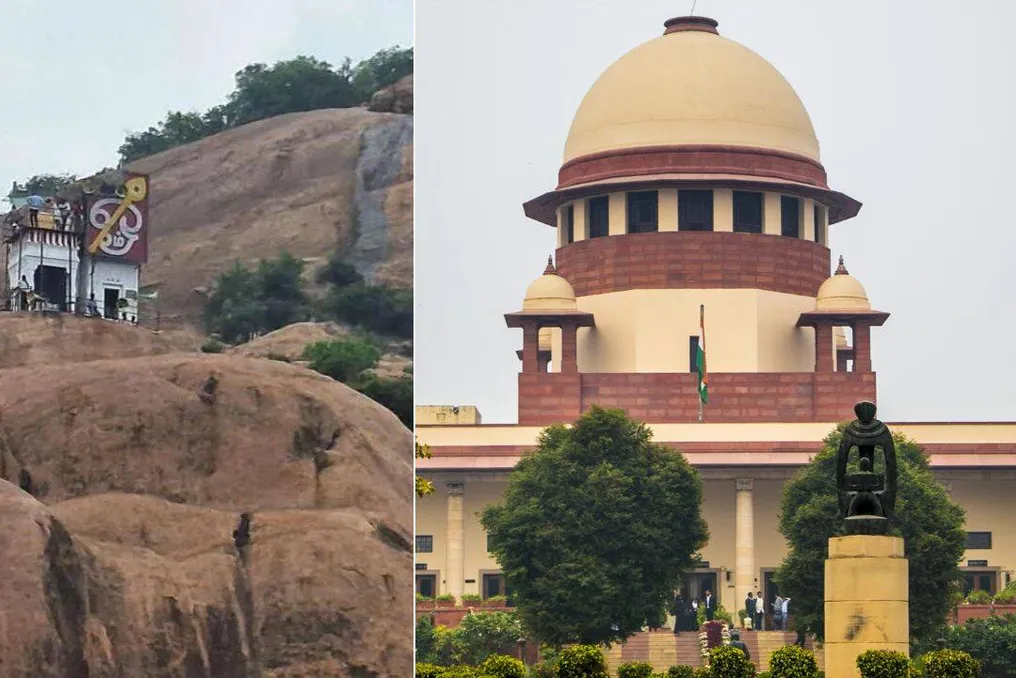
The Supreme Court granted temporary permission to conduct the traditional Karthikai Deepam ritual by lighting a lamp on the Depatun, a stone pillar located on the Tiruparanakundram hill in Madurai, Tamil Nadu, on November 24, 2026.
However, the bench comprising Justices Aravind Kumar and Vipul M Pancholi stayed part of the Madras High Court's decision, which had previously supported the demand to restore the practice of lighting the lamp on the Depatun. This temporary permission emerged amid a dispute between Hindu devotees and the dargah of Hazrat Sultan Sikandar Badush Aulia regarding ownership of the hilltop and the location of the ritual.
This development followed the dargah's arguments before the Supreme Court on Thursday. The dargah claimed ownership of the entire hill and opposed the demand to light the lamp near the stone pillar. The hearing on this matter remained incomplete, and the court scheduled the continuation of the proceedings for Friday.
Senior Advocate Amit Anand Tiwari, representing the dargah, cited a 1920 civil suit judgment establishing facts about the ownership of the staircase from Nellitope to the shrine hill. Tiwari stated: 'The entire top of the hill belongs to the dargah. There is no question of lighting Deepam at the top of the hill where the stone pillar is, regardless of the distance between the dargah and the stone pillar.'
He also presented the argument that the entire upper part of the hill, where the mosque, flagpole, and stone pillar are located, is the property of the dargah.
The essence of the Karthikai Deepam dispute
The conflict centers around the location for the traditional Karthikai Deepam ceremony at the Arulmigu Subramaniaswamy Temple in Tiruparanakundram. For decades, the festival lamp was lit in the Depa Mandapam, located near the Uchipillaiyar temple on the lower slopes of the hill.
Hindu groups sought permission to light the lamp on the Depatun—an ancient stone pillar situated higher up on the hill, approximately 50 meters from the dargah. This dispute led to legal proceedings concerning the location of the rite and land ownership rights over the hill.
The Tamil Nadu government objected to this demand, arguing that granting permission to light lamps near the dargah could cause broader legal and administrative complications. On Wednesday, it informed the Supreme Court that allowing this practice might lead to thousands of support pillars across the country acquiring religious status.
The dargah committee also challenged the procedure used by the Madras High Court. Senior Advocate Huzefa Ahmadi, speaking for the committee, argued that the single bench issued its decision without giving the dargah sufficient time to respond according to high court rules. He also stated that the judge visited the site without notifying the dargah before the ruling.
Tamil Nadu government opposes ASI takeover
The Tamil Nadu Hindu Religious and Charitable Endowments Department (HR&CE) opposed the petition seeking to transfer the temple and the entire Tiruparanakundram hill to the Archaeological Survey of India (ASI).
In an affidavit before the Supreme Court, HR&CE Commissioner T G Vinay stated that the ownership of the temple and existing religious practices were settled through years of litigation. He insisted that the hill belongs to the Arulmigu Subramaniaswamy Temple to the extent recognized by the 1923 civil court decree, which was subsequently upheld by the Private Council in 1931.
The affidavit contested three demands made by the petitioner from the Hindu Dharma Parishad: transferring the entire temple and hill to the ASI, maintaining the round-the-clock burning of the lamp near the stone pillar known as Depatun, and illuminating the entire hill with lamps during Karthikai Deepam.
The affidavit noted: 'Such an established title cannot be violated, and the management of the religious fund entrusted to HR&CE by law cannot be taken away and transferred to ASI based on a petition that lacks legal basis and requires satisfaction in violation of completed civil title proceedings.'
Regarding the lighting ceremony, the HR&CE Commissioner emphasized that the festival lamp was traditionally lit in the Depa Mandapam near the Uchipillaiyar temple, not on the hilltop or near the stone pillar.
The department also referenced historical records of attempts to light lamps near the hilltop where the dargah is located in 1862 and 1912. It asserted that the archaeological protection of Tiruparanakundram covered certain elements, including the rock cave and inscriptions, but did not extend to the entire hill or the functioning temple.
The department warned that permitting the lighting of lamps in multiple locations, especially near the dargah, could violate existing agreements and create issues with law and order at the site with a history of communal tensions.