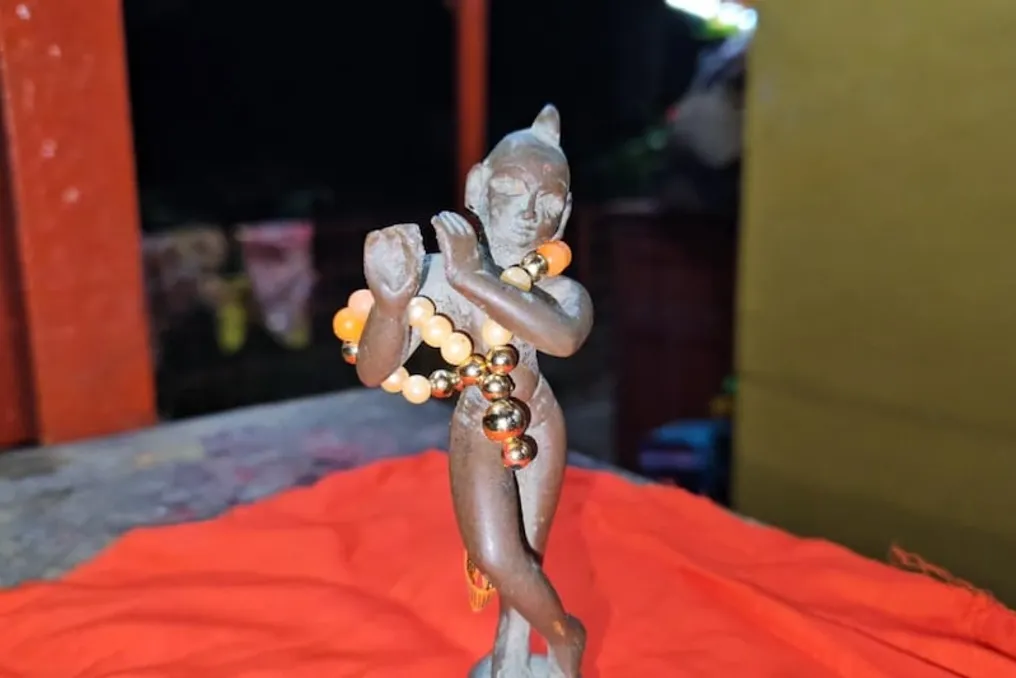
In Katihar city, Bihar state, an incident occurred while preparations were underway for the Chhath festival, causing significant interest and religious excitement among local residents. Workers engaged in earthworks to expand and build the bank for the Chhath ceremony discovered a metal statue of Lord Krishna. The statue depicts Krishna holding a flute and wearing a crown.
This finding quickly spread throughout the surrounding areas, and a large number of pilgrims headed out to worship. The event took place in the Jault Ram Chowk area, within the Katihar police station jurisdiction, near Jeke Gola. Construction and expansion of the bank were being carried out there for offering Arghya to Lord Bhaskara during Chhath Puja.
After a worker informed local residents about the discovery and showed them the statue, the news rapidly reached people associated with Hinduism. The district police also arrived at the scene after receiving information from local residents.
The location where the Krishna statue was found is very close to the public Shiva temple, which is deeply revered by local residents. Various religious events related to Hinduism are regularly held here. Consequently, the discovery of the Krishna statue during the Chhath Mahaparva works is viewed by people as a special coincidence.
Local residents unanimously decided that the statue should first be examined by the Archaeology Department. This will allow for determining the artifact's age and whether it holds any historical or archaeological significance. Discussions regarding the possible placement of the statue in a proper location after the completion of Chhath Puja will take place later.
Currently, the statue of Lord Krishna is safely kept in the public Shiva temple. A large number of female pilgrims visit the temple to see the statue, many of whom consider this event a direct manifestation of God. They note that the image with a flute and a crown perfectly matches the form of Lord Krishna. For them, such a find during Chhath Puja is a blessing.
Local women show great enthusiasm about the discovery. They believe that the appearance of Lord Krishna in this manner during Chhath Mahaparva is a matter of their faith and good fortune. Pilgrims assert that the statue has a flute in its hands and a crown on its head, and upon seeing this appearance, they worship it as the statue of Lord Krishna.
A local social figure and former district commissioner, Lallan Sultania, also confirmed the fact of the statue's discovery during the earthworks. He stated that during the bank expansion, workers extracted the statue of Lord Krishna from the ground and saw it themselves. According to Lallan Sultania, major religious events were previously held at this spot, so people believe a divine manifestation occurred here. However, information regarding the statue's age and antiquity will only become known after verification.
He demanded an inspection by the Archaeology Department so that people could receive accurate information about the statue's history and significance. The former commissioner also appealed to the administration to assist in this matter. He emphasized that if the inspection proves the statue's antiquity, it must be accorded due respect. Currently, the statue is in the public Shiva temple, and further decisions will be made after consultation with local acharyas.
Local resident Rakesh also reported the discovery of the Krishna statue during construction work on the Chhath bank. He added that the worker who extracted the statue has video footage of the event. Rakesh noted that the administration requested the completion of preparations for Chhath Puja, and until then, the statue must remain in the Shiva temple for rituals.
Currently, local residents are demanding that the administration help facilitate the examination of the statue by the Archaeology Department. This event, which occurred in the middle of Chhath Mahaparva, has caused widespread resonance in the region, and all attention is focused on what information will be obtained from the verification regarding the statue's age and historical significance.