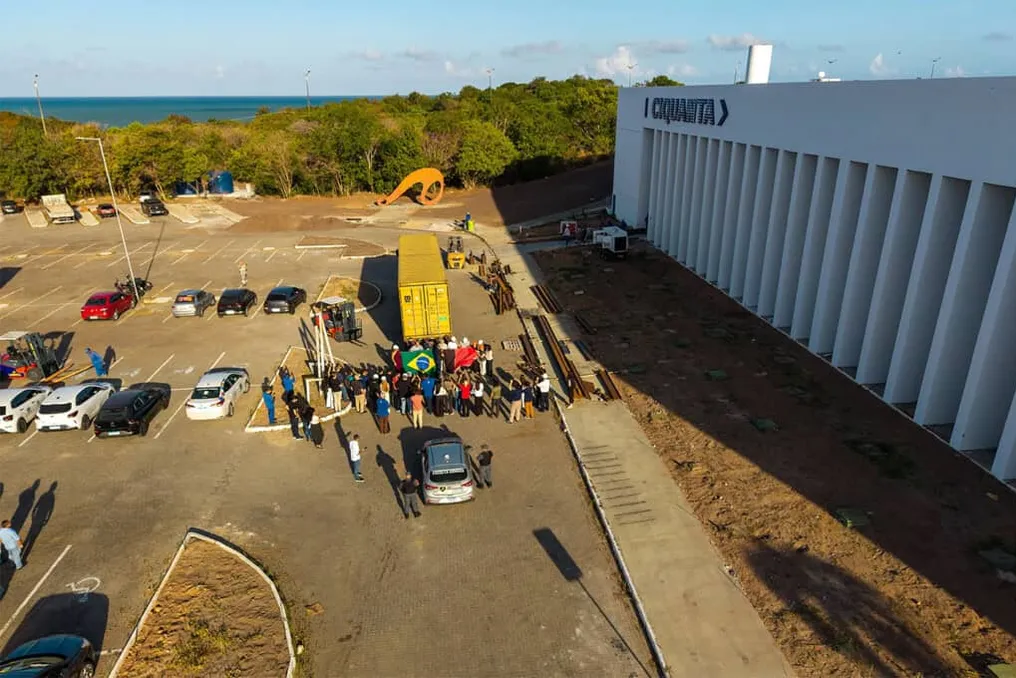
The first quantum computers from Latin America were introduced in Brazil on Monday, the 16th, representing a significant progress for local scientific investigation. These equipment, manufactured in China, will be installed in João Pessoa, Paraíba, giving access to this technology to Brazilian researchers, something previously limited to a few nations.
This initiative covers more than just operating the machines; it includes technology transfer and professional training, aiming to enable Brazil to develop its own quantum computers.
The machines will be housed at the International Center for Computing and Quantum Technologies of Paraíba (Ciquanta), located in the building of the former Arts Station. With an estimated state contribution of around R$150 million, the project aims to connect universities, companies, and research centers to an area with potential to generate innovations in medicine, industry, energy, and digital security.
The fundamental distinction lies in the data processing unit. While traditional computers operate with bits, which represent only zero or one, quantum computers use qubits. Qubits have the ability to manifest a combination of these states, a characteristic called quantum superposition.
Another crucial concept is entanglement, which creates correlations between qubits. Such properties enable the development of calculation methods distinct from those used by conventional machines, offering potential to solve certain categories of problems with greater efficiency.
It is important to note that a quantum computer is not inherently faster in all tasks nor does it replace current equipment. According to the State Secretariat of Science, Technology, Innovation, and Higher Education of Paraíba (Secties), its superiority lies in specific uses, especially those involving complex simulations and a vast range of possibilities.
In the medical and pharmaceutical industry, for example, the technology will assist in simulating molecular behavior and discovering new substances. In the logistics sector, it can optimize routes. Furthermore, energy, agribusiness, climate, and finance are priority sectors for Ciquanta.
Digital security represents another vital aspect. Highly advanced quantum computers can compromise certain current encryption systems. For this reason, researchers also need to focus on developing post-quantum cryptography, specifically created to shield information against such threats.
Quantum computers use processors based on superconducting circuits. For these components to function correctly, they must operate at temperatures very close to absolute zero, which corresponds to the theoretical limit of -273.15 degrees Celsius.
The chips require operation near absolute zero to maintain the properties of the superconducting materials used in the processor construction. Claudio Furtado, Secretary of State for Science, Technology, Innovation, and Higher Education of Paraíba and a Doctor of Physics, detailed the process in an interview with Olhar Digital. He explained that cooling is done by dilution, using a mixture of helium-3 and helium-4 with liquid nitrogen, reaching extremely low temperatures.
Furtado added that the chip technology is superconducting and operates around 10 millikelvin to ensure good performance. This temperature range is necessary because the chip is built with Josephson junctions made of superconductors.
He emphasized that thermal control is essential to preserve the quantum states of the processors, as heat can cause the loss of quantum coherence, harming calculations. Thus, the components remain isolated within the cooling system, even if the room's ambient temperature is maintained at approximately 21°C.
The equipment was manufactured by the China Electronic Technology Group Corporation (CETC) and traveled from the Asian country to Pernambuco, disembarking at the Port of Suape. Subsequently, they traveled by road to João Pessoa, under escort and with controlled speed to minimize vibrations during transit.
The secretary justified the choice of the former Arts Station to host the center due to the adequate infrastructure and architectural features favorable for equipment installation, such as the high ceiling, which allows for accommodating the computer niches. The building is being adapted to receive laboratories, support spaces, and researcher rooms.
However, the physical structure is only one part of the project. Collaboration with the Chinese manufacturer includes knowledge transfer on chip design and manufacturing, cryogenics, sensors, maintenance, telemetry, software, and cryptography.
Training of Brazilian professionals has already begun. An initial group participated in an online course and subsequently traveled to China for in-person training, where they are expected to collaborate on equipment assembly with the Chinese team. New groups will be continuously formed.
Furtado clarified that the agreement covers various phases of the technological chain, providing Brazilians with the necessary knowledge to understand the construction and maintenance of the devices. The expectation is that this knowledge will lead to the development of national equipment, which the secretary considers one of the greatest benefits of the initiative. He stated: 'From a technological point of view, we will first have access to and mastery of the entire chain. We are not talking about prototypes, but functional equipment and technology transfer. The next step is to develop new computers right here in Brazil, with the participation of Brazilian researchers from different centers across the country.'
Ciquanta will make the quantum computers available to universities, research institutes, companies, and government agencies. Access will occur through a cloud platform, allowing researchers from various regions of the country to use the equipment remotely, without needing to travel to João Pessoa.
Project selection will be carried out through public calls for proposals and in partnership with entities such as the Financing of Studies and Projects (Finep) and the Association for the Promotion of Brazilian Software Excellence (Softex).
The first actions supported by these institutions will focus on training and technological residency, offering capacity building from fundamentals to advanced knowledge to prepare professionals for quantum computing and technologies.
The center also aims to foster the creation of deep tech—startups that create solutions based on scientific research and complex technologies. The programming will include hackathons, courses, and events involving universities, companies, sectoral associations, and government representatives.
The plan foresees Ciquanta becoming an Autonomous Social Service (SSA) and functioning as a Scientific, Technological, and Innovation Institution (ICT). This structure will allow for expanding funding sources and accessing incentive mechanisms, such as the Bem Law and the Informatics Law.
The assembly of the computers is scheduled to begin on Tuesday, the 24th, with an expected completion by the end of December, after which the equipment will undergo testing and validation. The first research is planned to start in the first semester of 2027.
While the adaptations of Ciquanta continue, the project is already promoting activities to familiarize the public with quantum computing. A full-scale replica of the computers is on display at the Technological Park, in the Historic Center of João Pessoa, offering free guided tours led by researchers.
The arrival of these first quantum computers from Latin America in Brazil signals the opening of a new frontier for national science, integrating this technology into the country's research infrastructure and generating opportunities for Brazilian scientists to investigate complex problems and contribute to future technological transformations.