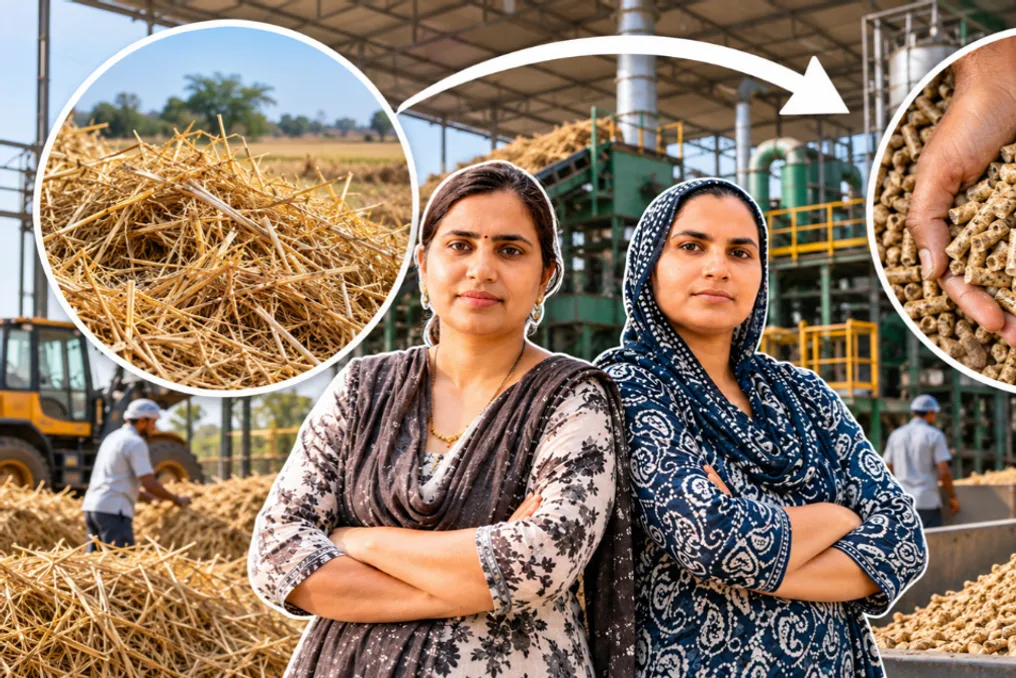
Every year after the rice harvest, farmers in Haryana face the problem of accumulated straw in the fields that needs to be cleared before planting the next crop. For many, the fastest way is to burn this stalk, but the smoke rising from these fields exacerbates the already serious air pollution in North India.
Imagine that the same straw could generate income, create jobs, and even power industrial enterprises. This is the opportunity two women from Haryana and neighboring Rajasthan saw.
Sanjana, a graduate from the village of Ghoranwali in Sirsa district of Haryana, and her friend Sonika from Bhadra in Rajasthan, discovered a commercial potential in the waste that farmers struggled with. They decided to collect leftover rice straw, known locally as 'parali', and convert it into biofuel pellets that can be used by power plants as alternative fuel.
In 2024, they founded SSAR Biomass Green Private Limited, investing about 2.5 crore rupees. Today, the enterprise shows an annual turnover of 7–8 crore rupees and employs more than 20 people.
From Pollution Problem to Business Idea
For Sonika, the idea arose after repeatedly observing the thick smoke dispersing into the sky during the rice harvest. Concerned about the environmental consequences and threats to public health, she began to think about how agricultural waste could be utilized more effectively. Instead of viewing straw burning as a problem without a simple solution, she and Sanjana started researching ways to transform this residue into a commercially valuable product.
Their concept aimed to solve two problems simultaneously: providing farmers with a productive use for their leftover harvest and creating alternative fuel for industry. Government policies and initiatives supporting straw management also contributed to shaping opportunities for this venture.
Creating a Farm Waste-Based Factory
In 2024, Sanjana and Sonika set up their production unit in Ghoranwali, investing approximately 2.5 crore rupees under the Agricultural Infrastructure Fund (AIF) scheme. The process at the factory begins directly in the fields. The women receive rice straw through baler operators in Sirsa and surrounding areas. These operators collect and press the loose residue, which facilitates its transportation and storage.
The straw is then transported to their plant, where machinery processes it into compact biofuel pellets. These pellets can be supplied to power plants as alternative fuel. The scale of operations is significant: the enterprise annually uses approximately 1 to 1.5 lakh quintals of rice straw. Since the raw material is mainly available during the harvest season, the founders must also plan for subsequent months. They collect and store post-harvest residues, ensuring that the factory has enough raw material for continuous production throughout the year. This model of seasonal supply and year-round production allows the business to operate outside the harvest period.
From Discarded Straw to a Growing Rural Enterprise
The impact of the enterprise extends beyond the pellets it produces. By creating a market for rice straw, SSAR Biomass Green Private Limited also generates business opportunities for local baler operators and other participants in the residue collection and transportation process. The factory itself provides jobs for over 20 people, bringing employment opportunities closer to the homes of villagers and their surroundings. With initial investments of about 2.5 crore rupees, Sanjana and Sonika built an enterprise with an annual turnover of 7–8 crore rupees. For the two founders, the next harvest season will bring another opportunity to collect more straw, maintain production, and expand the business. Their work has provided farmers in the region with another possible way to manage crop residues while simultaneously creating a market for material that would otherwise have little economic value. In Ghoranwali, the rice harvest no longer signifies just the end of the farming cycle; for Sanjana and Sonika, it is also the beginning of a new business season built on utilizing agricultural waste productively.