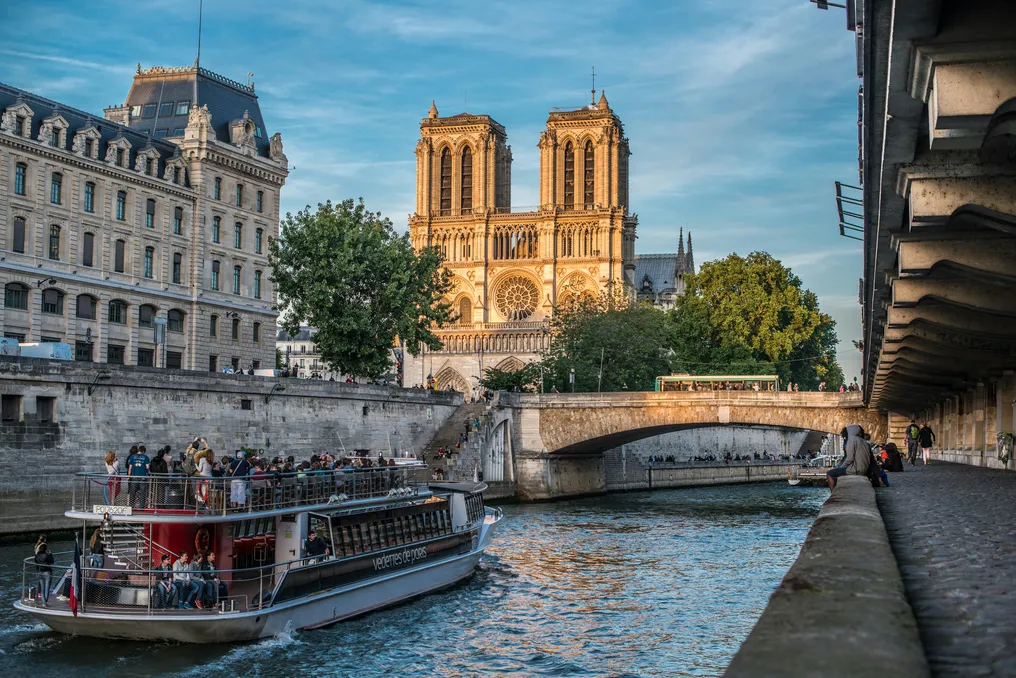
After suffering a severe fire in 2019, the Notre-Dame Cathedral in Paris is undergoing reconstruction and was reopened to the public in 2024. This year-end, the temple will receive a new collection of stained glass windows created by French artist Claire Tabouret.
This icon of the French capital has become a symbol of resilience after the catastrophe that occurred seven years prior. Before the fire, Notre-Dame was the most visited monument in the city, attracting over 12 million visitors annually, which doubled the number of visitors to the Eiffel Tower at the same time.
The construction of the cathedral, whose name literally means 'Our Lady,' began more than 860 years ago, in 1163. The initial phases of the building took almost a century, and the construction of the towers only began fifty years later.
The temple continued to receive additions and ornaments until approximately 1350. However, the French Revolution in 1789 led to the temporary removal of Church control, resulting in the removal of all valuable materials, especially metals, for practical purposes.
It was only with Napoleon, in the early 19th century, that the temple resumed its Catholic functions. In 1804, Bonaparte held a symbolic ceremony in Notre-Dame itself when he crowned himself Emperor of France. Despite this, the crisis following Napoleon's defeat in 1815 caused a sharp decline in Paris, affecting the cathedral, which was even considered for demolition due to poverty.
The history of the cathedral took a new direction with the publication, in 1831, of the book 'Notre-Dame de Paris' by Victor Hugo. Known as 'The Hunchback of Notre-Dame' in some translations, the novel, set in the late 15th century, aimed to raise awareness among the French public about the need to preserve the cathedral. This preservation was effectively initiated in the following decade, under the order of King Louis Philippe I, with works that included the addition of a taller spire and new gargoyles (decorative sculptures distinct from gargoyles).
Since then, the temple has withstood a failed attempt at arson during the Paris Commune in 1871 and armed conflicts during the liberation of Paris from Nazi forces in 1944. The most significant damage since the 19th-century renovations occurred on the afternoon of April 15, 2019, when the fire destroyed the spire and a large part of the nave's roof.
Notre-Dame remained closed for over five years for renovations, a project that cost more than 700 million euros, and was officially reopened to the public in December 2024. After a week of events celebrating the monument's return, normal operations resumed on December 16 of that year.
Although crucial parts are still recovering, another important milestone occurred in September 2025, when the towers of Notre-Dame were reopened to the public, albeit with limited access.
The next novelty will be inaugurated in December: a set of six new stained glass windows, designed by artist Claire Tabouret, illustrating biblical verses related to Pentecost, will be installed in the south aisle of the nave. This project aims to symbolize recent renewal but has generated debate, as the images being replaced were not damaged by the fire; these older stained glass windows, dating from the 19th century, will be removed and displayed in other areas of Paris and France.
Visiting the Notre-Dame Cathedral is free and does not require advance booking. However, it is possible to make a free reservation through the official website to avoid larger queues. Operating hours are: Monday to Friday, from 7:55 AM to 7:00 PM (extended until 10:00 PM on Thursdays); Saturdays, from 8:25 AM to 7:30 PM; and Sundays, from 8:15 AM to 7:30 PM. The last entry is permitted half an hour before closing.
To ascend the towers, reopened in 2025, the rules are different: while about 30,000 people pass through the cathedral daily, climbing is limited to 400,000 visitors per year, or approximately 1,100 per day. Tickets are sold separately, and there is a limit of groups of no more than 19 people, requiring advance planning and physical fitness, given that they are 69 meters high and have 424 narrow steps. The ticket costs 16 euros and can be reserved online.