A study conducted by Gorgona AI titled 'One meaning, different prices: how much does the Uzbek language cost for AI?' revealed that text in the Uzbek Latin alphabet requires 1.55–2.17 times more tokens compared to equivalent English text when using five major AI service providers, making it more expensive to process.
The researchers compared platforms such as OpenAI, Anthropic, Google, Qwen, and DeepSeek. For the analysis, 1337 parallel texts were used, representing translations of the same content, which were then passed through 15 different tokenizers. The results obtained were cross-referenced with the actual model responses.
Language models do not work directly with letters or words, but with tokens—fragments into which the text is divided by the tokenizer. The dictionaries of these tokenizers are formed based on training data, where the proportion of English language is significantly higher. Consequently, an English word often occupies one token, whereas an Uzbek word with its suffixes is typically broken down into almost three tokens on average.
Service providers charge the same fee per token regardless of the language, and the context window capacity is also measured in tokens. Since response generation occurs token by token, if the same value in Uzbek requires twice as many tokens, the bill doubles. Furthermore, the context window can accommodate half as many documents, and generating a response at the same speed will take twice as long.
Additional costs vary depending on the model and the text itself. Texts originally written in Uzbek generally fall closer to the lower end of the range, while translations from English tend to be closer to the upper end. In the FLORES dataset, which includes news articles, encyclopedic entries, and travel guides, the difference ranged from 1.78 times for OpenAI to 2.13 times for DeepSeek.
Meanwhile, Russian texts from the same dataset cost 1.35–1.60 times more than English ones. Uzbek is 1.24–1.54 times more expensive than Russian. The researchers noted that genre has a negligible impact on these ratios: the difference between genres for each model does not exceed 8%.
Morphology alone does not explain this issue. The study mentions a 2026 analysis where 30 identical sentences were tested using the GPT-4o tokenizer. The English text required 348 tokens, Russian required 551, Turkish required 609, Uzbek in Latin script required 763, and Uzbek in Cyrillic required 814.
Turkish, being another agglutinative language written in Latin script, required one-fifth fewer tokens. Turkish proved cheaper to process than Uzbek when using 13 out of 15 tokenizers. Exceptions were GigaChat 3 and NeuronAI-Uzbek.
The study's authors argue that the additional cost is determined not by the number of native speakers, but by how frequently the models encountered Uzbek text during training and what place this language holds in the tokenizer's vocabulary.
The choice of a specific model has the greatest impact on the final cost. Although Claude Opus 5.5 and GPT-5.6 Sol have the same stated price per token, processing a one-million-word English text translation in Uzbek will cost $14.78 using Claude and $8.70 using GPT, representing a difference of 1.7 times.
The Claude tokenizer uses 1.57 times more tokens than the OpenAI tokenizer for English text, and 1.70 times more for Uzbek text in Latin script. The study is based on official prices as of October 14, 2026, excluding caching. The cost of processing the same Uzbek text varies from $0.37 with Claude Haiku 5.5 to $14.78 with Claude Opus 5.5.
Thus, the authors recommend comparing models based on the cost of processing a specific text, rather than just the price per million tokens. They emphasize, however, that their findings only concern costs, as they did not measure the quality of the model responses.
Generating responses in Uzbek is also more expensive than in English. GPT-5.6 Luna and Claude Haiku 5.5 models were given 3904 prompts to summarize a paragraph and provide a detailed answer about it in four language variants. Visible Uzbek responses cost 1.7–1.8 times more than English ones, despite having almost an identical number of characters.
Claude Haiku 5.5 autonomously decided whether to perform reasoning before answering without special settings. It did this more often in Uzbek: in 28% of summaries compared to 10% in English, and in 95% of question answers compared to 63%. Although users do not see this reasoning, payment is made for it in the form of output tokens. When reasoning is included, the paid response in Uzbek costs 2.1–2.3 times more than in English. Researchers warn that this observation is based on one model and two tasks.
The difference in cost between Uzbek Cyrillic and Latin also depends on the model. Claude charges the same fee for both alphabets. Other providers find Cyrillic to be 7–23% more expensive, with the largest difference recorded for DeepSeek.
Researchers attribute this not to the structure of the Cyrillic alphabet, but to the volume of text in each alphabet that the models encountered during training. Additionally, the apostrophe used in Uzbek letters oʻ and gʻ increases the cost because it is currently typed using four different characters, which tokenizers treat as separate signs.
In the NTREX news dataset, the original spelling was 0.6% more expensive than the same text using a direct apostrophe when working with OpenAI, 1.9% with Claude, and 4.2% with Qwen. Gemini normalizes apostrophes to a single form and therefore showed no difference.
Researchers separately assessed the potential impact of the transition to a new alphabet. The law providing for this transition was signed on October 21, 2026, and will come into effect on April 22, 2027. The letters oʻ and gʻ will be replaced by ö and ğ, and sh and ch will turn into ş and ç. The combination ng will cease to be considered a separate letter.
Under the new writing system, texts will become 4% shorter in terms of character count. The number of tokens will decrease by 2–4% when using Claude, Gemini, and Qwen, while changes for OpenAI and DeepSeek will be minor. Thus, the study concludes that companies will not need to revise their AI budgets due to the change in alphabet. The authors see the main benefit in the unification of the spelling of each word, which will simplify document searching, duplicate removal, and the use of AI assistants with knowledge bases.
Independent researcher Dusmammat Karimov reached similar conclusions regarding the alphabet. In October, he tested about 460,000 characters from the Uzbek Wikipedia and the Gazeta.uz news articles using seven tokenizers. Open models demonstrate that the additional cost is determined by the vocabulary used by the tokenizer. The same Uzbek text requires 25% fewer tokens with GigaChat 3 than with the OpenAI tokenizer. With NeuronAI-Uzbek, the difference is only 2%. YandexGPT processes Russian effectively, but Uzbek costs twice as much to process as Russian.
Over time, Uzbek is becoming cheaper slower than major languages. When OpenAI switched from the GPT-4 tokenizer to GPT-4o, the additional cost of Uzbek texts in the FLORES dataset decreased from 2.19 to 1.78, which is a reduction of approximately one-fifth. With Qwen, the transition from version three to 3.5 reduced the cost of Uzbek text in Latin script by only 6%, whereas for Russian, the reduction was 23%.
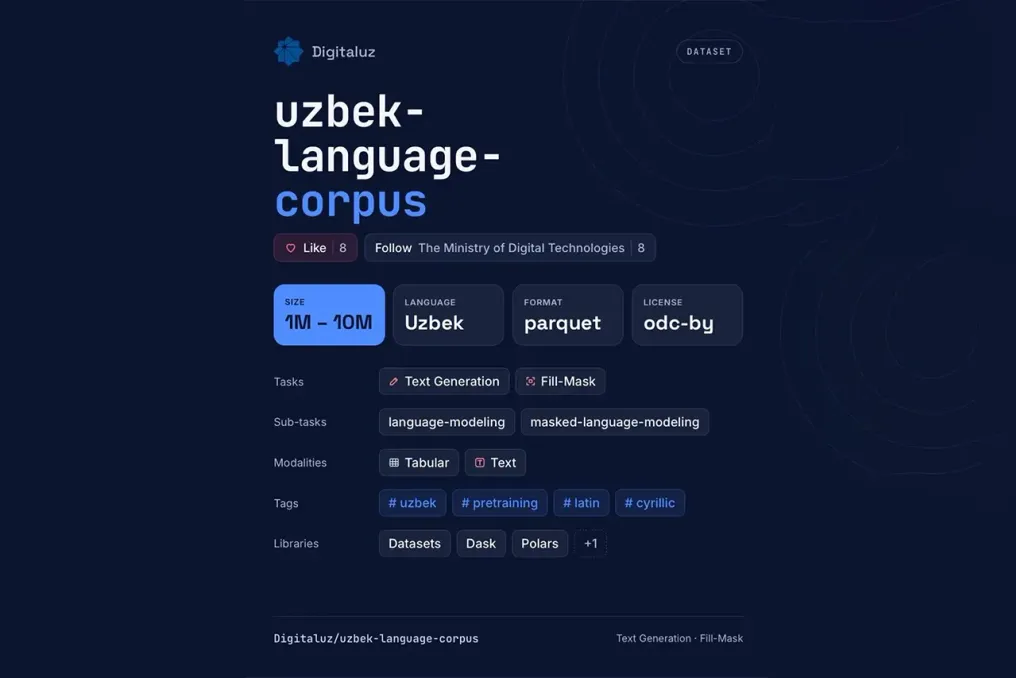
Researchers view open collections of Uzbek texts as digital infrastructure: the more data available, the cheaper AI services in Uzbek will become for everyone, from startups to government institutions. By April 2027, they propose preparing parallel text collections in both alphabets, tools for open conversion, and standardized spelling rules. According to the study, creating collections of Uzbek texts, morphological dictionaries, tokenizers, and quality tests will require cooperation between companies, universities, and the state, as well as dialogue with model developers.