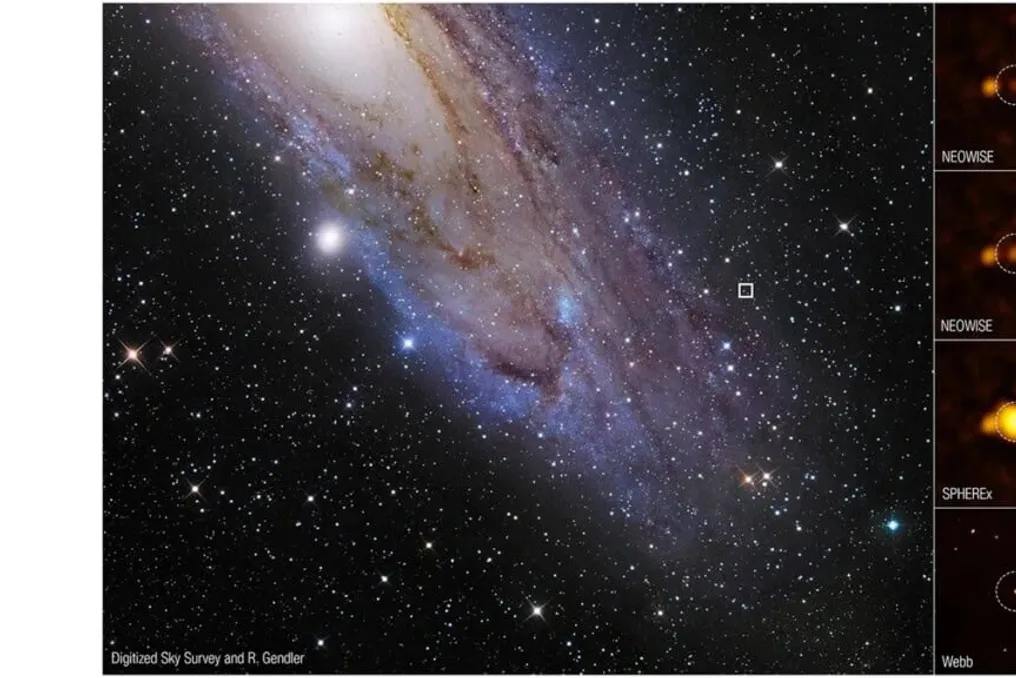
Astronomers were able to record a phenomenon predicted by science but never previously observed directly: a giant star swallowed its companion. This event occurred in the Andromeda Galaxy, located approximately 2.5 million light-years from Earth, allowing researchers to recreate various stages of stellar merger.
The system was named Bao and consisted of two stars of significantly different sizes. The larger star, called Big Bao, had a mass approximately seven times that of the Sun and a radius 350 times that of our Sun. Its companion, Little Bao, possessed about 70% of the Sun's mass.
Details of this discovery were presented in a study published in the scientific journal Nature on Thursday (the 18th). Various instruments, including NASA's James Webb Space Telescope, were used to collect data.
One of the most striking aspects of this phenomenon was the speed at which the flare developed. According to Nadia Blagorodnova, a researcher from the University of Barcelona (Spain) and co-author of the study, scientists expected that the explosion associated with such a massive star would take years to reach its peak luminosity. However, the increase in brightness happened very quickly: the event reached its peak in just one week.
Researchers calculated that the explosion ejected into space an amount of matter equivalent to approximately 10%–20% of the Sun's mass. Although observations indicate that Big Bao swallowed its companion, and that both stars might have merged into a single object, scientists have not ruled out other possibilities yet.
According to Viraj Karmabalkar, the lead author of the study, the stars could have survived this episode but begun orbiting much closer. Therefore, the team plans to continue monitoring the system after the effects of the explosion subside. New observations will help determine exactly what happened to both objects.
This discovery marks progress in understanding stellar mergers—phenomena that have been predicted for decades but have been extremely difficult to observe in real-time. Researchers also hope to find other similar cases using future observatories, such as the Nancy Grace Roman Space Telescope and the Vera C. Rubin Observatory.