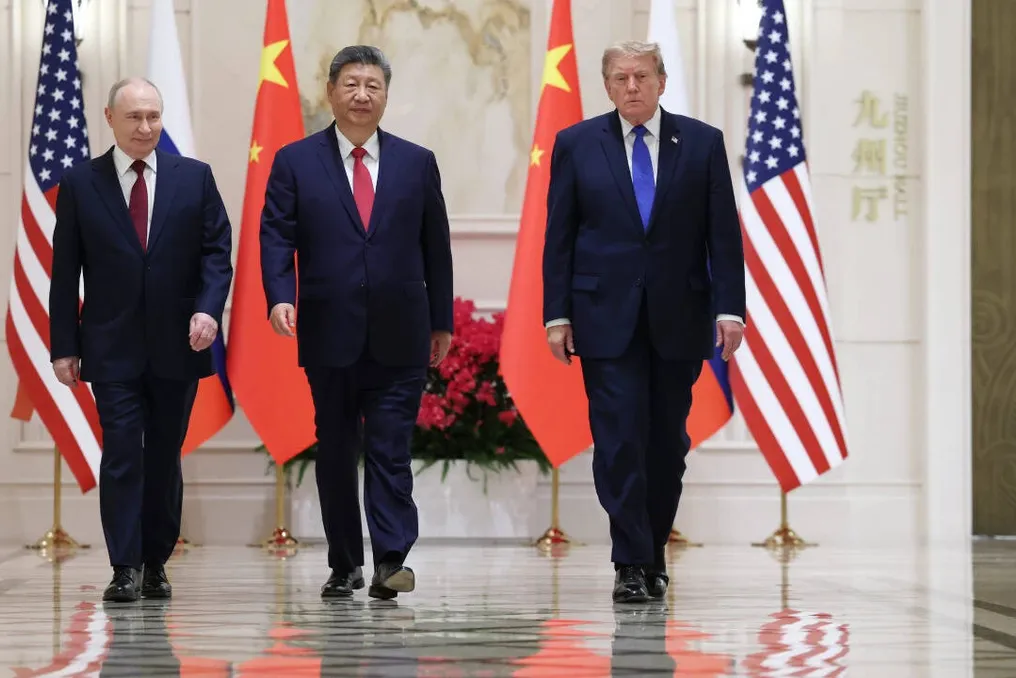
Although the Shenzhen summit may not signify a crisis for India, the government is closely tracking the likely outcomes of the meeting. India recognizes the potential of this summit to alter several dynamics that it manages daily in relations with the US, China, and Russia.
There was no official response from India regarding the 'historic' 90-minute meeting held in China's technology hub between President Donald Trump and his Chinese and Russian counterparts—Xi Jinping and Vladimir Putin. However, official sources reported that India is observing the summit and its consequences with strategic caution.
This meeting, which Chinese state media characterized as positive and highly productive, concluded with a declaration. It affirmed commitment to UN reforms, more effective global problem-solving, ensuring energy flow stability, and reducing nuclear risk, as well as countering the 'abuse' of the International Criminal Court's (ICC) jurisdiction, which issued an arrest warrant for Putin. India is not a party to the ICC and maintains a safe distance from it.
Key pillars of India's foreign policy in a world engulfed in conflicts are UN reform, focusing on expanding permanent members of the Security Council, and ensuring stable and predictable energy supplies. Any hint of urgency regarding UN reforms is viewed as a positive development. Nevertheless, India is reluctant to believe that the call to align with the UN's 'fundamental mission' of peace and security is merely empty words.
India attributes the delay in Security Council and foreign affairs reforms to the five permanent members (P5). Foreign Minister S. Jaishankar accused these countries of short-sightedness due to their refusal to weaken their powers.
The emphasis on stable energy flows lends some diplomatic validity to India's position that purchasing Russian oil contributed to stabilizing global energy markets. It is also important that the declaration mentions expanding the production and supply of refined petroleum products, as India is becoming a crucial refining center, processing Russian crude oil. For India, any possible softening of the US's hardline stance on India's energy policy would be a welcome step.
The declaration's assertion against nuclear war also aligns with India's core nuclear doctrine. India welcomed such phrasing in the P5 joint statement in 2022, noting that it creates a security environment conducive to global disarmament.
In the long term, there are concerns that India might worry about the potential consequences of this meeting. Answers to these questions may lie in strengthening its strategic autonomy and multilateral partnerships. Despite time-tested ties with Russia, a cartel of great powers or the Group of Three (G3), acting as an exclusive club for managing world affairs, may not align with India's focus on a multipolar world and multipolar Asia, nor its efforts to involve the Global South in decision-making.
The meeting did not contain direct mention of the wars in the Middle East and Ukraine, where India is interested in a swift resolution and even proposed maritime security, working to ensure sea lanes in the Strait of Hormuz. India asserted that the Global South cannot remain a helpless spectator and must play a role in shaping peaceful resolutions to conflicts that most affect the developing world.
While much attention is paid to the signal the US sends to China through the Manila Quad summit, India understands that it must remain vigilant regarding the implications of the US-China agreement. Any understanding between Washington and Beijing that disrupts the balance in the Indo-Pacific region may not be in India's interest. Even the Quad summit took place two years later and only on the sidelines of a multilateral event.