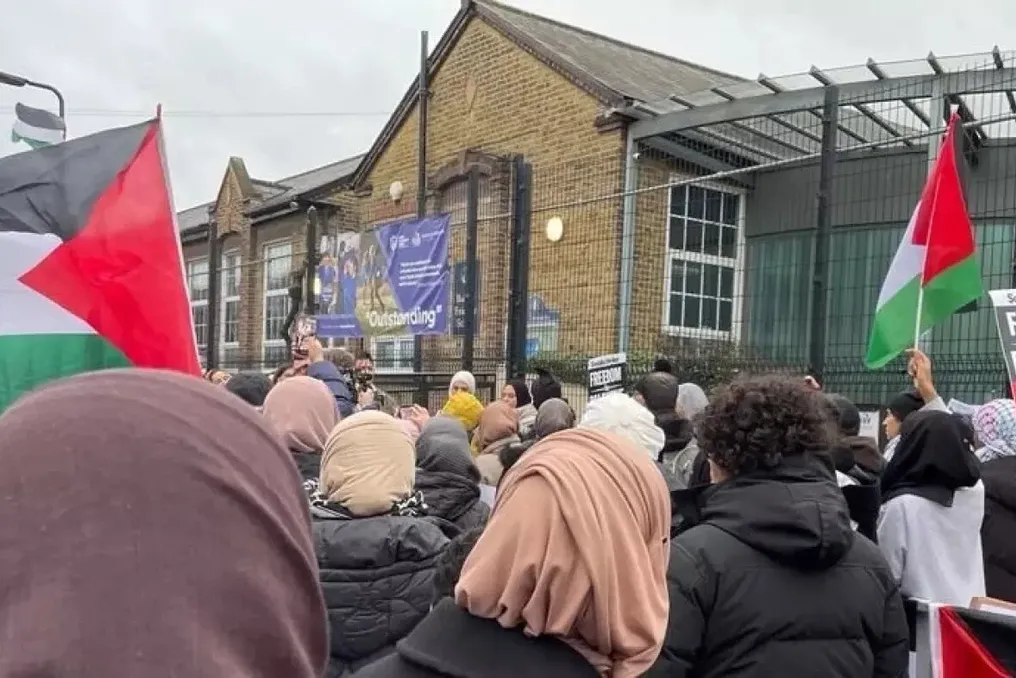
UK school pays compensation to children threatened over Palestinian symbols
Read more
Middle East Eye
www.middleeasteye.net

UK school pays compensation to children threatened over Palestinian symbols

The trust structure of a UK school apologized and agreed to pay compensation to four children who were threatened with referral to the Prevent counter-terrorism program after wearing Palestinian colors and symbols at a school charity event.

These children attended Barkley Primary School in Leyton, East London, in November 2023. They displayed Palestinian colors in memory of children killed in Gaza during the 'Children in Need' school event.

The primary school is part of the Lion Academy Trust, which manages eleven primary academies in East London. Following the incident, parents of the children received letters warning of possible referral to Prevent or to a hate crime police unit for wearing the Palestinian flag or its colors, which the school deemed as 'open displays of political beliefs' that could be 'considered offensive.'

Middle East Eye learned that the letter was sent to families of several children, including an eight-year-old boy who lost fourteen family members in Gaza. The organization Prevent Watch, which supported the families throughout a three-year legal battle, confirmed to MEE that the court approved a settlement on Thursday after the families, represented by the law firm Leigh Day, filed lawsuits under the Equality Act 2010 and the Human Rights Act 1998.

This case has once again raised questions about the use of the British counter-terrorism system in educational institutions and how solidarity with Palestine is interpreted in schools.

Parents accused of falsehood and malice

The incident sparked a wider dispute between the school and parents, as over 170 parents signed a letter demanding the school heed their concerns. In this letter, the parents described the threats to report the children to Prevent as an infringement on their freedom of speech and as inconsistent with the school's previous positions on global conflicts, particularly Russia's invasion of Ukraine.

The parents noted in their appeal: 'As parents and guardians, it was particularly difficult for us to read your letter of November 17 compared to your letter of March 4, 2022, regarding the Russian invasion of Ukraine.' They continued: 'Instead of wishing for a peaceful resolution in Ukraine and all other conflicts in the world, as you apparently did in March 2022, you state that children are being deprived of their right to freedom of expression, going so far as to imply that wearing red and green could justify escalation to a hate crime unit.'

'While you noted 'palpable concern and anxiety among students' regarding Ukraine, the agency of these students appears to be excluded in the context of Palestine. Instead, you are more concerned that children demonstrating support for Palestine are 'being used as political pawns',' they pointed out.

After receiving no response from the educational trust, hundreds of parents protested outside the school in December 2023. At the time, Lion Academy Trust characterized the parents' concerns and attempts to hold them accountable as 'false' and 'malicious.'

Laila Aitladj, director of Prevent Watch, stated that this case demonstrated how Muslim communities and those expressing solidarity with Palestinians can be portrayed as extremists. She emphasized: 'We repeatedly see Muslims protesting outside schools being portrayed by the media as extremists. Prevent is a political tool, and this is no exception. It was directed against children for wearing Palestinian colors and against their parents for objecting.'

Aitladj criticized the trust for allowing the dispute to drag on for three years instead of apologizing sooner. She added: 'The school could have apologized sooner. Instead, it contested it and dragged it out for three years. These are three years during which these children bore the burden of the belief that their compassion for children dying in the Israeli genocide in Gaza was wrong.'

Prevent Watch concluded that the outcome showed the harm that government counter-terrorism programs can cause when applied in an educational setting. The organization called for the withdrawal of the Prevent duty in education, arguing that children and families should not be subjected to counter-terrorism screening for expressing solidarity with Palestinians. The Prevent program is part of the UK's counter-terrorism strategy and imposes a legal obligation on certain public bodies, including schools, to consider the need to prevent people from involvement in terrorism.

Similar stories

Procedures for Informing Parents in the UAE About School Incidents Involving Children
Read more
www.khaleejtimes.com

Procedures for Informing Parents in the UAE About School Incidents Involving Children

When a child returns home from school with an unexplained injury, talks about bullying, or complains about an unpleasant interaction with a classmate, parents often want to know what happened, how the school reacted, and whether they should have been notified sooner.

In all UAE schools, these concerns are addressed through established 'incident reporting' and child protection procedures. These mechanisms range from classroom-level reporting and counseling to formal investigations and disciplinary committees.

While minor incidents can be resolved within the school, more serious cases involving physical injuries, bullying, or behavioral issues may require immediate parental notification, meetings with school staff, and documented follow-up action.

School principals in the UAE note that the response depends on the nature and severity of the incident. Schools also place great emphasis on protecting children's emotional well-being, maintaining confidentiality, and involving families when necessary.

Abhilasha Singh, Principal of Shining Star International School in Abu Dhabi, reported that teachers first direct incidents to the inclusion department or the school counselor, where statements are gathered from all participants before an investigation begins.

The school's reaction also considers the emotional impact on the child, even if there are no external signs of physical injury. Singh emphasized: 'If a child is injured, they are sent to a clinic, which informs the parents and determines what actions need to be taken. This applies not only to visible physical injuries but also to situations where a child might be experiencing emotional stress, even without external signs of injury. In some cases, we may also send the child home.'

Singh added that bullying issues are also taken seriously, even if the incidents involve hurtful remarks between children rather than physical violence. Such cases are referred to the inclusion department, and parents are involved in the process when the matter becomes more serious.

She noted: 'We are proud that our children are sensitive enough not to cause physical or psychological harm to each other. However, children are children, and there are times when they consciously or unconsciously exchange hurtful words.'

At Dewvale School in Dubai, students are advised to immediately report incidents, whether it is an injury, witnessing bullying, or encountering inappropriate behavior. Siema Umar, the school's principal, said that students can approach a teacher or any available staff member, after which the issue is formally recorded through a QR code-based reporting system.

The school counselor works with the section head and other relevant staff to assess the incident, conduct an investigation, and ensure proper follow-up support. Umar stressed the transparency of the school's reporting approach: 'Parents are informed about physical incidents, peer issues, low-level bullying, and behavioral problems via a phone call followed by an official email detailing the incident and the actions taken.'

If necessary, the school organizes a meeting on the same day involving the school counselor, the inclusion department head, and the section head. Umar emphasized that parents receive information not only about serious incidents but also about peer issues and low-level behavioral concerns.

When another student is involved, the school contacts both sets of parents separately to protect the children's confidentiality. Umar clarified that parents are informed about their own child's involvement, the nature of the incident, and the measures taken by the school. Depending on the severity, interventions may include counseling, formal warnings, or suspension. She added that accountability is maintained through written records, including incident reports, meeting minutes, and official email correspondence.

In other educational institutions, the reporting process may begin in the classroom, with class monitors and volunteers helping teachers identify and escalate issues. Some schools have created channels for resolving incidents, with minor issues usually being handled internally before being escalated.

Pramod Mahajan, Director and Principal of Sharjah Indian School, stated that there is a proper channel for addressing incidents occurring at the school. He noted that in cases of minor incidents, parents are not necessarily informed, as the school handles it internally. Every class has a class monitor and student volunteers who report incidents to the class or subject teacher.

However, if the incident is more serious, the matter is referred to a disciplinary committee chaired by the director. The committee includes the deputy principal, physical education teachers, and other faculty members. Mahajan reported that parents are informed and may be invited to the school when serious problems arise. He also added that schools in Sharjah follow guidelines issued by the Sharjah Private Education Authority (SPEA), which classify incidents according to their severity and determine how they should be escalated and resolved. SPEA has provided schools with clear guidelines classifying incidents into different levels, such as Categories 1, 2, and 3, and describing how each should be escalated and resolved.

Popular