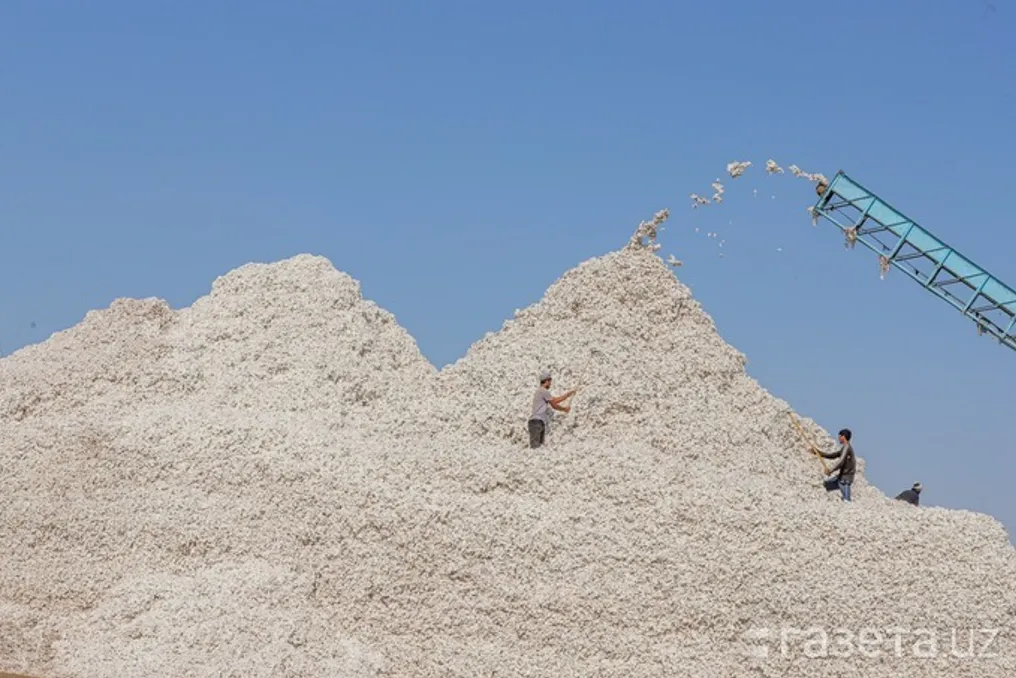
In 2026, Uzbekistan managed to harvest over 5 million tons of raw cotton. This significant result was made possible by the application of modern biotechnological varieties and new agricultural technologies resistant to the bollworm. The Minister of Agriculture, Ibrohim Abdurakhmonov, announced this achievement at a press conference on November 6.
According to the minister's statement, the total value of the harvested crop reached 34 trillion soums. It is worth noting that in 2025, the country produced about 4 million tons of cotton. In the current season, the average yield across nearly 400,000 hectares was 70 centners per hectare, while on approximately 70,000 hectares, it reached 100–110 centners.
However, results among farms showed significant differences. Abdurakhmonov specified that about 250,000 hectares maintained previous yield levels because not all farmers implemented innovative methods. The minister noted that some farmers did not plant varieties resistant to the bollworm and did not pay enough attention to planting density. Additional problems included heavy rains, which led to fields being overgrown with weeds, and damage to cotton plants during weeding, which reduced the number of plants to 48–50 thousand per hectare in some areas.
Farms with low results were entered into a special registry of the Ministry of Agriculture and divided into three categories: green, yellow, and red. Overall, 75–80% of this year's harvest was collected mechanically. Full mechanization of cotton harvesting was achieved in the Syrdarya and Jizzakh regions. It is planned that starting from 2027, the country will completely abandon manual cotton harvesting.
Reasons for the increase in cotton yield
One of the main factors contributing to the increased yield, Abdurakhmonov stated, was the introduction of biotechnological varieties resistant to the bollworm—one of the main pests of the crop. Previously, traditional varieties cultivated in Uzbekistan lacked sufficient protection against this pest, leading to the loss of a significant portion of the harvest.
The minister emphasized that the bollworm posed a serious problem, as one caterpillar could destroy ten bolls overnight. Thanks to the introduction of new biotechnological varieties, farmers were able to minimize losses that were previously inevitable.
Favorable weather conditions also had a positive impact, particularly the dry autumn of 2025, which promoted better cotton opening and extended the harvest until the end of November. Specialists of the Cotton Council under the President discovered another problem: cotton was often harvested before reaching full maturity.
Abdurakhmonov explained that the initial practice involved harvesting three to four lower opened bolls in September, a second harvest in October, and a third closer to December, while unopened bolls remained on the plants. He stated that it is necessary to learn how to bring the cotton to full maturity, considering Uzbekistan's location in the northern part of the global cotton growing belt, where the full development cycle can last from 220 to 270 days.
Studying the experience of China, Turkey, and Brazil
To increase yields, Uzbekistan studied the practices of several countries, including Turkey, China, Brazil, and Argentina. Special attention was paid to the dense planting technology used in the Xinjiang Uyghur Autonomous Region of China. Abdurakhmonov reported that in Turkey, the average yield reaches at least 50 centners per hectare, and the experience of these varieties was imported and applied in Uzbekistan. In Xinjiang, the yield averages 90 centners per hectare with a planting density of about 250 thousand plants per hectare.
Similar technologies are used in Brazil and Argentina, where planting density can exceed 200 thousand plants per hectare. In 2024, Uzbekistan introduced bollworm-resistant biotechnological varieties on 142 thousand hectares, using two-row planting with a density of over 200 thousand plants per hectare, which ensured a yield within 50–60 centners.
The head of the Ministry of Agriculture noted that previously, 100 thousand plants were used per hectare with a row spacing of 90 centimeters, whereas Brazil, Argentina, and China have switched to technologies allowing up to 200 thousand plants to be grown. The 2024 experience showed that increasing planting density leads to increased yield. Furthermore, reducing the row spacing from 90 to 76 centimeters increases land use efficiency by 14%, and with two-row planting, up to 240 thousand plants can be placed per hectare.
In parallel, methods were introduced to limit the height of the cotton plant to approximately 95 centimeters so that the plant would not waste extra resources on stem growth.
Adjusting the fertilization system and applying microelements
The minister also mentioned a change in the approach to cotton fertilization. If previously up to one ton of nitrogen fertilizer was applied per hectare, this volume was reduced to 200 kg in the current season. Instead, the focus was placed on using phosphorus and microelements.
Abdurakhmonov explained that only macrofertilizers were previously used, and despite applying a ton of nitrogen, the yield did not reach 100 centners. In the new season, manganese, iron, boric acid, and calcium, which were not previously used in cotton cultivation, began to be applied.
The minister explained the functions of microelements: manganese participates in photosynthesis, iron and calcium help absorb nutrients, and boron promotes flower and boll retention. Specifically, boric acid was applied twice as a suspension in doses of 250 to 500 grams per hectare, which helped reduce flower drop even on hot days.
Aspirin and yeast were also used in cotton farming. 250–500 grams of aspirin were used per hectare, and yeast was used to accelerate glucose absorption by the plant. These agents are relatively inexpensive: the cost of aspirin is about 35 thousand soums per hectare, and boric acid is 80 thousand soums. Abdurakhmonov stressed that these are not new discoveries but methods already used in global cotton farming, which are now being systematically introduced among local farmers.
Main innovation: starting preparation for ripening in August
One of the most important changes mentioned by Abdurakhmonov was the preparation of the plant for ripening, which began in early August. Previously, farmers performed defoliation—artificial removal of leaves—in the second half or end of September using the ethephon preparation, but by then, most of the bolls had not yet matured.
This year, the Ministry of Agriculture, together with scientists from the Cotton Council, decided to change the sequence of agrotechnical operations. A firm decision was made to stop cotton flowering on August 1st so that the plant would direct all its energy to maturing the existing bolls, rather than forming new ones. Ethephon, which regulates plant aging processes, was used for this purpose.
According to the minister, after treatment with ethephon, aging begins after about twelve days, the formation of new bolls stops, and nutrients from the leaves are redistributed to the already formed bolls. Previous methods, which included removing green leaves in September, led to nutrient loss. The new approach, started with ethephon, allowed for an increase in yield by 20 centners per hectare as early as August.
After this, defoliation and desiccation (drying the plants before harvest) were carried out at separate times. Defoliation was completed before August 25th, and desiccation, aimed at drying the stems and root system, was completed before September 15th. The minister warned that boll opening does not equal full maturity; cotton ripens when the stem dries and its mass increases. In 2024 experiments on desiccated plots, the yield reached 100 centners per hectare, whereas without desiccation, it remained at 45–50 centners.
Abdurakhmonov concluded that the main success lies not in purchasing expensive equipment but in adapting known agricultural technologies to local climatic conditions. He emphasized that the main innovation is the start of work on August 1st, and the other technologies were adapted from existing scientific knowledge, which does not require large financial investments, only attention and the right approach. Earlier ripening also allows the harvest to be completed before the onset of autumn cold and rain.
Goal: increasing yield to 70 centners per hectare
The minister announced that the goal for 2027 is to raise the average cotton yield to 70 centners per hectare, which could potentially lead to a total harvest exceeding 6 million tons. Simultaneously, the authorities plan to reduce the areas allocated to cotton by increasing productivity on existing fields.