Study points to greater advancement of men than women in jobs affected by Artificial Intelligence
Read more
Olhar Digital
olhardigital.com.br

Study points to greater advancement of men than women in jobs affected by Artificial Intelligence

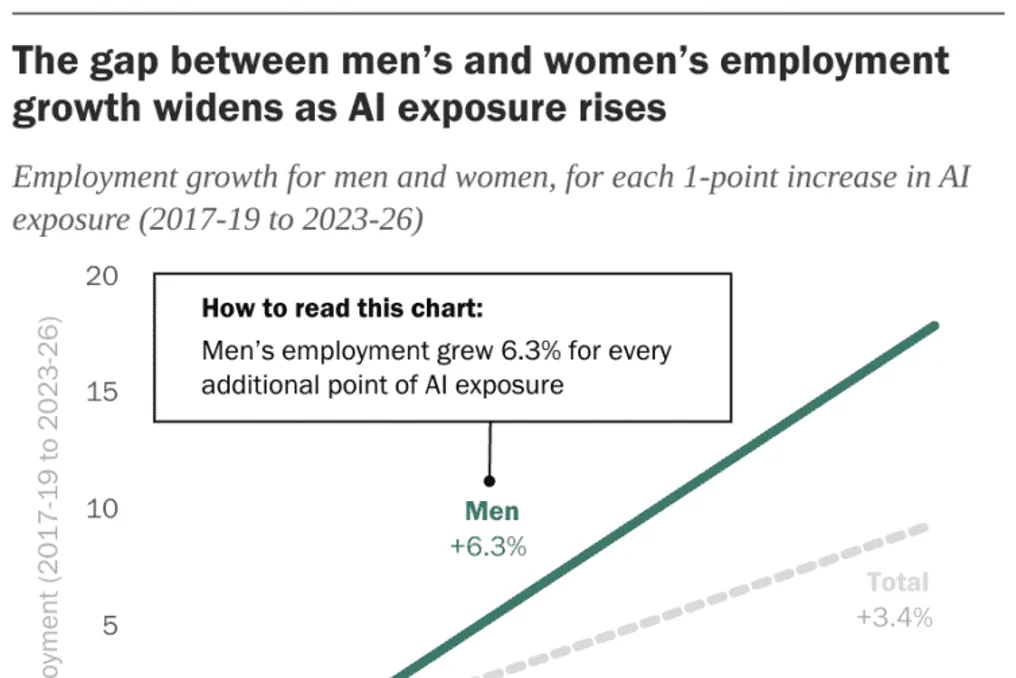
A survey conducted by the Pew Research Center revealed that job growth among men surpassed that of women in professions more susceptible to artificial intelligence (AI) in the United States. The analysis compared labor market data before and after the dissemination of generative AI to map gender disparities.

The study examined the evolution of the number of workers in the period between 2017 and 2019, and also between January 2023 and June 2026. The years 2020 to 2022 were omitted from the comparison due to changes caused by the Covid-19 pandemic in the work environment.

The findings indicate that the higher the degree of exposure of a function to AI, the more pronounced the difference becomes in job growth between men and women. Specifically, for every one-point increase on the AI exposure scale of an occupation, male employment registered a 6.3% increase, while the female variation was almost insignificant, with an advance of only 0.2%.

This discrepancy became even more noticeable in careers with high technological exposure. Male employment grew approximately 24% more in occupations most impacted by AI compared to those least exposed. In contrast, female employment growth remained practically stable across this exposure scale.

However, the scenario reversed in professions with less contact with artificial intelligence, where women showed higher job growth than men.

The survey emphasizes that the correlation between AI exposure and increased hiring does not necessarily imply that technology is the direct cause of these differences, given that other transformations occurred during the period and could have influenced the results.

To conduct this analysis, the Pew Research Center used data from 480 occupations, based on information provided by the Occupational Information Network (O*NET), a database maintained by the U.S. Department of Labor. Occupation classification takes into account the tasks performed in each profession, the feasibility of these tasks being assisted or performed by generative AI, and the relevance of these activities to work.

The evaluation scale used ranges from zero to 3.5; the higher the score, the greater the proportion of critical tasks in an occupation that can be supported or done by technology.

Professions with very low exposure include truck drivers, construction workers, and cleaning professionals. In the intermediate range are medical assistants, cashiers, and audiologists. On the other hand, occupations with very high exposure include accountants, software developers, and financial managers, as their activities involve information processing, reading, and writing, processes susceptible to assistance from generative AI.

The research also pointed out that the variation in job growth differs according to the educational level of the workers. Among individuals with a high school diploma or lower education, male employment grew by 8.8% for each additional point of AI exposure. For women at this same level of education, however, there was a reduction of 9.5%.

The difference was less pronounced among those who attended college but did not complete a higher education course; however, the gap between the results for men and women remained considerable in this group. Among workers with a bachelor's degree or higher education, no significant changes in job growth were observed for either gender as AI exposure increased.

Additionally, the study observed distinctions in the distribution of workers across professional categories. Men without a four-year university degree tend to be concentrated in activities less exposed to AI, such as cargo transport, construction, and merchandise handling. Women with the same level of education, on the other hand, more frequently work in roles such as receptionist, customer service, and secretarial work, occupations located in intermediate or higher positions on the AI exposure scale, suggesting a potential role for tools like chatbots and automated systems in these activities.

Finally, the Pew Research Center stresses that it is still premature to define the long-term impacts of artificial intelligence on the labor market, and the presented analysis focuses on the differences observed in job growth, without establishing a direct cause-and-effect link between technology adoption and changes in hiring.


Similar stories

Software Engineer's Doubts About Career Due to Low Salary and Job Instability in Tech Sector
Read more
www.aajtak.in

Software Engineer's Doubts About Career Due to Low Salary and Job Instability in Tech Sector

Despite years of study, project creation, and interview preparation to become a software engineer, job security is absent, and job stability after obtaining the position is not guaranteed. Amid layoffs in the technology industry, growing competition, and the increasing influence of artificial intelligence (AI), one software engineer has questioned their career decision. Following the publication of this post on social media, a discussion began about how safe and attractive a career in technology remains.

A technical specialist named Aisha shared her opinion on the social network X. She ponders whether pursuing software engineering was the right choice. According to Aisha, people spend years mastering technical skills, developing projects, and preparing for interviews. Nevertheless, they have to compete with thousands of candidates for a single vacancy. Moreover, there is no certainty that the job will be retained the next day after getting it. She also questions the point of all the effort if the job can disappear at any moment.

User opinions in response to Aisha's post were varied. One user expressed understanding of her concern but simultaneously raised the question of whether similar salaries could be obtained in other sectors. This user noted that software engineering offers good earning potential, but difficulties are also increasing in this field. Furthermore, the use of artificial intelligence raises questions about whether high salaries associated with application development can be maintained in the long term. Another user found the uncertainty about job permanence exhausting. At the same time, one user pointed to civil service as a more stable alternative.

Growing Anxiety Among Tech Company Employees Due to AI and Layoffs

Software engineering was long considered a field with good pay and career growth opportunities. However, the growing application of AI, companies' attempts to reduce costs, and layoff reports have intensified concerns among people working in this sector. Thus, Aisha's post reflects not only the personal doubts of one individual about their career but also a nationwide discussion about the safety and future of work in the technology industry. It should be noted, however, that this opinion, expressed on social media, does not allow for the conclusion that career opportunities in software engineering are disappearing.

The Impact of AI Automation on the Labor Market and the Role of Women in the Tech Sector
Read more
yourstory.com

The Impact of AI Automation on the Labor Market and the Role of Women in the Tech Sector

India's ambitions for self-reliance in defense have received a significant boost through a five-year agreement between Sarvam and the Ministry of Defence. This Indian company, based in Bengaluru, will be responsible for developing, creating, and implementing artificial intelligence-based applications for the armed forces' needs, including decision support, training, and operational tasks, as well as providing subsequent technical assistance. The deal includes the use of common foundational models, agent infrastructure, and perception and geospatial data systems.

Concurrently, intense corporate battles continue within the Tata group. Noel Tata, Chairman of Tata Trusts, challenged the decision to reappoint N Chandrasekaran as Chairman of Tata Sons. This decision was made at the board meeting of the conglomerate Tata 17th September. According to sources, Noel considers this reappointment 'invalid' because it was made out of turn and was not on the agenda of the meeting.

Meanwhile, Microsoft, reorganizing its staff amid major investments in AI, is offering employees the option of voluntary separation. The American tech giant announced a voluntary exit program for eligible employees in India, the USA, the UK, and Canada. The package includes one month's salary for each full year of service, as well as medical insurance and career transition services. Globally, the program is available to approximately 60,000 employees, with about 23,000 Microsoft employees in India, though the exact number of potential participants in the country remains unclear.

Furthermore, Wall Street is closely monitoring the upcoming reports from major technology companies, which may serve as an indicator of AI growth amidst overall market turbulence.

Women in Tech

As part of a series of publications on women in the technology sector, Kripa Venkatachalam, Vice President of Technical Organization India and Global Customer Success at Cadence Design Systems, shares her views on gender barriers, changes in workplace policies, mentorship, and the importance of having people who support you. Her career, spanning over two decades, has included work at various companies such as LSI Logic Corporation, Synopsys, GlobalFoundries, and Siemens EDA. Today, as VP of Technical Organization India and Global Customer Success at Cadence Design Systems, she has what she calls a 'front-row seat' to observe how world-class microchips are being developed in India.

At the TechSparks 2026 event, K Yatish Rajawat, co-founder of Hundred Million Jobs—a non-profit initiative aimed at creating 100 million clean jobs in India over the next decade—stated that future waves of employment in the country will be shaped by factors such as SMEs, data laws, entrepreneurship, and upskilling.

Popular