Air quality deterioration expected in Delhi due to various pollution sources
Read more
The times of India
timesofindia.indiatimes.com

Air quality deterioration expected in Delhi due to various pollution sources

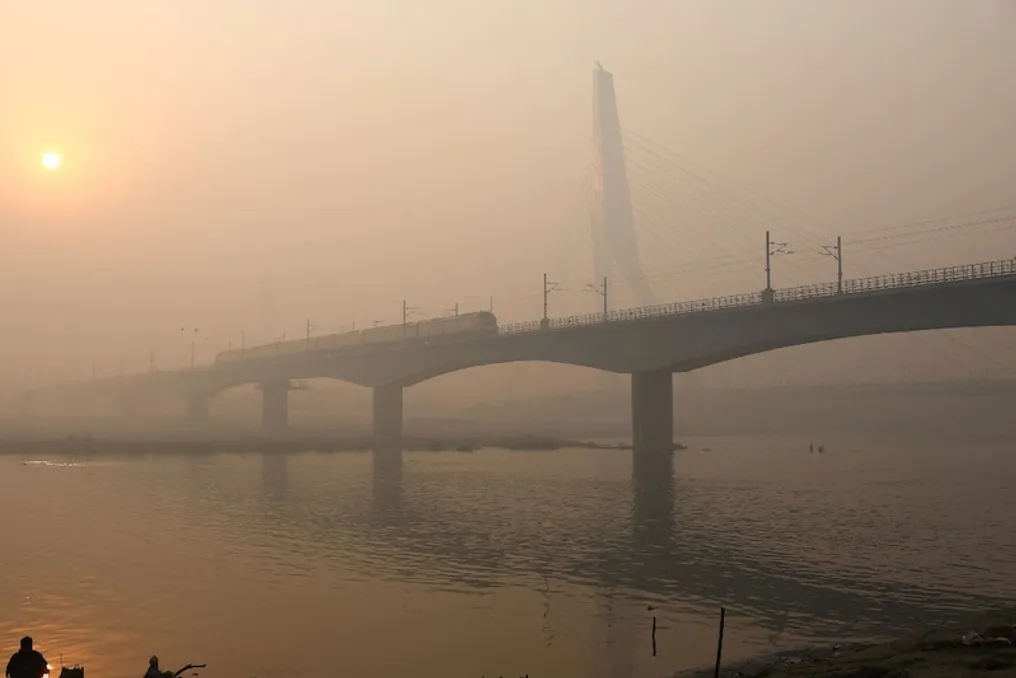
A worsening of the air pollution problem is forecast for Delhi. This is compounded by emissions from fireworks, vehicle exhaust fumes, and the burning of stubble in neighboring states. Furthermore, unfavorable weather conditions may hinder the dispersion of pollutants.

Rohitashva Rajan, a digital journalist for The Times of India, analyzes Indian politics, viewing it as a carefully staged performance with scripts, subtext, and all hidden details. His reports cover elections, party dynamics, and aspects that often go unnoticed in news headlines. When he is not studying vote distribution or alliances, he usually seeks the true essence of events between the lines.

Similar stories

Air remains dangerous in Delhi: AQI reached 450 in Punjabi Bagh, over 11 areas exceeded the 400 mark
Read more
www.aajtak.in

Air remains dangerous in Delhi: AQI reached 450 in Punjabi Bagh, over 11 areas exceeded the 400 mark

The air quality situation in the capital city of Delhi remains extremely alarming. Even on Sunday morning, smog hung over many areas, and the Air Quality Index (AQI) was recorded at a dangerous level. According to fresh data published by the Central Pollution Control Board (CPCB) at 6 am, the AQI is in the 'hazardous' category in many parts of the city.

The most toxic air was noted in the Punjabi Bagh area, where the AQI reached 450. Nearby, in RK Puram, the reading was 449, and in IIT Delhi—446. The situation also remained very poor in Dwarka, West Delhi, where the AQI stood at 444.

Furthermore, an AQI of 425 was recorded in Matura Road, 423 in Sirfort, and 423 in the North Campus (DU). The areas of Pusa, Chandni Chowk, Burari Crossing, and NSUT Jafarpur were also in the 'hazardous' category with AQI readings above 400: 415, 417, 411, and 409, respectively.

Even where the AQI was below 400, breathing there was still difficult. According to statistics, Narela recorded a reading of 399, ITO registered 396, and Mandir Marg showed 393. Uttam Nagar had an AQI of 373, Burari 370, Talkatora Garden 369, and Ay Nagar also recorded an AQI of 369.

Similarly, Vasundhara Enclave had an AQI of 356, while Tikri Kalan and Badarpur recorded a reading of 349. In Karawal, the AQI reached 337, and on Lodhi Road (IITM)—333.

This level of air pollution in Delhi-NCR before Diwali poses a serious threat to public health. Despite the implementation of GRAP-3 restrictions by the administration, no significant improvement in air quality has been observed.

Delhi leads in air pollution among major Indian cities with an AQI of 197
Read more
www.aajtak.in

Delhi leads in air pollution among major Indian cities with an AQI of 197

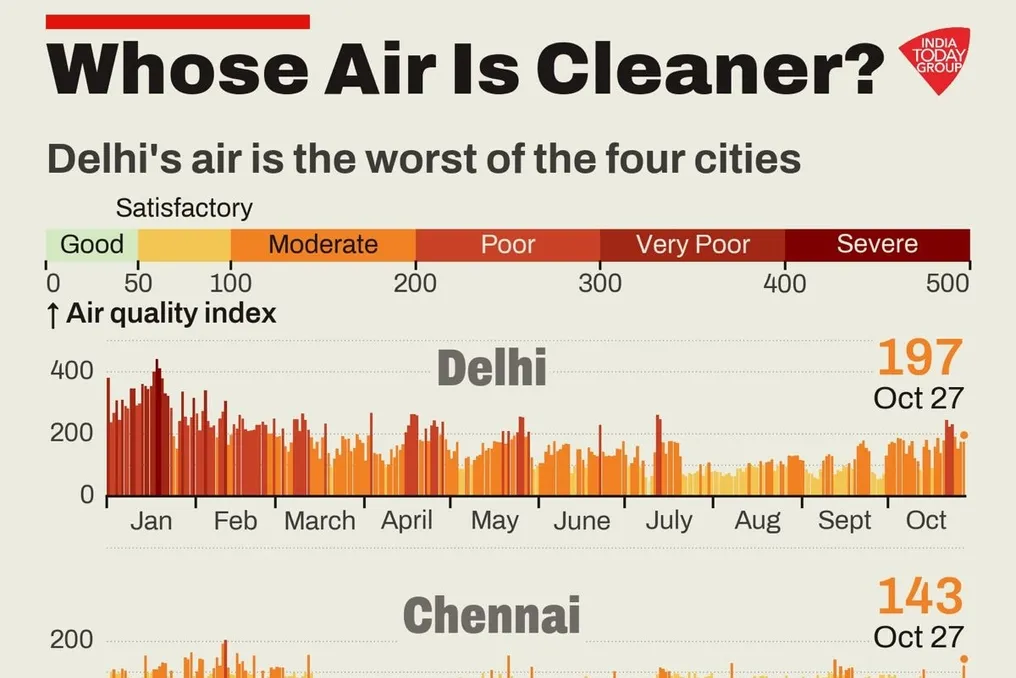
When comparing the air quality in four major cities in the country, the air in Delhi was the most polluted on Tuesday. According to data from the Central Pollution Control Board (CPCB), the Air Quality Index (AQI) in Delhi was 197. In Chennai, this figure reached 143, in Mumbai it was 99, and in Kolkata it was 81. Thus, Delhi ranked first among all four cities, while Kolkata ranked last.

The AQI is a scale that determines the degree of air purity or pollution in a city; the higher the value, the more polluted the air is considered. This is why on October 27, the air in Delhi appeared the most polluted among all four cities.

The specific figures for the four cities were as follows: Delhi — 197, Chennai — 143, Mumbai — 99, and Kolkata — 81. The AQI in Kolkata was the lowest.

Comparing the data for Delhi and Chennai, it is evident that the AQI in Delhi (197) exceeds the figure in Chennai (143) by 54 points. This gap widens even further compared to the figures for Mumbai (99) and Kolkata (81), indicating that the air in Delhi is more polluted than in the other three cities.

In the CPCB graph, AQI levels are divided into different categories. According to this scale, AQI values from 101 to 200 fall into the 'moderate' category. Based on this, the readings for Delhi (197) and Chennai (143) fell into the moderate category. Meanwhile, the figures for Mumbai (99) and Kolkata (81) were below 100, meaning they did not reach the lower boundary of the moderate category.

It is important to note that the CPCB data is based on the 24-hour average value calculated as of around 4:00 PM on Tuesday.

Popular