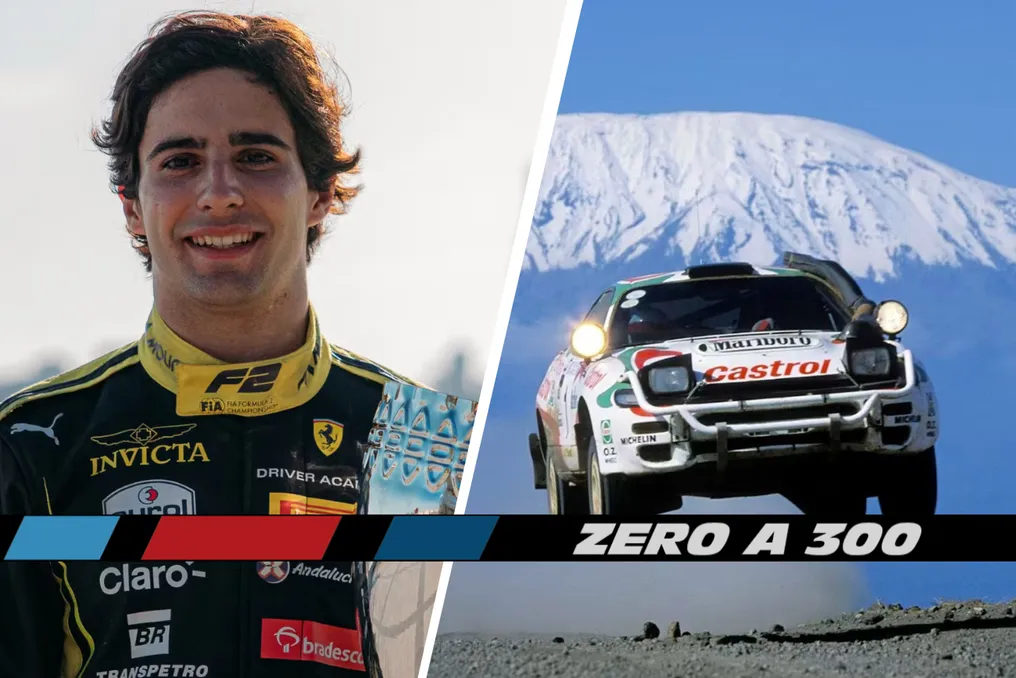
Rafael Câmara will make his debut with the Haas team ahead of schedule. Although initially contracted for the 2027 Formula 1 season, the Brazilian driver will participate in the next round in Interlagos, which takes place this weekend. Haas officially announced this change yesterday (3).
The change in plans occurred due to a disagreement between Esteban Ocon and team principal Ayao Komatsu during the Mexican Grand Prix. As a consequence of this discussion, Ocon was prematurely removed from Haas, and reserve driver Ryo Hirakawa took his place starting from the third free practice.
This will be the first time since 2016 that two Brazilian drivers will be on the F1 grid in Interlagos, the time when Felipe Massa (Williams) and Felipe Nasr (Sauber) competed for the championship. Haas also confirmed Rafael Câmara's presence at the Las Vegas Grand Prix, scheduled for the 22nd. However, in the two most recent races of the season—the Qatar and Abu Dhabi GPs—the Pernambuco native already has commitments with the Formula 2 finals, which will take place in a double round on the same weekends. Currently leading the championship, Câmara chooses to focus on winning the F2 title while awaiting his definitive spot at Haas.
Toyota confirms Celica's return to WRC
The Toyota Celica, which transcends the status of a mere street classic or Gran Turismo icon, has a long history in the WRC. In the 1990s, the GT-Four versions (ST165, ST185, and ST205) brought four titles to the manufacturer in the World Drivers' Championship (in 1990 and 1992 with Carlos Sainz, 1993 with Juha Kankkunen, and 1994 with Didier Auriol) and two in the Constructors' World Championship (in 1993 and 1994). Now, it is returning to competition.
Toyota confirmed that its next competitor in the WRC will be a new Celica, debuting in the 2027 season, competing alongside the GR Yaris. Both models are going through the final homologation phases for the new championship regulations, which will be implemented starting next year. According to Motorsport.com, the new Celica will be driven by Elfyn Evans, Oliver Solberg, and Sami Pajari, while the GR Yaris will feature Ott Tänak, Takamoto Katsuta, and Kalle Rovanperä.
Images of prototypes photographed and filmed months ago, which increasingly resemble a mid-rear engine sports car, suggest they are the preliminary version of the new Celica. However, this does not clarify the future of Toyota's new street sports cars, given that both the return of the Celica and a new MR-2 have recently generated speculation. The manufacturer neither confirms nor denies anything, only suggests that both cars may materialize in the near future.
October Sales and Automotive Launches
Analyzing the October sales ranking, it can be noted that the Fiat Strada maintains its leadership in the Brazilian market, as has been happening in recent months. However, looking at lower positions, the BYD Dolphin Mini stands out, having surpassed the Fiat Argo and the Volkswagen Polo, two of the country's most popular vehicles.
In October, the Strada secured overall leadership for the tenth consecutive month, with 14,566 registrations. Second place was occupied by the Hyundai HB20, which rose from 11th place in September to register 9,037 units, representing a 43.1% increase in just one month. The biggest transformation came with the BYD Dolphin Mini, which reached third place with 8,432 registrations, slightly surpassing the Fiat Argo (8,331 units) and widening the gap to the Volkswagen Polo, which dropped from second place to fifth place, with 8,125 units. This is a significant achievement for an electric vehicle introduced in Brazil less than three years ago, which now competes directly with combustion compact hatchbacks, historically the highest volume models in the national market.
The rest of the ranking demonstrates market evolution. Among the top ten best-selling vehicles are three SUVs: the Volkswagen T-Cross (sixth, with 7,567 units), the VW Tera (seventh, with 7,489), and the Toyota Yaris Cross (which finished the ranking with 6,243 registrations). The Chevrolet Onix (7,016 units) and the Renault Kwid (6,346 units) also featured. In total, 253,298 new passenger cars and light commercial vehicles were registered in October, representing a 5.3% reduction compared to September, but a 2.2% increase compared to the same period in 2025. Electrified vehicles accounted for 24.4% of this volume, and Chinese brands achieved a 22.7% market share. BYD alone registered 24,114 vehicles, equivalent to 9.5% of the market. That is, almost one in ten new vehicles sold in Brazil in October was a BYD.
Finally, an important correction: previous interpretations regarding BYD's leadership in retail sales as an indication of predominantly private purchases cannot be made solely with this data. According to Fenabrave, the distinction between retail sales and direct sales does not depend on the buyer's profile, but rather on who issues the invoice. When the invoice is issued by the manufacturer, the transaction is classified as direct sale, even if mediated by a dealership. In other cases, it is considered retail sale. Both modalities can involve buyers with CPF or CNPJ. Therefore, BYD's leadership in retail does not allow us to state that its cars are predominantly bought by individuals, just as the volume of direct sales does not reveal how many vehicles were destined for rental companies, fleets, or individual buyers; for that, it would be necessary to know the buyer's profile, not just the billing channel.
Pagani Huayra 70 Anima Revealed with V12 Biturbo and Manual Gearbox
There is always deep respect for Pagani, as the manufacturer is one of the main contributors to the popularization of carbon fiber in supercars, and its creator, Horacio Pagani, is an example of fidelity to his ideals. Pagani follows its own guidelines in manufacturing its vehicles, maintaining this tradition, and works closely with clients to customize each unit, ensuring that no Pagani is identical to another of the same model. This constitutes the concept of tailor-made.
In this context, the last of the Huayra 70—a trio of cars built custom to celebrate Horacio Pagani's 70th anniversary—was presented yesterday (3). The mere existence of this vehicle is remarkable: even with Pagani producing the Utopia, its successor, the Huayra still demonstrates technical capability. Its mechanical package reflects principles and personality: the engine is the well-known 6-liter Mercedes-AMG derived V12 biturbo, generating 862 hp at 6,000 rpm and 112.2 kgfm of torque. The gearbox is a seven-speed manual from the Xtrac brand, and the drivetrain is rear-wheel drive, equipped with a mechanical locking differential, without electric motors.
The chassis adopts the classic Huayra configuration, including overlapping triangular wishbone suspension, electronic adjustable dampers on all four wheels, carbon-ceramic brakes with Brembo calipers, and imposing 20-inch wheels in the front and 21-inch wheels in the rear, using Pirelli P Zero Trofeo R 265/30 and 335/25 tires, respectively. Pagani demonstrates an ability to build an extremely refined supercar, which certainly demands a skilled driver if the goal is to use it rather than keep it in a climate-controlled environment.
It is impossible to ignore the car's style. Naturally, the Huayra is an elaborate and, to some extent, exaggerated vehicle, which is part of its essence; those seeking elegance and discretion should look to the competition or give up on a supercar. In the specific case of the Huayra 70 Anima, the level of ostentation can be excessive. The combination of blue over blue colors, the chrome trim (both on the body and in the cabin), and the white leather upholstery highlight that the owner likes to attract attention and does not want to be compared to other Huayra owners. However, as mentioned earlier, part of the charm of owning a Pagani lies in the possibility of choosing every finishing detail.
The Huayra 70 Anima reminds one of some Jacob & Co. watches, those grandiose pieces with unconventional style, often inspired by supercars, which sometimes feature miniature replicas of V12 engines operating alongside the caliber. They are impressive complications, encased in high jewelry worthy cases, but everything is very flashy, bordering on vulgar. One admires and respects the art, but one cannot say it is beautiful in the strict sense of the word. However, the mechanical package deserves emphasis: V12 biturbo, manual gearbox, rear-wheel drive, and absence of electric motors. This is where the importance lies.
Cadillac May Sell Formula 1 Team After Only One Season
Cadillac invested over US$ 1 billion to enter Formula 1 in 2026, but it seems the team owners are already considering selling the venture, potentially for more than the amount invested. According to a Sportico article published on Monday (2), businessman Mark Walter, controller of TWG Global, is evaluating the sale of his stake in the team for a minimum value of US$ 3 billion. Furthermore, there are already at least seven potential interested buyers.
The Cadillac team is managed by TWG Motorsports, a division of Walter's group that also manages operations such as Andretti Global and Wayne Taylor Racing. General Motors acts as a partner and provides the Cadillac name to the project, although the exact distribution of shares has never been disclosed. Thus, the US$ 3 billion refers to the valuation of the entire team, and not necessarily the amount Walter would receive for his share.
This figure is notable because Cadillac is still in its first season in Formula 1 and faces challenges in establishing itself competitively. The operation required about US$ 450 million just to compensate other teams for the entry of a new participant in the championship, in addition to an initial investment of at least US$ 1 billion in competition infrastructure, facilities, and development. Despite this, the valuation proposed by Walter approaches the average of Formula 1 teams, which reached US$ 3.42 billion in 2025.