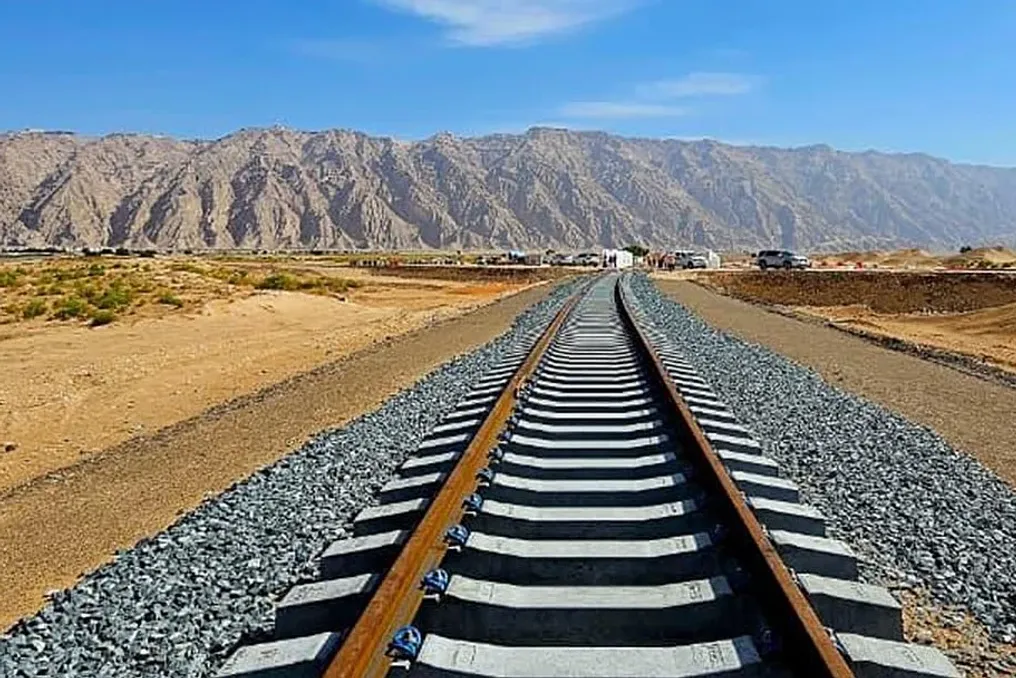
Jassim Mohammed Al Budaiwi, Secretary-General of the GCC Secretariat, announced on Sunday that the railway network project of the Gulf Cooperation Council (GCC) countries is approximately 56% complete. Full operation of this network is planned to begin in December 2030.
This 2,117-kilometer railway network will connect all six Gulf countries, including the United Arab Emirates, and will be used for both passenger and freight transport.
This announcement followed the signing of a general agreement by the six GCC countries in Bahrain, aimed at unifying national railway networks into a single, integrated, and compatible regional network.
The agreement was signed at the Riffa Al Zahir Palace on November 8. Al Budaiwi noted that this agreement establishes a common framework for the implementation and operation of the railway network by member states, ensuring the compatibility of their national systems to operate within a unified regional structure.
According to GCC Secretariat data, the planned route will start in Kuwait and extend to Dammam in Saudi Arabia, with subsequent connections to Bahrain and Qatar. From Saudi Arabia, the network will enter the UAE, passing through Abu Dhabi and Al Ain, before continuing to Oman via Sohar, ultimately reaching Muscat.
The project is designed to carry both passengers and cargo, offering an alternative mode of transport between the Gulf countries, which will support trade, tourism, and economic activity. Passenger trains are designed to travel at speeds of up to 200 km/h, while freight trains will operate at speeds of 80 to 120 km/h, according to the GCC Railway Authority.
According to forecasts previously stated by the GCC Secretariat, by 2045, the network will be able to transport over eight million passengers and 95 million tons of goods. In the UAE, the regional network is intended to integrate with the country's national railway infrastructure.
Previously, the GCC Secretariat confirmed that the UAE has completed the construction of railway connections to the border of Saudi Arabia. Furthermore, the UAE and Oman are developing the 238-km Hafeet Rail project, which will connect Sohar to the UAE's national railway network.
The signing of this agreement comes amid the Gulf countries' efforts to strengthen transport links and create alternative supply routes following disruptions in regional maritime transport. Speaking at the GCC Transport Ministers meeting in Manama on Sunday, Al Budaiwi emphasized that recent disruptions in maritime corridors, as well as rising freight and insurance costs, highlighted the importance of strengthening logistics and transport networks.
He specifically thanked the UAE, Saudi Arabia, and Oman for their assistance in creating alternative routes for goods during the Iranian attacks, which helped maintain supply chains to other GCC countries. Al Budaiwi stated: 'These efforts contributed to providing alternative routes for the movement of goods and raw materials and ensuring the continuity of supply chains in the rest of the GCC states.'
Al Budaiwi stressed that integrating the Gulf's transport networks and diversifying supply routes will help member states respond to future crises and maintain market stability. He also reported that the transport and storage sector in the GCC countries demonstrated real growth of 5.7 percent in 2025, becoming one of the fastest-growing non-oil sectors in the region.
Additionally, he mentioned that GCC leaders instructed officials in April 2026 to prepare a study on enhancing logistical integration among member states.