
VCT and LoL league partnership model: revenue sources for esports teams
Read more
Olhar Digital
olhardigital.com.br

VCT and LoL league partnership model: revenue sources for esports teams

Although tournament prizes are the most visible part, they constitute only one of the various income sources for esports organizations. In titles such as VALORANT and League of Legends (LoL), Riot Games implements partnership programs that provide financial support to specific teams, aiming to ensure the continuity of club operations and stimulate investment in the competitive scene.

These partnership schemes are crucial for understanding the importance of selecting participating organizations in the market. The VALORANT Champions Tour (VCT) will undergo changes in 2027, introducing a new two-year partnership cycle. According to information from Riot Games and detailed by THESPIKE Brasil, there will be eight partner organizations in each of the four regions, totaling 32 teams in the program.

The annual payments allocated to teams in the Americas can vary significantly, ranging between US$ 600 thousand and US$ 5 million, depending on several factors. This revenue comes mainly from three distinct sources. Starting in 2027, even non-partnered organizations will have the opportunity to compete in the main tournaments through open qualifiers and will receive financial incentives based on their performance. Furthermore, Riot Games has announced an additional contribution of US$ 6 million in prizes and incentives for the circuit.

In the Brazilian context, LOUD, FURIA, MIBR, and paiN advanced in the selection process for the new cycle, as reported by THESPIKE Brasil in June; however, this advancement did not confirm the partnership. In League of Legends, the model combines commercial partnerships with revenue generated by the competitive ecosystem. Clubs in structured leagues with partner organizations may receive transfers defined in their agreements with Riot, in addition to revenue linked to digital products and commercial results. This LoL model also includes initiatives for profit sharing from virtual items related to esports, although contractual terms and distribution criteria may differ from those of the VCT, varying according to the league and season.

Even with transfers from the developers, teams need to develop other revenue streams to maintain their activities. Brand sponsorships, content creation, official merchandise sales, commercial agreements, and supplementary prizes help make up the organizations' budget. Such resources are essential to cover player salaries, coaching staff, training infrastructure, travel expenses, and administrative personnel.

The fundamental distinction between the partnership models and conventional championships lies in financial stability. Instead of relying solely on tournament victories, a partner organization can count on pre-established payments and commercial opportunities. Despite this, participating in a league does not guarantee profit, as operational costs remain high, and success depends on each club's ability to convert audience, performance, and fan relationship into revenue. In summary, the partnership model demonstrates that the esports business transcends matches, encompassing the commercialization of digital products, brand interest, and the maintenance of an active community.

Similar stories

EngageXP launches Gamin PLUS, a benefits club for gamers with a virtual currency system
Read more
olhardigital.com.br

EngageXP launches Gamin PLUS, a benefits club for gamers with a virtual currency system

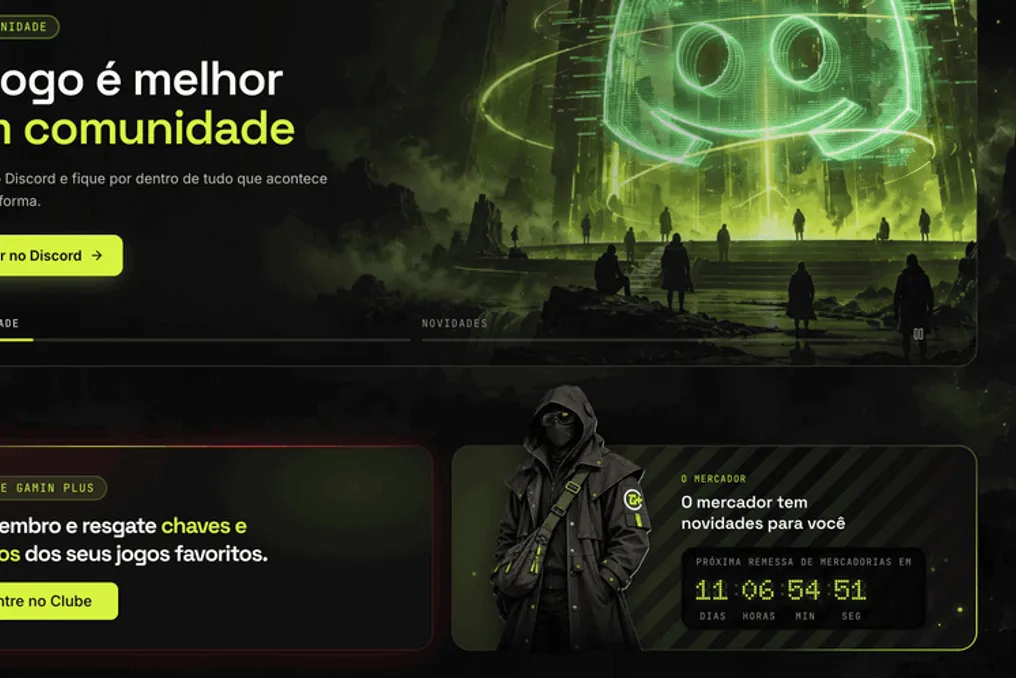
EngageXP, a company established as a performance solutions center for the gaming sector since 2021, has introduced Gamin PLUS. This new membership club is specifically designed for the gaming audience, integrating digital benefits, rewards, and community interaction opportunities.

The proposal of Gamin PLUS differs from traditional game subscription models. Instead of merely granting temporary access to a vast library, as seen in services like Xbox Game Pass and PlayStation Plus, this club allows users to accumulate virtual coins. These coins can be used to exchange for games, in-game credits, and other advantages, all under a single subscription.

Each subscriber receives 1,000 G-Coins monthly, which are the virtual coins designated for redeeming items from the service's catalog. According to EngageXP, it is possible to redeem complete games using 1,000 G-Coins or more, while credits for online games start at 100 G-Coins. Furthermore, the platform offers various other types of benefits and discount coupons.

An important point is that accumulated G-Coins do not expire, allowing members to save them for future exchanges of higher-value items. However, the variety of available products is subject to the catalog, which is updated with new titles every month.

The service incorporates its own gamification system. Participants can complete missions to earn experience points (XP), progress through levels, and receive extra prizes, which can serve as a more accessible way to obtain certain rewards. Additionally, there is an exclusive Discord community, a space where members can connect, find other players, and participate in joint activities.

In terms of cost, Gamin PLUS is available for R$ 25 per month during its promotional launch period. The standard price set is R$ 40 per month. Quarterly options were also offered for R$ 70.00, and an annual plan for R$ 250.

Interested parties can access the service through the official EngageXP website to check all enrollment conditions and detailed benefits. EngageXP acts as a performance solutions center focused on the gaming ecosystem, connecting players, content creators, and the video game industry itself.

Gamification goes beyond games and changes the interaction between brands and consumers
Read more
olhardigital.com.br

Gamification goes beyond games and changes the interaction between brands and consumers

Mechanics characteristic of video games, such as points, missions, rankings, and rewards, are no longer exclusive to the gaming sector. These elements are increasingly integrated into digital platforms, loyalty programs, and applications, transforming how companies motivate consumer engagement.

The strategy known as gamification involves applying typical game elements to actions that are not games themselves. In Brazil, the adoption of these experiences contributes to a high level of public familiarity with this field. According to the Pesquisa Game Brasil 2025 study, about 82% of Brazilians consume digital games.

In practice, gamification uses tools such as achievements, levels, challenges, and rewards to stimulate specific behaviors. For example, a loyalty program may award points for purchases and provide bonuses as the customer advances through levels. Similarly, educational platforms can apply daily goals and achievements to maintain continuous learning.

This logic is also evident in fitness apps, financial services, and advertising campaigns. According to a survey cited by Gamers Club, 34% of Brazilian players participating in the study state a constant desire to improve their results and overcome difficulties.

According to Jonathan Pereira, Marketing Director of the company, it is this habit that helps explain the expansion of this strategy. He notes: 'The logic of gamification does not arise from nothing; it stems from behavior that has been consolidated among gamers over many years. Competition, development, and recognition are part of this experience.'

Although rankings and competitions are common elements, gamification does not necessarily require pitting users against each other. The feeling of progress can also stimulate participation, especially when rewards are tied to clear goals. Pereira explains: 'Not everything has to turn into direct competition. It engages the feeling of evolution, the feeling of achievement. Competition is one way, but not the only one.'

Nevertheless, the growth of these strategies raises questions about using mechanisms that encourage constant presence on platforms. This becomes particularly relevant when rewards and challenges are applied in the financial services sector or in money-related experiences. According to the director, the main task is to prevent gamification from becoming solely a tool to increase usage time. He concludes: 'When the experience becomes merely a stimulus for retention at any cost, it loses value. What truly works is what has a purpose and represents a meaningful path for the user.'

The spread of gamification demonstrates how elements developed and popularized by video games have begun to influence other industries. The current challenge is to use these mechanics to create meaningful experiences without turning every interaction into an obligation to compete or accumulate rewards. The article was first published in Olhar Digital.

Giga+ and Sky discuss possible merger that could create a major player in the Brazilian fiber optic market
Read more
tecnoblog.net

Giga+ and Sky discuss possible merger that could create a major player in the Brazilian fiber optic market

Giga+, formerly known as Alloha Fibra, confirmed that it has maintained conversations with Sky in recent months regarding a potential merger and acquisition. This information was disclosed in a statement to the market after B3 requested clarifications, prompted by a news item published by the Broadcast website, which belongs to Grupo Estado.

However, the company emphasized that there has been no deliberation by the company's management, nor the formalization of any agreement, commitment, or binding contractual document, as reported by the Teletime website.

A union of Giga+'s broadband operations with Zaaz, which is the fiber operator of Waiken ILW, the controller of Sky, would have the potential to establish the fourth largest fixed internet provider in Brazil, boasting approximately 1.91 million users.

In its statement, Giga+ declared that it has held dialogues with Sky and other industry players in recent months. The operator also mentioned that it conducts periodic evaluations of business opportunities and strategic alternatives aimed at expansion and capital management.

Such a transaction could be advantageous for Giga+, given that it registered a 16.5% drop in its access base during the twelve months ending in August. In contrast, Sky and Zaaz's broadband operation showed an expressive growth of 47.7% in the same period.

In addition to operating in the fiber optic network, Sky is seeking to penetrate the mobile network segment. In August, the company officially launched the commercial plans for Sky Móvel, which operates as a virtual operator (MVNO) using Surf Telecom's infrastructure. There are also plans to introduce Sky Link, a competitor to Starlink in the satellite internet market.

An eventual operation would include Giga+ and the broadband assets of the Waiken ILW group, which owns Sky and Zaaz. According to data from the consultancy Teleco, Giga+ had about 1.29 million accesses in August, while Sky and Zaaz totaled approximately 627 thousand customers. Combined, these operations would reach about 1.91 million subscribers.

This volume would position the consolidated group behind only the large companies Claro, Vivo, and Nio—the latter having absorbed Oi's fiber clientele—but ahead of Brisanet, which had about 1.58 million accesses at the same time.

The geographical reach would also be expanded. The two operations would operate in 1,110 combined cities, leading in 173 municipalities. Currently, there is a network overlap between the companies in only 123 cities.

Currently, Brisanet holds the fourth position, slightly ahead of Brasil TecPar, which has about 1.38 million accesses. The latter also aims to increase its market share through the acquisition of Ligga Telecom's operation, a deal that has already received approval from Anatel and the Administrative Council for Economic Defense (Cade), but which is still awaiting a ruling from the Ministry of Communications.

Popular