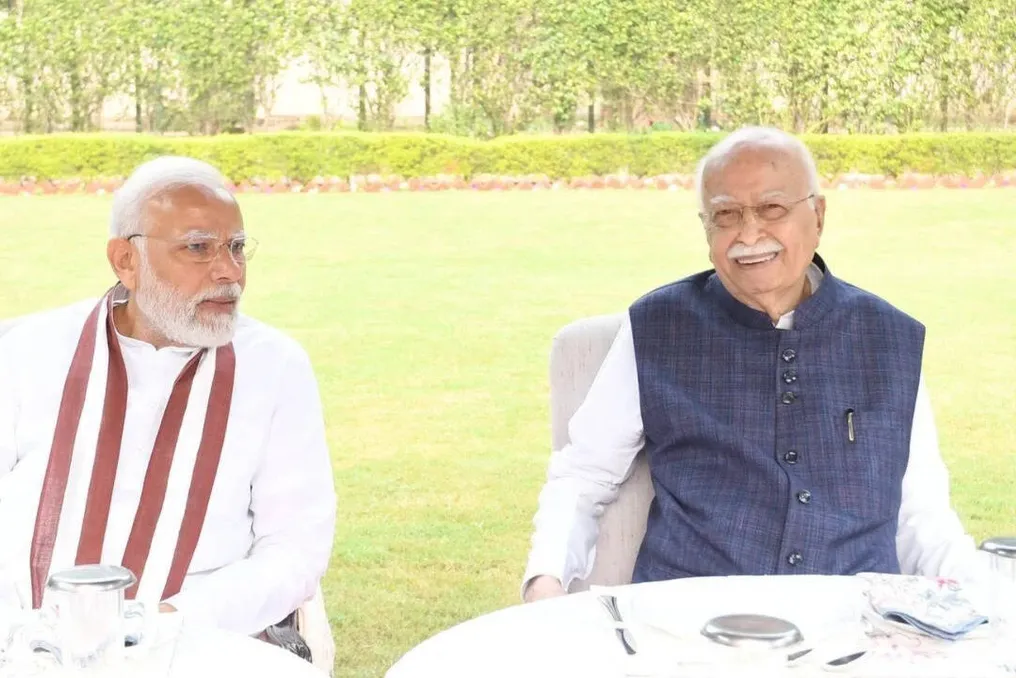
Shri Lal Krishna Advani celebrated his centenary on November 8th. This day coincided with Diwali, which is traditionally associated with Prabhu Shri Ram and the Diya. During this period, the 75th anniversary of the founding of Jana Sangh, the 125th anniversary of Dr. Siama Prasad Mookerjee, and the centenary of the RSS were also observed.
Few people have influenced so many chapters of modern India. Advani was born on November 8, 1927, on the festival of Dev Deepavali. In 1947, as a young man, he experienced the difficulties of leaving his familiar world in Sindh, yet managed to rebuild his life from scratch without resentment. This ability to build anew despite all obstacles remained with him throughout his life. This quality was evident during the strengthening of Jana Sangh and later in the building of the BJP.
During his tenure as President of the BJP, there was a sharp decline in Congress support from 400 to less than 200 in 1989, and in 1996, the BJP became the largest party for the first time. Advani nurtured generations of activists and laid a strong foundation for the Party based on the principle of 'Nation First.'
Two qualities always distinguished Advani as a leader: firstly, his ideological clarity and intellectual sharpness, which was reflected in his speeches and writings. The decisions of Jana Sangh and BJP that he authored remain worthy of reading to this day, and his interviews were always characterized by accuracy and insight. Secondly, the manner in which he exposed the pseudo-secularism promoted by a significant part of Indian politics over many years.
Advani undertook any responsibility with immense diligence. As a pracharak of the RSS, he initially worked in various parts of Rajasthan before moving to the national capital, where he began working closely with Atal. History shows that it is rare for two great political leaders to work together for decades without becoming competitors. Advani and Atal set a wonderful example; together they changed the course of Indian politics.
Delhi, where Advani arrived, was just beginning to cope with the horrors of Partition. He dedicated himself entirely to strengthening Jana Sangh. In 1967, Advani became the Chairman of the Delhi Municipal Corporation, where he worked alongside the late Vijay Kumar Malhotra Ji, who served as Executive Advisor.
In 1970, Advani entered the parliamentary phase of his career. His interventions gained recognition across the political spectrum. He succeeded as a Member of Parliament, and later as the opposition leader in both houses and from the government faction. Despite his parliamentary duties, he frequently traveled across India, meeting people.
The Emergency era was a turning point in Advani's life. He stood at the forefront of saving democracy and protecting the Constitution. His experience was documented in the book 'A Prisoner's Scrap-Book'. One part of this book, titled 'A Tale of Two Emergencies', perfectly explained the striking similarities between the events in India starting in June 1975 and the events in Nazi Germany in 1933.
Advani was a fiery opposition leader, but also an excellent administrator. When the Janata government came to power in 1977, Advani became the Minister of Information and Broadcasting. It is widely acknowledged that his work in this department was immensely significant. As Deputy Prime Minister and one of India's longest-serving Home Ministers, he played a crucial role in strengthening India's security system. His efforts to improve the lives of our security forces are remembered with great warmth. His unequivocal stance against terrorism ensured a strict anti-terrorism law for India.
Of course, a landmark moment in Advani's life was the Rath Yatra from Somnath to Ayodhya. It changed the course of Indian society for the better. I consider it a privilege that I had the opportunity to participate in this procession from the stage of idea to realization. Being present in Somnath when the procession began was particularly special. A procession can be very demanding, requiring long hours, constant travel, physical stamina, and the ability to maintain concentration despite fatigue. Advani embodied this endurance.
I also have memories of the sad moments of Advani's arrest in Bihar. Later, in Gujarat, the BJP withdrew support from the Chimanbhai Patel government. This conveyed a simple message: when it comes to our ideology and the Ram Temple, there will be no compromises. Many of our senior leaders and karyakartas swore that no matter what, the Ram Temple would be built. And years later, with the blessings of the people of India, the magnificent Mandir for Prabhu Shri Ram became a reality in Ayodhya.
There is much more outstanding about Advani. For instance, his simplicity. After the Navnirman movement, Advani went to Junagadh and spent a month there as an ordinary karyakarta, preparing the Party for the Assembly elections in which the Congress failed. He always demonstrated what dedication in public life means. He is a passionate reader. Those who spent time with him know how meticulously he studies newspapers. He is a big fan of cinema and theatre and was an enthusiastic film critic. His sense of history and the need to preserve it is evident in his book 'My Country My Life.'
Advani always maintained a connection with Sindhi culture. Another initiative was the popularization of Puja Sindhu Darshan near Le. I myself attended such a Puja with Advani and George Fernandes Ji.
Any account of Advani's remarkable journey would be incomplete without mentioning Kamla Advani Ji. She was a constant source of strength and support throughout his public life.
Having grown up in Karachi, Advani could hardly imagine the path his life would take. In gratitude, the people of India honored him with the 'Bharat Ratna' award in 2024. As Advani enters his centenary year, I pray that he is blessed with good health and continues to inspire us all, as he always has done.