Marajó Island, located in the state of Pará, is distinguished by its large size, comparable to Switzerland's, and its rich biodiversity, a result of its position between the Amazon and the Atlantic Ocean. Despite this natural wealth, the region hosts approximately 500,000 buffaloes.
Although buffaloes originate from Asia, their presence in Marajó has several explanations, but most agree that they were introduced by European farmers attracted by the 700 kg animals they saw in the Orient.
About two hundred years ago, the economic activity based on buffaloes, known as bubalinoculture, sustains many of the 600,000 local residents. These animals provide meat, cheese, leather, and are even used in the logistics of the Military Police.
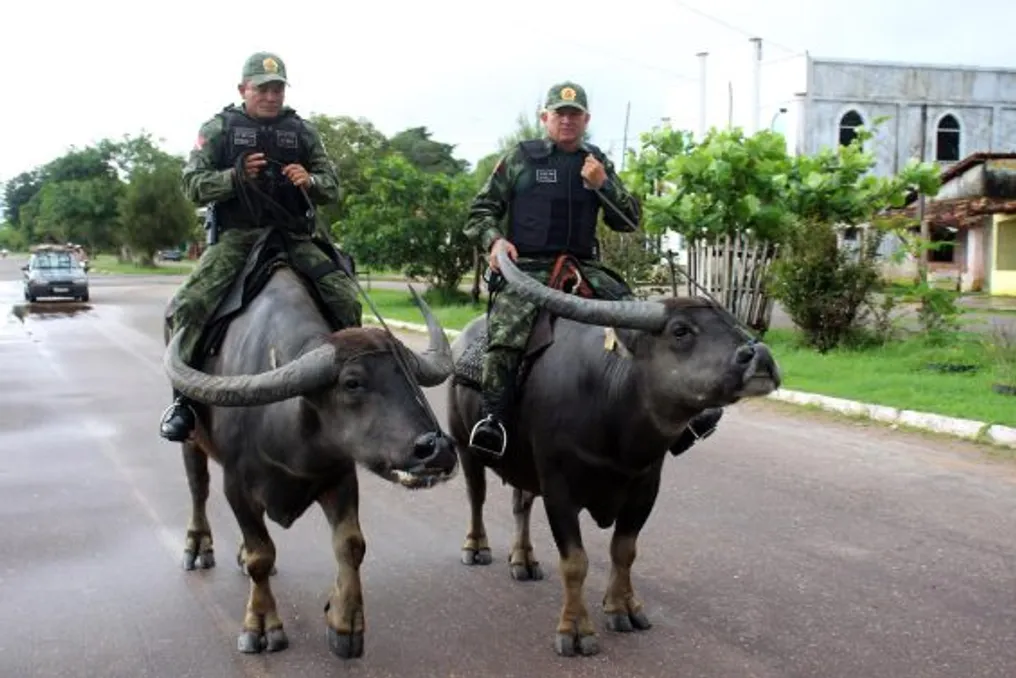
Since 1992, the Military Police of Pará has employed buffaloes as transportation for patrolling and visible policing. A sergeant told The Wall Street Journal that this initial decision was motivated by the low cost, as the corporation only had one Kombi at the time. Buffaloes represented the most economical way to reach swampy and flooded areas, common in Marajó during the rainy season.
For a buffalo to fulfill its civic function alongside police officers, it requires rigorous training that begins when it is a calf. Handlers report that it can take up to a year for the animal to be domesticated enough to accept riding, in addition to being very attached to their caretakers.
Because of this, the police officers who work with the buffaloes are residents of the island. They mention that while horseback riding helps, there are important distinctions between the species. In the case of buffaloes, the saddles are specific, and the reins are attached directly to the ring piercing the animal's septum.
Considering their large size, the buffalo generally moves at a speed of about 6 km/h, covering between 10 and 20 km daily in working conditions, according to data from Embrapa and Veterinary World. This capacity is more than sufficient, especially in swamps where motorcycles and horses could not advance.
It is no coincidence that the buffaloes of Marajó operate mainly outside urban areas. According to police reports, they are particularly useful in combating cattle rustling, which is more frequent in isolated rural regions.
The aptitude of these animals for swimming and crossing obstacles was a factor that led Marajoara breeders to encourage the reproduction of this invasive species instead of trying to combat it.
Despite the appreciation and folklore associated with the animals, technology has transformed buffalo patrolling into a practice of cultural preservation, recognized by certain bodies. The pair Baratinha and Canária, for example, receives tourists arriving on the island every morning.
Although it seems like a small number, this pair represents a significant portion of the fleet; records vary, but generally point to about five buffaloes currently in use by the Military Police. This number is half of what there was fifteen years ago. Other animals remain on more distant farms, aiming for a faster response to incidents in the rural area, according to The Wall Street Journal.
In parallel, the Military Police, which operated with only one Kombi in 1990, is now better equipped. Regional Policing Command XI, responsible for the buffaloes, received three Renault Dusters and 20 Toyota Hiluxes in 2024, vehicles prepared for ideal off-road terrain for the region.
However, the replacement of buffaloes is mainly being done by drones from the modern geo-referenced Rural Patrol, implemented by CPR XI in early 2025. In this program, each rural property is registered with GPS coordinates and monitored by a central station. In emergencies, the drone is the first to arrive at the scene, offering a privileged view of the occurrence, with a special focus on cattle theft and other buffaloes.
Colonel Augusto Guimarães, then commander of CPR XI, stated that 'Our police officers needed this specific knowledge to be able to give a better response in preventive and reactive missions. With the use of drones, we will have more control over urban, rural, and fluvial areas' during the course that trained the police in the use of the new technology the previous year.