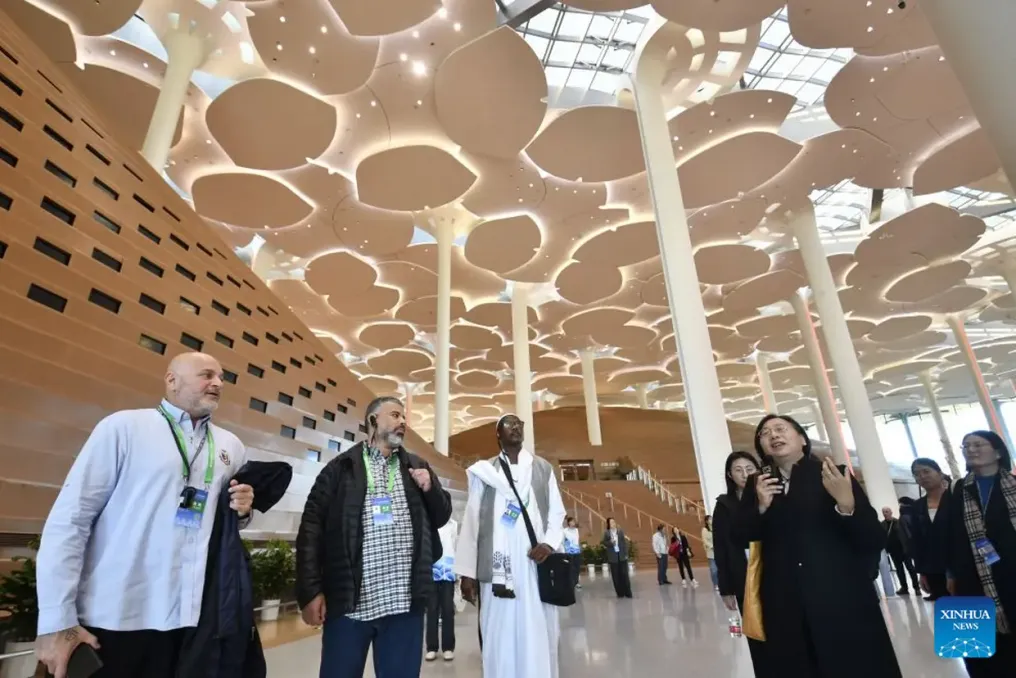
Participants of the seventh World Media Summit, held in Beijing from November 5 to 9, 2026, took an excursion to three significant cultural attractions in the Chinese capital: the 798 Art Zone, the Beijing Library, and the Grand Canal Museum.
This summit was jointly organized by Xinhua News Agency and the Municipal Government of Beijing. The event gathered about 500 delegates representing nearly 330 media organizations, think tanks, government agencies, and other structures. The main theme of the conference was 'Media in the Age of AI: From Consensus to Action.'
First Stop: 798 Art Zone
The first stop on the route was the 798 Art Zone, located in Beijing's Chaoyang District. This cultural cluster covers an area of approximately 300,000 square meters and is situated on the site of the former 718 joint venture complex, which specialized in electronics manufacturing. Industrial buildings designed in the Bauhaus architectural style now function as art galleries, studios, cafes, and designer shops. The zone hosts about 500 galleries, studios, and cultural venues; entry to the territory is free, although tickets or pre-registration may be required for individual exhibitions.
Visit to the Beijing Library
Next, the delegates visited the Beijing Library, also known as the 'Forest Library.' The building spans about 75,000 square meters and is constructed under a wide roof resembling ginkgo leaves. The library houses eight million books and can accommodate around 2,400 visitors simultaneously. The central area, equipped with terraces and bookshelves, is designed to allow readers to spend extended periods there.
Program Concludes at the Grand Canal Museum
The program concluded with a visit to the Grand Canal Museum, located in the Tongzhou District. The museum's permanent exhibition features over a thousand historical artifacts and works of art, divided into eight chronological sections. The museum complex covers approximately 99,700 square meters and includes a 270-meter-long water street. The exhibition explores the role of the Grand Canal in the development of Beijing, including the transportation of grain and goods, the movement of people, and cultural exchange. The waterway is presented not only as transport infrastructure but also as one of the factors that contributed to the city's development as a capital. Thus, the tour allowed delegates to familiarize themselves with various aspects of Beijing: from the transformation of a former industrial zone into a modern art center to the development of public infrastructure and the historical heritage of the Grand Canal.