Bowler unexpectedly featured after injury in India vs New Zealand match
Read more
Aaj Tak
www.aajtak.in

Bowler unexpectedly featured after injury in India vs New Zealand match

In the second game of the five-match ODI series between India and New Zealand, held on Saturday, November 7th, at Henry Stadium in Wellington, the hosts New Zealand suffered a significant blow.

Fast bowler Blair Tickner sustained a head injury and consequently could not bowl for New Zealand. Fast bowler Matthew Fisher was included in the starting eleven as a replacement for the concussion.

The right-arm fast bowler Fisher seized this opportunity and sent Axar Patel to the stands in his very first over. In the 41st over, Indian fast bowler Anshul Kamboj bowled a bouncer that hit Tickner's head. Despite the injury, he continued to play but lost two personal runs in the same over, and New Zealand's innings concluded with a score of 134 runs.

After a medical examination, he was advised not to bowl in the second match. Matthew Fisher debuted in an ODI against the West Indies in July. This was his first experience playing international cricket in this format in New Zealand.

Fisher attracted the attention of New Zealand coach Rob Walter with his pace when he was the team's net bowler before the tour of Zimbabwe last year. Following this, he was given a spot in the national team. The Indian team demonstrated impressive performance throughout the five-match ODI series; in the first match played in Auckland, the Indians won by Duckworth-Lewis method. Two Test matches will also take place between the teams after the conclusion of the ODI series.

Similar stories

Captain Shubman Gill drops an easy ball from Daryl Mitchell; Kel Rahul's reaction causes surprise
Read more
www.aajtak.in

Captain Shubman Gill drops an easy ball from Daryl Mitchell; Kel Rahul's reaction causes surprise

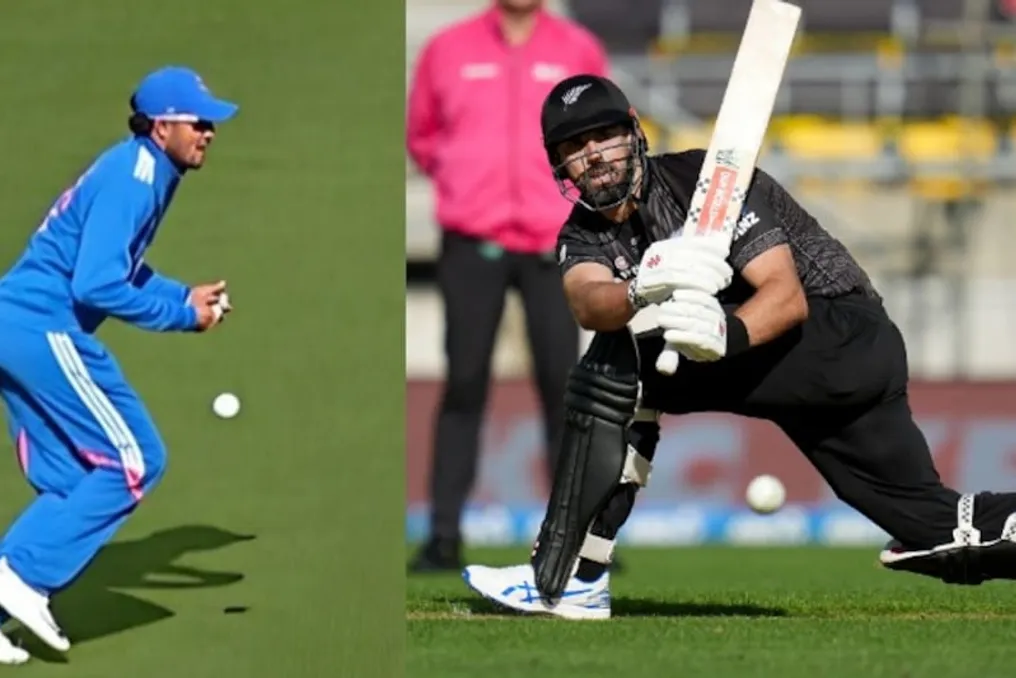
During the second ODI match between India and New Zealand in Wellington, Indian captain Shubman Gill made a highly unexpected error on the field.

Video of this incident is quickly spreading across social media and sparking widespread discussion. This happened in the 17th over of the New Zealand team's innings. Kiwi player Daryl Mitchell was in good form. He attempted to hit a powerful outside edge shot at the ball bowled by Anshul Kamboj from behind the line.

The ball struck the top part of the bat and flew towards the off-field. After the shot, Mitchell himself decided he was out of play and started heading towards the dressing room. Indian captain Shubman Gill had enough time to catch this ball. Gill tried to take the ball with both hands but failed to catch this simple delivery.

After the captain dropped the ball, wicketkeeper Kel Rahul and other players were stunned. Kel Rahul's expression while watching the event from the west end of the wicket was striking.

On the field in Wellington, the Indian bowlers once again demonstrated a brilliant start. In the 20th over, young bowler Gurunur Bhadar delivered two serious wickets. He first got Tom Latham (7 runs) caught by Naman Dira, and on the last ball of that over, dismissed Anshul Kamboj caught by Anshul Kamboj, preventing him from scoring a single run.

After 20 overs, New Zealand's score was only 53 runs for the loss of five wickets. Nevertheless, after this, Daryl Mitchell and Mitchell Santner tried to stabilize the game. Mitchell Santner was dismissed after scoring 31 runs off 38 balls.

Mohammad Kaif criticized the Indian team's composition after the loss to New Zealand, questioning the team's tactics
Read more
www.aajtak.in

Mohammad Kaif criticized the Indian team's composition after the loss to New Zealand, questioning the team's tactics

Despite the Indian team winning the T20 series against New Zealand, they faced a significant defeat in the fourth match. During this game, the Indian bowlers came under heavy criticism, raising questions about the quality of their play.

Former Indian cricketer Mohammad Kaif expressed his dissatisfaction with the team's performance, posing sharp questions. He noted that the team wins matches solely due to a powerful batting attack, while the bowling condition remains extremely weak. Kaif also sharply criticized the team management's player selection policy, calling it a bad habit.

Discussing the situation with Vaibhavi Suryavanshi, Kaif harshly criticized the management. He pointed out that although the team claims to support new players, Vaibhavi was still left out of the starting lineup even after the series was effectively over. Kaif raised the question of why the young player was not given another chance when Ishan Kishan was not fully fit and only played as a wicketkeeper. Such constant exclusion jeopardizes the confidence of this future superstar.

Commenting on the bowlers' performance on the New Zealand pitches, Kaif stated that fast bowlers are under immense pressure, and the economy rate of all bowlers is low. Meanwhile, spinners such as Varun Chakravarthy and Kuldeep Yadav are on the bench and capable of taking wickets, but they are not given opportunities to play. Kaif ironically asked why spinners like Varun Chakravarthy are kept out when fast bowlers constantly concede runs, and this is done merely to ensure there are players up to the eighth spot in the squad. He warned that if this trend continues, the weakness in bowling could turn into serious problems in the future, even if the series is won.

How India will cope with the crisis: problems in attack and inefficiency in defense
Read more
www.aajtak.in

How India will cope with the crisis: problems in attack and inefficiency in defense

The Indian team, which had previously won a series by winning three consecutive T20 matches against New Zealand, suffered a crushing defeat in the fourth match. On home soil, at Eden Park in Auckland, the hosts posted a substantial score of 259/7, while the Indian squad managed only 172/9 in 20 overs. Consequently, New Zealand won this match by a margin of 87 runs, taking the series lead to 3-1.

This loss once again highlighted two significant weaknesses of the Indian team: firstly, the loss of batsmen due to excessive aggression in attack, and secondly, the inability to stop opponents in bowling. India's aggressive playing style has always been its strength, but the question arises as to how appropriate it is to play in such a style under all circumstances. Furthermore, what should the captain and coach do when their players cannot stop the runners or take wickets?

Gautam Gambhir and captain Shreyas Iyer now face the task of finding a way out of this difficult situation while maintaining their aggressive approach to the game.

India's new style of play is based on aggressive cricket. The strategy of hitting powerful shots from the start of the over-rock and putting pressure on the opposition bowlers has brought India many brilliant victories. Players like Abhishek Sharma, Sanju Samson, Ishan Kishan, and Vaibhav Suryavanshi play according to this philosophy. Vaibhav demonstrated this idea already in the third T20, scoring 45 runs in just 19 balls.

However, in the fourth match, this same aggression became a problem. Aiming for a target of 260 runs, the team needed a quick start, but Sanju Samson and Ishan Kishan departed in the very first over. Abhishek Sharma scored 27 runs off 15 balls but was also dismissed during the powerplay. Captain Shreyas Iyer managed 22 runs off 11 balls. India lost four batsmen in the powerplay and six before the tenth over concluded.

Under such conditions, the batsmen should have stayed on the field for some time to stabilize the innings. Nevertheless, the Indian batsmen continued to lose wickets while trying to increase the tempo. Tilak Verma fought, scoring 35 runs, and Naman Dir scored 28, but by then the match was far from being under India's control. In the end, the entire team managed to score only 172/9.

Abhishek Sharma's role in India's attack has become extremely important. He starts the innings by attacking the bowlers and has the potential to change the course of the match in the powerplay. But the question remains: what is the team's plan if Abhishek gets out quickly? This is exactly what happened in the fourth T20: Abhishek was dismissed with 27 runs, and after him, no one could play a big innings. Sanju and Ishan were gone in the first over, and Shreyas Iyer was also dismissed in the powerplay. This increased the pressure on the middle order, but they failed to stabilize the innings.

India needs to determine that aggressive cricket does not just mean hitting powerful shots off every ball. Managing the innings after early setbacks, building partnerships, and then increasing the pace in the final overs are also part of T20 cricket. The team must develop a strategy for its batsmen that allows them to return to the game even after early difficulties.

India's problems are not limited to aggressive batting. Constant changes and experiments in the batting order also raise questions. Akshar Patel was sent to the fifth position, while Tilak Verma came in at seventh. What was the reason for sending a batsman like Tilak to the lower order? Does the team management see him as a finisher, or is it simply a change in batting order that disrupts his natural role? Although the team might have had a certain strategy by batting Akshar higher, such experiments in batting order are ineffective when early batsmen get out quickly. Akshar is a useful batsman, but was he the best option in such a situation compared to Tilak? The team should also pay attention to whether constant changes affect the role and responsibility of the batsmen.

Among the aggressive options, such as Vaibhav Suryavanshi, Abhishek Sharma, Sanju Samson, and Ishan Kishan, there is an issue of securing a spot in the top order. At the same time, the middle order also looks unstable. Gambhir and Shreyas must decide who will bat at which position and under what circumstances each batsman will be sent in. Experiments are necessary, but their goal should be to strengthen the team, not to create confusion among the batsmen regarding their roles.

India's concerns are not limited to batting. Bowling is also under constant scrutiny. In Auckland, New Zealand scored 259/7 in 20 overs. This was the highest score any team had ever posted against India in T20 International. Indian bowlers took some wickets early on, but they completely failed to stop the New Zealand batsmen in the middle overs. New Zealand's start was also not very good.

Popular