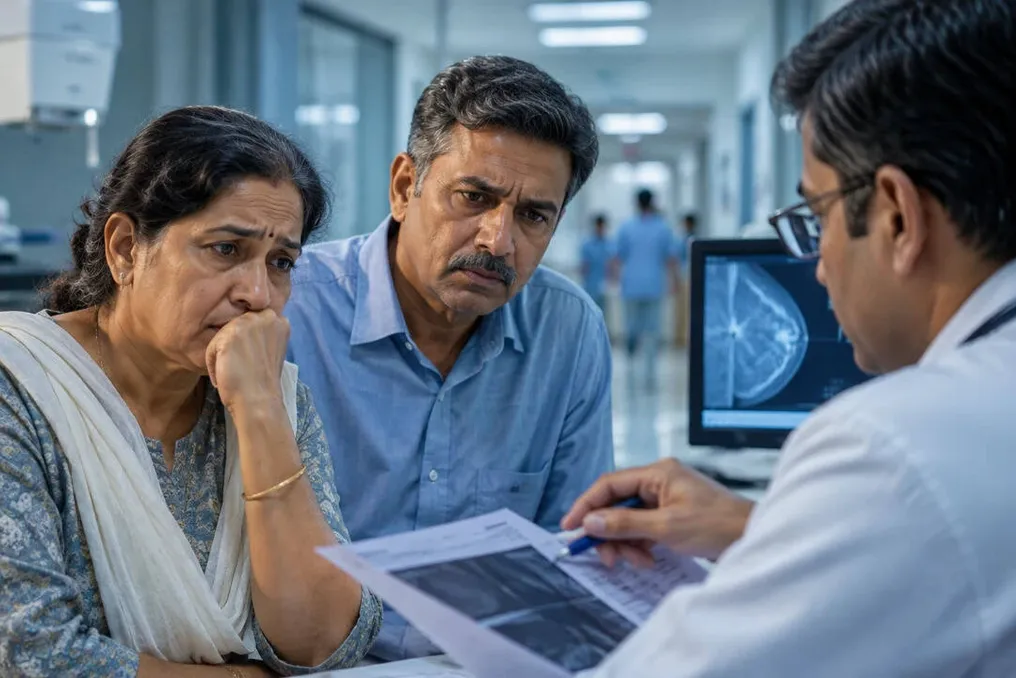
Cancer in India is frequently detected at advanced stages, meaning the disease has progressed by the time of diagnosis. At these stages, treatment becomes more complex, and survival chances decrease. This is partly attributed to how screening is organized in the country and partly to how the population responds to early signs of illness.
The stakes in this situation are very high. According to estimates from the National Cancer Registry Programme of the Indian Council of Medical Research, 13.92 lakh new cases of cancer were registered in India in 2020, compared to 13.25 lakh in 2018. Furthermore, around 7.7 lakh cancer deaths were recorded in 2020, according to data presented to the Lok Sabha by the Ministry of Health and Family Welfare. This raises the question of how many of these cases could have been detected earlier.
India has a government screening program, although the habit of using it has not yet formed. The National Programme for Prevention and Control of Cancer, Diabetes, Cardiovascular Diseases and Stroke, now known as the National Programme for Prevention and Control of Non-Communicable Diseases (NP-NCD), was launched in 2010 in 100 districts across 21 states. In 2016, population-based screening was added for all individuals aged 30 and above. This program covers hypertension, diabetes, and three types of cancer: oral cavity, cervical, and breast cancer.
The concept of the program aims to bring screening closer to the people. As per the directives of the Ministry of Health, an ASHA worker conducts screening based on community surveys. Then, people aged 30 to 65 are offered an oral cavity visual examination, and women are offered a clinical breast examination and a visual inspection of the cervix using acetic acid. Each of these examinations should be repeated every five years.
According to the ministry's training module for nurses, in a population of 1000 people, approximately 370 people are eligible for oral cancer screening, and about 182 women are eligible for breast and cervical cancer screening. Initial cervical cancer testing is conducted at the primary healthcare level.
National survey results revealed low participation. The Fifth National Family Health Survey, conducted between 2019 and 2021, found out whether adults aged 30 to 49 had undergone any cancer screenings. Among women, 1.9 percent reported having had a cervical cancer test, 0.9 percent reported having had a breast examination, and 0.9 percent reported having had an oral cavity examination. Among men, 1.2 percent reported having had an oral cancer examination.
Significant variation was observed between states. Tamil Nadu demonstrated the highest rates of cervical and breast cancer screening—9.8 percent and 5.6 percent, respectively. In Gujarat, Assam, and West Bengal, the cervical cancer screening rate was only 0.2 percent, and in at least half of the states and union territories, less than one percent of women had ever undergone this screening.
Dr. Prasad explains the problem through two aspects: India lacks a mandatory screening program, and patients often ignore early symptoms, leading to diagnosis only when the disease is at an advanced stage. The Ministry of Health's operational plan for cancer screening in 2016 confirms this view. It points out that cancer in India tends to be detected late, leaving little opportunity for effective treatment, and leads to five-year survival rates for early-stage oral, breast, and cervical cancers of 60.2%, 76.3%, and 73.2%, respectively, versus 3.3%, 14.9%, and 7.9% at advanced stages. These figures are based on a 2010 population study.
The framework also emphasizes that screening itself is not the ultimate goal. It requires guaranteed treatment, regular follow-up monitoring, and linkages between all levels of healthcare so that a person with a positive result can undergo confirmation and receive treatment.
Dr. Prasad presented his recommendations, which differ from the public program's suggestions, dividing them into groups. According to his recommendations, women should start breast cancer screening at age 40. Sexually active women are advised to get screened from age 21, primarily for cervical cancer prevention. Men aged 45 to 50 can undergo Prostate Specific Antigen testing once a year. Men and women should undergo colonoscopy every 10 years after reaching the age of 50. From age 40, he stated, men and women should undergo a mandatory comprehensive medical check-up.
These two approaches differ in scope, age, and frequency. The national program's screening protocols cover three types of cancer—oral, breast, and cervical—for people aged 30 to 65 with an interval of five years; prostate and colorectal cancer are not included in this list. Although the program itself notes that breast cancer screening is much more beneficial for women over 40, the initial age is set at 30 due to programmatic and operational reasons.
Dr. Prasad also highlighted HPV vaccination for girls aged 9 to 14, which, he said, can prevent cervical cancer in women by 95–98 percent. In a speech on the federal budget in February 2024, it was announced that the government would encourage vaccination of girls in this age group.
The national HPV vaccination campaign was launched in February 2026. It offers a free, voluntary, one-time vaccine to 14-year-old girls with parental consent in government health facilities. The Ministry of Health estimates the annual cohort of 14-year-old girls at approximately 1.2 crore, citing estimates from the General Registrar of India. By September 11, 2026, the ministry reported that over 80 lakh doses had been administered. Gujarat, Uttar Pradesh, Madhya Pradesh, and Mizoram reported 100 percent coverage of target groups, while Bihar, Andhra Pradesh, and Assam exceeded 90 percent. Uttar Pradesh vaccinated over 22 lakh girls, which is the highest figure among all states.
When asked what prevents people from getting screened—cost, fear, lack of awareness, or access—Dr. Prasad replied that the main reason is lack of awareness, as well as the belief that nothing will happen to them. He stated, 'Anything can happen to anyone at any time.' The Ministry of Health shares a similar view. It argues that due to low health awareness, screening for asymptomatic conditions is viewed as unnecessary, especially among the poor, for whom one day spent at a secondary or tertiary facility can mean losing a day's wages. Regarding treatment costs, the Ministry of Health informed Parliament that medical care in government hospitals is either free or heavily subsidized for the needy.
In Dr. Prasad's opinion, in cities, accessibility and availability of services are abundant, and a person with symptoms can receive oncological help. However, the best cancer care may be absent in second and third-tier cities, although screening is available in almost all government colleges and hospitals. The advantage of first-tier cities lies in awareness, as their residents have easier access to screening information.
The state cancer care network is intended to bridge the remaining gap. Under the central government scheme to strengthen tertiary cancer care, 19 government cancer institutes and 20 tertiary cancer care centers have been approved. Expenses are shared between the center and states in a ratio of 60:40, and 90:10 for northeastern and hilly states, according to a response in the Rajya Sabha. In the Federal Budget for 2025–26, the Finance Minister stated that the government will facilitate the creation of cancer day care centers in all district hospitals within three years, with 200 such centers planned for 2025–26.
If asked about the single change that would bring the most benefit, Dr. Prasad suggested introducing mandatory annual or bi-annual medical check-ups for everyone working in the public and private sectors. He expects the benefit to extend to employees' families, as many of them will also undergo examinations. Compared to the national screening programs, which are conducted every five years, his proposal is significantly different.
In conclusion, all necessary elements are in place: the government program offers screening for three types of cancer for people aged 30 to 65, the vaccination campaign covers 14-year-old girls through government institutions, and the budget provides for the creation of cancer day care centers in district hospitals. However, the 2019–21 survey shows a gap between the offered services and the actual level of utilization, with fewer than two out of every hundred women aged 30 to 49 ever having been screened for cervical cancer. Dr. Prasad attributes this discrepancy to a simple reason: people do not believe something like this can happen to them.