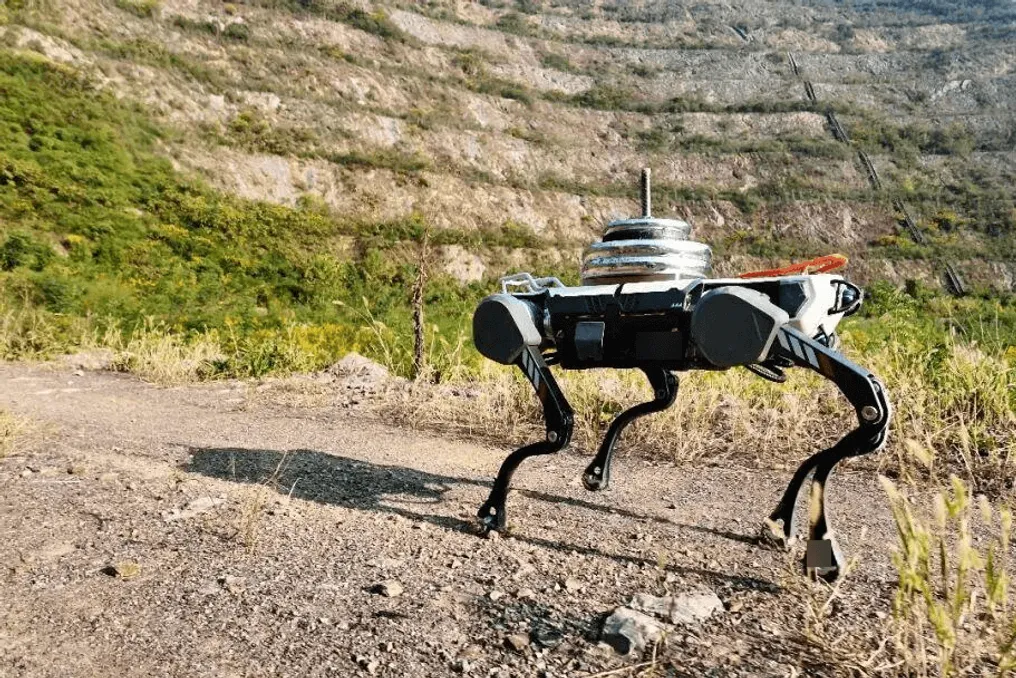
DEEP Robotics unveiled quadruped robot X50 with a claimed payload capacity of 50 kilograms
Read more
Pandaily
pandaily.com

DEEP Robotics unveiled quadruped robot X50 with a claimed payload capacity of 50 kilograms

DEEP Robotics has released the X50 model, a heavy-duty quadruped robot designed for inspections in the energy sector, emergency response, and firefighting. Chinese reports published on November 6 and 7 describe the robot as being engineered to traverse complex terrain, rather than merely serving as a demonstration platform.

According to a Chinese report republished by the 21st Century Business Herald, the company claims that the X50 is capable of carrying a 50-kilogram load while moving at a speed of three meters per second over a distance exceeding two kilometers. Furthermore, this increase in payload did not necessitate an increase in the chassis dimensions, although the report does not provide details on the robot's size or weight when unloaded.

These specifications combine payload, speed, and distance into a single stated operational mode. It is important to note that this data should not be interpreted as a general indicator of battery range for any configuration of terrain or accessories. The source did not provide a third-party testing protocol, and all specifications are data provided by the company itself.

The robot utilizes a fusion of LiDAR point clouds with inertial measurement unit data and other sensors. DEEP Robotics states that reinforcement learning-based motion control uses this information to predict topography and select footholds, while responsive joints translate planned movements into physical steps.

The company also reported that the X50 can repeatedly clear platforms up to 80 centimeters high, step over stone blocks separated by 70 centimeters, and ascend open staircases. These capabilities aim to extend equipment transport and inspections beyond flat routes, including industrial ladders, pipeline structures, and uneven open areas.

A separate Chinese report circulated by Sina describes a posture control system that reacts to jolts, impacts, and uneven surfaces. In a firefighting scenario, the company claims the robot can adjust its body position to compensate for the reactive force from sprayed water and help maintain nozzle direction.

Potential payloads include hydraulic tools, electrical testing equipment, rescue gear, and medical supplies. These items represent potential use cases, not proof of completed deployments of the new model. The mentioned reports do not disclose the price or delivery schedule for the X50. This model complements the company's line of industrial quadruped robots previously used for inspection work at manufacturing sites.


Similar stories

NASA presents the X-70 Fractal, a new experimental aircraft for advanced testing
Read more
olhardigital.com.br

NASA presents the X-70 Fractal, a new experimental aircraft for advanced testing

NASA unveiled the X-70 Fractal, its latest experimental aircraft, during the UP.Summit event held at the Kennedy Space Center in Florida.

This manned aircraft was designed as a versatile platform intended to accelerate both the development and testing of cutting-edge aerospace technologies. The X-70 features a flight control system that can be rapidly reconfigured, allowing NASA to investigate aircraft maneuverability in scenarios not yet proven in manned flights.

The aircraft structure supports up to 907 kg (equivalent to 2,000 pounds) of experimental equipment, which can be installed both internally and externally. With a takeoff weight of 4,535 kg (10,000 pounds), the model is designed to operate at a cruising speed of Mach 0.75, which corresponds to 75% of the speed of sound.

Furthermore, the X-70 has the capacity to reach altitudes of up to 45,000 feet (approximately 13,700 meters) and possesses an operational range exceeding 2,777 km (1,500 nautical miles).

Jared Isaacman, NASA administrator, emphasized the relevance of this platform for the agency's experiments. He noted that the modular design will allow for the agile replacement of internal and external payloads, simplifying the execution of various types of tests.

Isaacman stated: 'The X-70 Fractal gives NASA a high-performance manned platform to test advanced flight control, maneuverability, and other cutting-edge technologies in real flight.' The first flight of the aircraft under NASA's banner is expected within the next two years.

The X-70 fits into the long history of NASA's experimental aircraft, known as X-planes, which are used to advance aviation technology. This trajectory encompasses models that have defined distinct phases of aeronautical research.

Laurie Grindle, director of the Aeronautics Division at NASA's Research and Technology Mission Directorate, expressed enthusiasm for the arrival of this new model, viewing it as an opportunity to intensify the agency's work. She commented: 'It is exciting to bring another X-plane to accelerate and drive aeronautical research.'

Xbox will raffle off a customized alligator replica of the Series X in the United States
Read more
tecnoblog.net

Xbox will raffle off a customized alligator replica of the Series X in the United States

Microsoft innovated in console customization by creating a fully functional Xbox Series X embedded within an alligator sculpture approximately 1.5 meters long. This exclusive item, named Xbox Series X-BITE, will be offered in a giveaway hosted by Microsoft in the United States.

The unique piece was developed by John Nolan Studio, a company specializing in practical effects for film and television. Additionally, the set includes a customized controller featuring bite marks.

This promotional initiative takes place a few weeks before the release of GTA 6, referencing the alligator, an animal prominent in Florida. This state serves as inspiration for the Leonida region, where the city of Vice City, the setting of the new game, is located. Alligators have already been incorporated into various game promotional materials and are expected to appear in the fauna during gameplay.

John Nolan Studio is a renowned British company for its practical effects, having collaborated on productions such as The Witcher and the Harry Potter series currently being produced by HBO. The specific alligator used in this project was custom-built to accommodate the console.

The sculpture was designed to simulate the scene where the animal would have swallowed an Xbox Series X. The console hardware is integrated into the statue's body, and the illuminated Xbox logo button is visible through the scales.

The controller also integrates the playful concept; Microsoft manufactured an Xbox Wireless Controller with bite marks, positioned between the sculpture's teeth. The eyes of the replica were detailed with elements inspired by the brand's visual identity, including pupils in the iconic Xbox symbol.

Although it has an unusual appearance, the Series X-BITE functions as an operational console. However, Microsoft treats this project primarily as a collector's and display piece. PlayStation also develops special editions related to the next Grand Theft Auto, albeit without a concept as elaborate as this one. The Japanese company's console has already received a themed controller in the game's colors.

Microsoft produced only one unit of this model and has started a raffle to determine the owner. The promotion will run from November 3 to November 10, 2026, but it is not available to residents of Brazil. Similar to the GTA 6 collector's edition, it is restricted to US residents aged 18 or older.

To participate, US residents must follow the official Xbox account on X, Instagram, or TikTok, repost the campaign announcement, and use the hashtag #XbitSweepstakes. It is mandatory that the profile used remains public for participation to be validated. After the draw, the winner will have 48 hours to contact Microsoft and claim the prize; if there is no response within this period, the company may choose another participant.

XHEART Company Releases X7 Ultra Chip with 700 TOPS Performance and Plans X9 for 2027
Read more
pandaily.com

XHEART Company Releases X7 Ultra Chip with 700 TOPS Performance and Plans X9 for 2027

The automotive chip company XHEART, established as part of the Momenta chip program, unveiled its X7 Ultra chip on October 29. The company positions this chip as a solution specifically designed to work with large control models, estimating its computational power for such tasks at 700 TOPS.

The head of XHEART noted that the development began with the observation that driver assistance software is shifting from numerous small models to a single, comprehensive large model, which requires corresponding chip adaptation. When the company was founded in 2023, the decision was made to work in reverse, starting from the models actually used in vehicles, and organizing computation, memory, and data movement around them, leaving room for future models.

The X7 Ultra is equipped with a very large NPU core. XHEART claims that data transfer within a single core occurs orders of magnitude faster, reaching terabytes per second, compared to data transfer between cores. A multi-level cache, designed for high throughput and parallelism, aims to reduce inference latency and power consumption. A specialized operator engine accelerates key Transformer operations, such as LayerNorm, Softmax, and Transpose, and also supports FP16 and FP32 vector mathematics to maintain model accuracy.

According to the company's data, production models running on the chip meet benchmark results with 99.99 percent accuracy, and compute utilization reaches 98.7 percent. Compared to products the company calls industry flagships, XHEART states an 80 percent reduction in memory bandwidth consumption and a doubling of energy efficiency. These figures are presented by the company itself and have not undergone independent testing.

The chip also includes, according to XHEART, China's first mass-produced automotive Armv9 processor, which demonstrates 20 percent higher performance and 10 percent better energy efficiency. The architecture with a large cluster improves the coordination of multi-core processors and access to L3 memory, while the new SVE2 vector engine provides higher signal processing performance compared to the previous generation NEON.

XHEART also demonstrated its next chip. The X9 model targets 3000 TOPS for large model computations and 700 GB/s memory bandwidth per chip, with its release planned for 2027. It will be developed jointly with next-generation world-class models, synchronizing computation and memory access for efficient operation of larger models.

The company reports being in a cycle of producing one generation, developing the next, and researching a third. Two years have passed from its founding until mass production. The first X7 chip was operational within 24 hours of returning from the factory, and on the 17th day, the chip, low-level software, and control model were working together in a full vehicle.

Popular