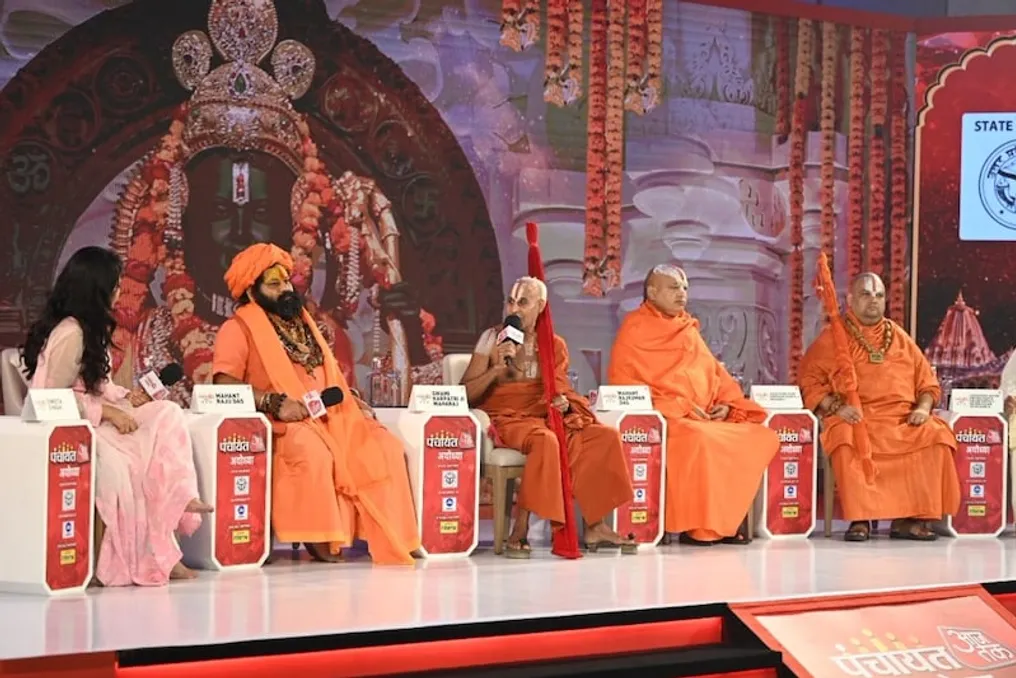
During a special session titled 'How has Ayodhya changed?' on the 'Panchayat Aajtak Ayodhya' platform, leading spiritual figures of the Sanatan society discussed issues related to Sanatana culture, the development of Ram Mandir, security measures, and donations.
The event was attended by respected spiritual leaders such as Mahant Raju Das from Hanuman Garhi, Swami Karpati Tri Maharaj, and Jagadguru Ramdinesacharya, along with other dhermacharis. The clergy openly spoke about the transformation of Sanatana culture, the movement for Ram Mandir, and the changing face of Ayodhya.
Mahant Raju Das and other dhermacharis noted that significant changes have occurred in Uttar Pradesh since 2017, both in development and in the administrative system. Regarding an alleged theft at Ram Mandir, the clergy asserted that no theft took place, but rather there were issues related to banking operations. Speaking about the changes in Ayodhya, they emphasized that previously followers of Rama faced numerous restrictions and difficulties, but the situation has now changed.
The clergy highly praised the governance model of Mukhyamantri Yogi Adityanath, noting that he has done important work in promoting peace, security, and cultural values in Uttar Pradesh. In their view, Yogi Adityanath has become an influential leader at national and global levels.
In the 'Panchayat Aajtak' program, the spiritual leaders recalled the struggle and dedication of the Sanatan society, the National Volunteer Corps (RSS), the Vishva Hindu Parishad (VHP), and the followers of Rama who stood behind the construction of the magnificent Shri Ram Mandir. Mahant Raju Das and other dhermacharis pointed out that the journey from the 1980s to the construction of Ram Mandir was a testament to long efforts, sacrifices, and self-sacrifice. Recalling the past, they said that at one time, it was difficult even for Rama's followers to utter Rama's name or participate in religious events.
Raju Das stated that the vow, 'We will accept the bullets and the hail, but we will build the temple right here,' has been realized in the magnificent and divine Shri Ram Mandir. He mentioned the events of October 30 and November 2, 1990, paying tribute to the followers of Rama who sacrificed their lives during the Ram Mandir movement. He also recalled the events on Digambar Akhada street and urged everyone to always remember the sacrifices of the unarmed followers of Rama, calling for this memory to be spread worldwide.
On the 'Panchayat Aajtak' stage, Jagadguru Ramdinesacharya and other saints discussed the mythological and religious significance of Ayodhya. They emphasized that Ayodhya is not just a city or a piece of land, but a central hub of Indian civilization and Sanatana culture, which transmits a message of humanity and religion to the world. The clergy mentioned religious beliefs, stating that in ancient times, Maharaja Vikramaditya contributed to the revival of ancient religious sites and shrines in Ayodhya. According to him, 196 sacred places in Ayodhya were identified at that time.
The clergy noted that similar to the revival in antiquity, modern Ayodhya has received a new impetus for development and renaissance since 2017. They mentioned the religious beliefs of Namisharani and Makhabhumi (Mahaudham in Basti), pointing to the special connection of these sacred places with the advent of Lord Rama and the tradition of Ramayana. In the opinion of the saints, Ayodhya is once again moving towards its ancient and spiritual form today.
Regarding employment, trade, and tourism in Ayodhya, the clergy stated that the construction of Shri Ram Mandir and events like Dipotsav have given a new boost to the local economy. Jagadguru Ramdinesacharya noted that millions of pilgrims arrive in Ayodhya from various countries. They come not only to see the infrastructure and modern amenities but also to witness the birthplace of Lord Rama and express their faith in this holy land.
According to the saints, the growing number of pilgrims has led to an increase in local business, hospitality, transport, and other employment opportunities, bringing positive changes to the lives and economic activities of the residents of Ayodhya. They added that the development of Ayodhya is not limited only to physical amenities; its spiritual significance is also growing globally.
During the event, the Sanatan society highlighted the religious and cultural significance of Awadh, recalling verses by Goswami Tulsidas. Jagadguru Kripalu Ram Bhushan Devacharya said that thanks to the blessings of mothers and saints, the construction of Shri Ram Mandir became possible in Awadh. He emphasized that today's movement of Ayodhya towards realizing the concept of Rajya Rama is the result of the collective resolve of the mothers and the society of saints of Awadh. The clergy concluded that those who detach themselves from material attachments and dedicate themselves to the nation and religion are guiding society in the right direction. Today's changing face of Ayodhya shows the youth of the country and future generations.