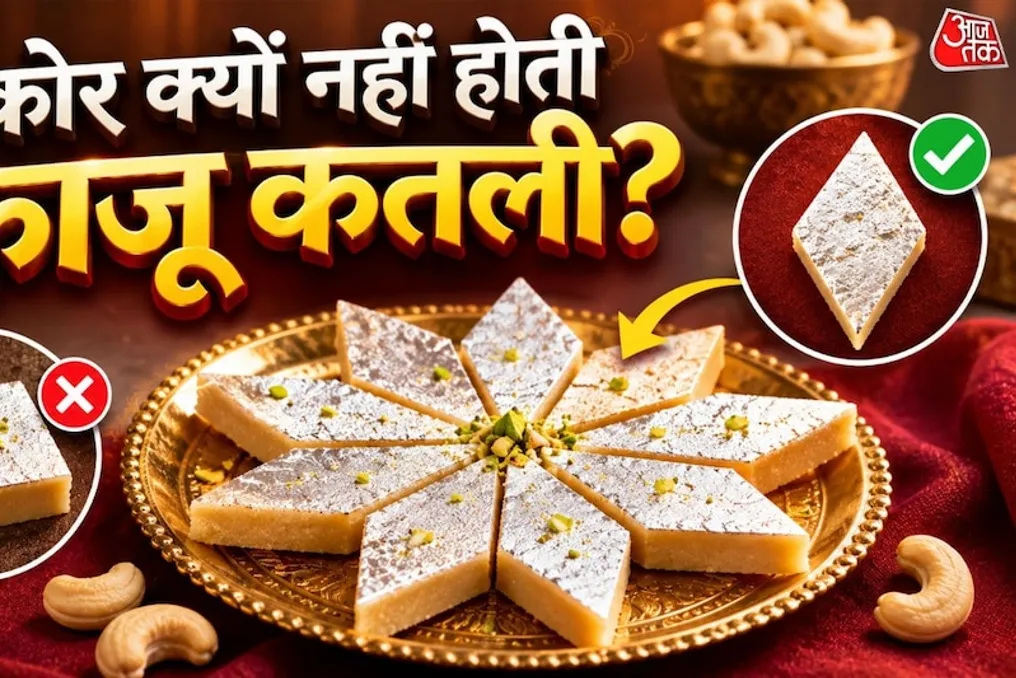
Kaju Katli is very popular and can often be found in confectionery stores during holidays, weddings, or other joyous occasions. The appeal of this delicacy lies not only in its taste but also in its characteristic shape.
Unlike other sweets such as Basan Ki Barfi, Nargil Ki Barfi, and Dudh Ki Barfi, which usually have a square or rectangular shape, Kaju Katli is most often cut into a rhombus or diamond shape. This raises the question of whether this specific shape is related to any particular reason or if it is simply a traditional method of preparing this sweet.
To make Kaju Katli, cashews are first ground into a fine powder. Then, a sugar syrup is prepared in another vessel by mixing sugar and a little water. When the syrup reaches the desired consistency, the cashew powder is added to it. The mixture is cooked while stirring constantly so that the cashews and syrup are evenly combined. After the mixture thickens and acquires a dough-like consistency, it is removed from the heat. After cooling slightly, the dough is kneaded and rolled out thinly using a rolling pin. Then, it is left to cool until it hardens and takes on the desired texture.
The main reason for giving Kaju Katli a rhombus shape is related to the convenience of cutting and serving. When a large, thin sheet of the cashew mixture is rolled out, it is easier to cut along diagonal lines. First, a long cut is made in one direction, and then a diagonal cut is made in another. This approach allows for obtaining many identical rhombus pieces with less effort. Furthermore, all the resulting pieces look approximately the same, which is why Kaju Katli is prepared in this shape in confectioneries.
Technically, Kaju Katli can be made in a square shape, and this does not affect its taste or quality. However, the rhombus shape has become a traditional characteristic of Kaju Katli. Confectionery stores have been making it in this shape for years, and consumers are accustomed to seeing it in this form. Thus, the rhombus shape of Kaju Katli is not a secret to its taste, but rather an old and simple way of making and cutting it.