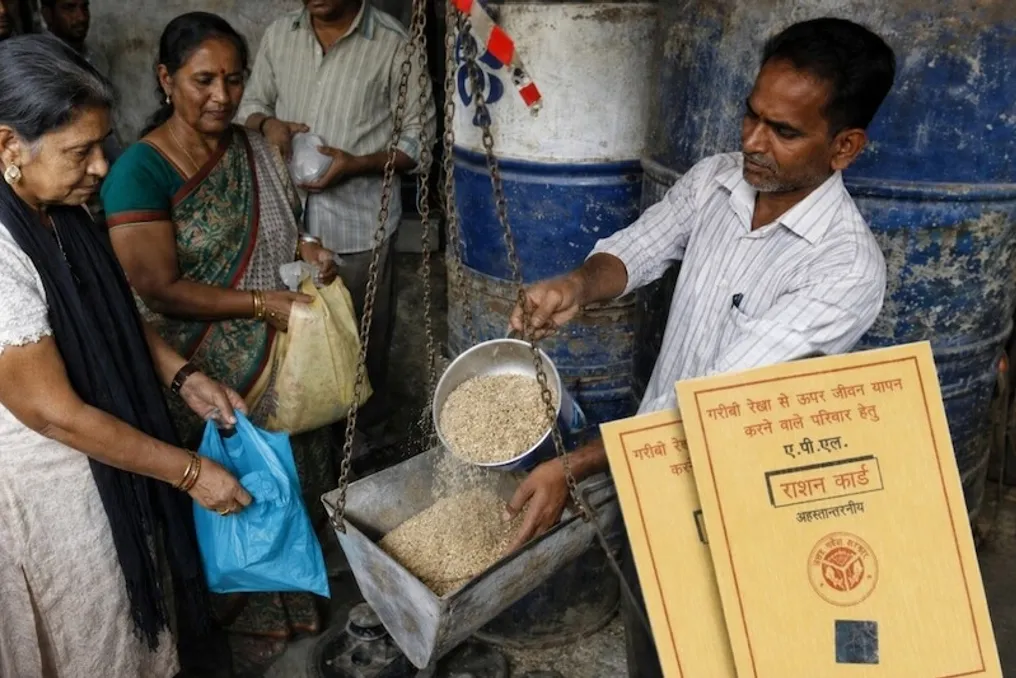
A Ration Card serves not only as a document for obtaining subsidized or free grain but also for identifying a family and providing information about its members in several government programs. For example, the 'Pratishka Shri Mahatma Undergroundji' (PMUY) program requires the presence of a card or another government document confirming the family composition. Similarly, in the 'Ayushman Bharat Pradhan Mantri Jan Arogya Yojana' (AB PM-JAY) program, the card is used for family identification, although this is not a mandatory requirement for every beneficiary.
Why is a food ration card important?
Thanks to this card, needy families receive grain at a reduced price or for free in government stores. Furthermore, it is an important document related to family members and their identities, which is used in various government initiatives to confirm family data. However, it is important to understand that the food ration card is not mandatory in all government programs; some programs accept other government documents. Therefore, before applying for any program, you must check the eligibility criteria and required documents.
Necessity of a card in the Pratishka Shri Mahatma Undergroundji program
Under the PMUY program, designed for poor families, adult women are provided with gas connection (LPG) without a deposit. To meet the program requirements, the woman must be at least 18 years old, and there should not already be an existing connection in the name of anyone in the family. In this program, the food ration card is used to confirm the composition and number of family members. If the card is unavailable, another valid document confirming the family composition issued by the state or central government may be provided.
Documents required for the PMUY program
If the current address is correctly mentioned in the Aadhaar identity card, it can be used as proof of address. If the address differs, valid proof of address must be provided. Under this program, beneficiaries eligible for a deposit-free connection are also provided with the first gas supply in a cylinder and a stove free of charge.
Is a card required in the Ayushman Bharat program?
Under the PM-JAY program, eligible families can receive treatment without payment up to ₹500,000 annually. First and foremost, it is necessary to ensure that your name is included in the government list of beneficiaries. It should be noted here that for Ayushman card application, it is not required for every person to have a food ration card. According to the National Health Authority (NHA), Aadhaar or another valid government document can be used for beneficiary identification, and for family identification—a food ration card or another valid family document.
What to prepare for the Ayushman card application
Eligibility criteria and document requirements may vary depending on the beneficiary category and the state. The Ayushman Vay Vandana Card program has been launched for all citizens over 70 years of age under AB-PMJAY, which provides them with cashless treatment up to ₹500,000. Electronic verification based on Aadhaar is required for registration in this category, and Aadhaar itself is the primary document.
How to apply for a card if you don't have one?
If you do not have a food ration card, you can apply through your state's Department of Food and Civil Supplies. Online services are available in most states. The method of application may vary slightly depending on the state.
How to check the status after an online application?
After submitting the application form for a food ration card, it is crucial to save the application reference number. With it, you can check the application status on the website of your state's Department of Food and Civil Supplies. If any deficiencies are found in the application, the department may request additional information or documents.
Who can apply for a food ration card?
In India, the right to apply for a food ration card primarily belongs to families that meet the established conditions of the respective state government or union territory. Poverty alone is not the sole criterion. Eligibility is determined based on family income, employment, financial status, and social circumstances. States determine eligible families according to the National Food Security Act (NFSA), 2013. Generally, families from these categories may be given priority...
However, belonging to any of these categories does not guarantee receiving a food ration card. You must also check the rules and eligibility conditions of the state. Before applying for a food ration card, be sure to familiarize yourself with the official eligibility conditions of your state.