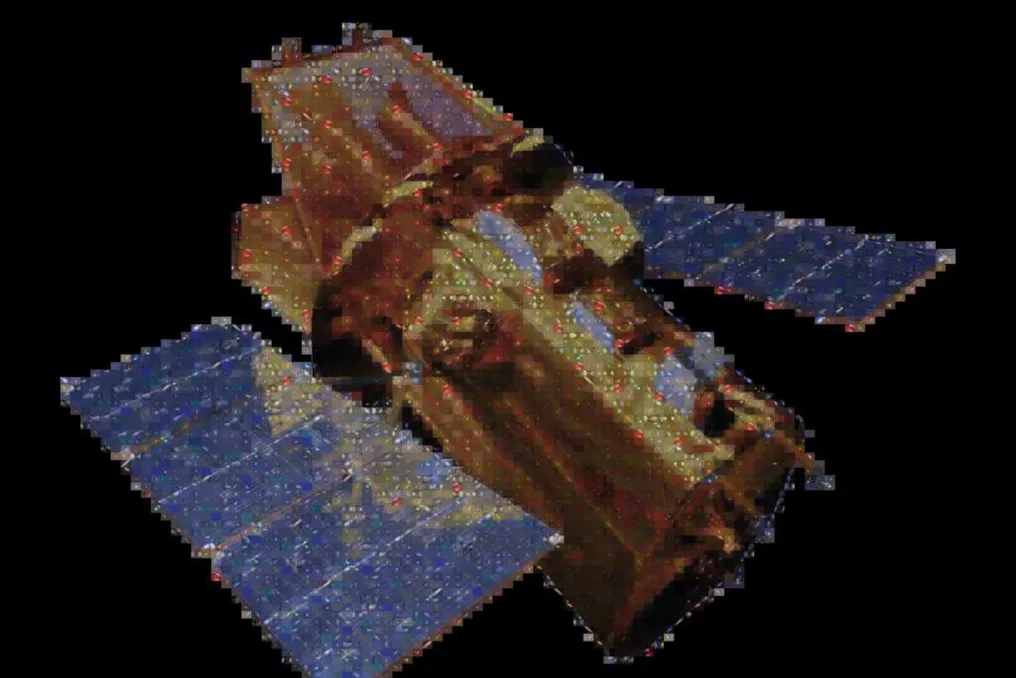
NASA releases mosaic composed of one million space images collected by Swift
Read more
Olhar Digital
olhardigital.com.br

NASA releases mosaic composed of one million space images collected by Swift

NASA has released a mosaic consisting of approximately one million photos captured by the Neil Gehrels Swift Space Observatory. This record presents a small selection from the vast amount of data generated by the equipment over almost twenty-two years of operation, offering a visual overview of its study of some of the most powerful phenomena in the Universe.

The US agency selected this image for the edition of Friday (6) of the Astronomy Picture of the Day. The mosaic was created in 2018, using some of the first photographs recorded by the Swift Ultraviolet/Optical Telescope.

This material transcends mere visual composition, representing part of the legacy of an observatory that assisted astronomers in investigating gamma-ray bursts, supernovae, black holes, and other cosmic events.

The release held additional significance because Swift concluded its mission on Wednesday (4), re-entering Earth's atmosphere after nearly two decades in space.

The mosaic was assembled from records obtained by the observatory's ultraviolet/optical telescope. This instrument had the capability to monitor celestial bodies across various wavelengths, complementing observations made by the mission's other instruments.

The composition includes a considerable number of photographs taken in the early years of Swift's operation. Each record helps delineate the scientific scope of the observatory, which analyzed different areas of the sky and tracked short-duration astronomical events.

The telescope played a crucial role in observing gamma-ray bursts, which are extremely high-energy events that can last from fractions of a second to several minutes. Such bursts are among the most intense phenomena known to astronomy, making rapid identification and subsequent observation essential to understand their causes and consequences.

The mosaic's publication occurred concurrently with the end of the mission. On Wednesday, the observatory re-entered the Earth's atmosphere over the North Sumatra area of Indonesia at 9:39 AM (Brasília time).

This re-entry resulted from the progressive loss of altitude, intensified by increased solar activity. The heating of the upper atmosphere caused it to expand, increasing drag on the satellite.

NASA attempted to extend the mission's lifespan through a rescue operation involving the company Katalyst Space. The plan involved sending a robotic spacecraft to capture the observatory and boost it into a higher orbit, but failures in the guidance system prevented the operation from succeeding.

Even inactive, Swift will remain valuable to science, as its data will remain accessible to researchers, who can explore the archive accumulated over almost twenty-two years in search of new discoveries.

The mosaic presented by NASA thus serves as a visual tribute to this journey: a collection of images symbolizing part of the work of an observatory dedicated to studying the most extreme events in the Universe.
Similar stories

NASA's Swift Space Observatory Completes Mission After 22 Years of Operation
Read more
uza.uz

NASA's Swift Space Observatory Completes Mission After 22 Years of Operation

The Swift Space Observatory from the U.S. National Aeronautics and Space Administration (NASA) has completed its mission after 22 years of productive activity.

This was reported by the Turkish news agency Anadolu.

NASA's Swift Space Telescope Returns to Earth After More Than Two Decades in Orbit
Read more
olhardigital.com.br

NASA's Swift Space Telescope Returns to Earth After More Than Two Decades in Orbit

The NASA Swift space telescope concluded its journey of more than twenty years in space this Wednesday (4). The observatory reentered the Earth's atmosphere uncontrollably, three months after a rescue attempt by a private company failed.

Officially named the Neil Gehrels Swift Observatory, the instrument was placed into orbit in November 2004 with the purpose of investigating gamma-ray bursts, considered some of the most powerful events in the Universe.

According to data reported by Space.com, the telescope crossed the atmosphere at 9:39 AM (Brasília time) over northern Sumatra, Indonesia. The equipment weighed approximately 1,450 kg and its dimensions were comparable to a microbus.

Most of the structure was expected to disintegrate during atmospheric passage. Before re-entry, NASA calculated that the probability of any surviving fragment hitting someone on the Earth's surface was only one in 2,100.

The return to Earth could have been postponed. In September 2025, NASA signed a contract worth $30 million (equivalent to about R$165 million) with the American company Katalyst Space to develop a robotic mission aimed at raising Swift's orbit.

The observatory was progressively losing altitude due to atmospheric drag and did not have its own thrusters to counteract this effect.

To execute the rescue, the company created LINK, a robotic spacecraft equipped with three arms and similar in size to a refrigerator. This equipment was launched on July 3, 2026, aiming to reach Swift in August.

However, the operation did not proceed as planned. LINK faced issues with its propulsion system and the reaction wheels responsible for maintaining its spatial orientation, which made meeting the telescope impossible. The rescue spacecraft itself ended up returning to Earth on September 25.

Despite the failure of the rescue mission, NASA assessed that the initiative provided valuable knowledge for future satellite maintenance and life extension operations.

The end of the Swift mission is not an isolated event. A 2025 report cited by Space.com indicates that, on average, at least three large objects—whether decommissioned satellites or rocket parts—reenter the Earth's atmosphere daily.

This number is projected to increase in the coming years as humanity increases the number of satellites in orbit, especially through mega-constellations. Thus, the end of the Swift mission also highlights a growing challenge for space exploration: managing the ever-increasing amount of orbital equipment and planning the fate of these structures when they cease to operate.

NASA improves satellites and presents the most accurate record of atmospheric CO2
Read more
olhardigital.com.br

NASA improves satellites and presents the most accurate record of atmospheric CO2

NASA has implemented improvements to the system for monitoring carbon dioxide (CO2) in the Earth's atmosphere, utilizing a new version of the algorithms used to process data from two space instruments. This update has enabled the creation of a more precise global record, consolidating measurements taken since September 2014.

This set of instruments is based on observations from the Orbiting Carbon Observatory-2 (OCO-2) and OCO-3. Daily, these devices capture over one million records of sunlight reflected by the Earth's surface. Through the physics of light propagation in the atmosphere, algorithms convert this information into estimates of carbon dioxide concentration.

OCO-2 was launched in 2014 as an autonomous satellite, while OCO-3 was integrated into the International Space Station (ISS) in 2019. Together, the instruments provide essential worldwide coverage for scientists to study the carbon cycle, which describes the circulation of this element among the planet's various reservoirs.

One of the greatest advantages of this new arrangement is the ability to track the rate of carbon dioxide accumulation in the atmosphere monthly, instead of relying solely on annual comparisons. This higher frequency allows researchers to observe more quickly how extreme events impact the carbon cycle, including wildfires, drought periods, and climatic phenomena such as El Niño.

Additionally, the historical data can be useful for investigations into the behavior of carbon at different scales, ranging from urban areas to the planet as a whole. The updated record is already available to the public. Researchers indicate that this data has the potential to deepen the understanding of the carbon cycle and assist in evaluating the effectiveness of environmental policies.

Popular