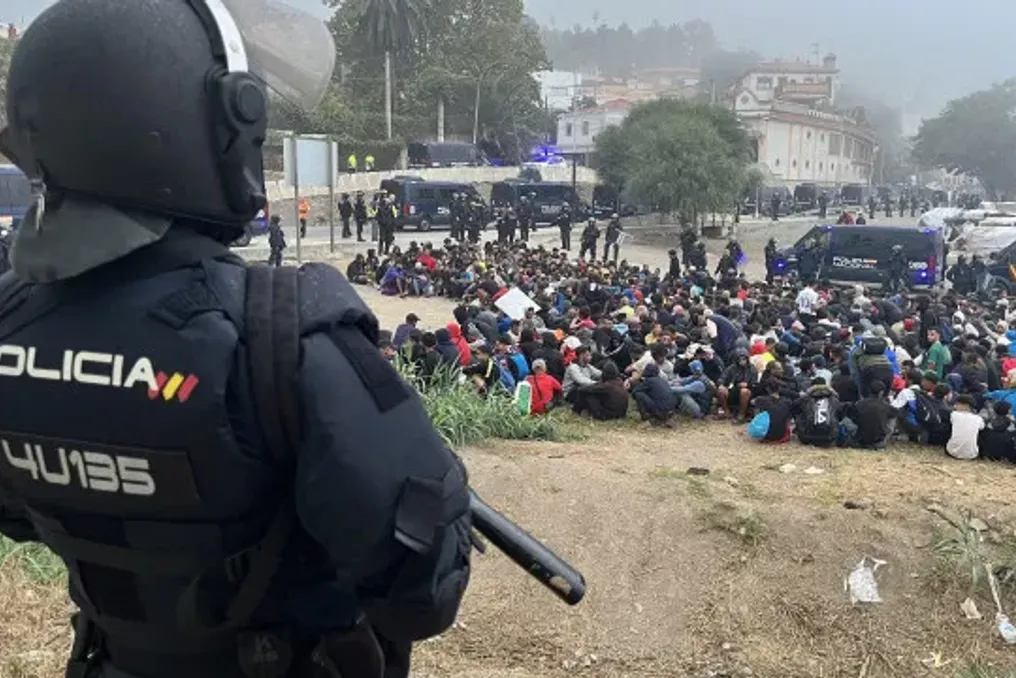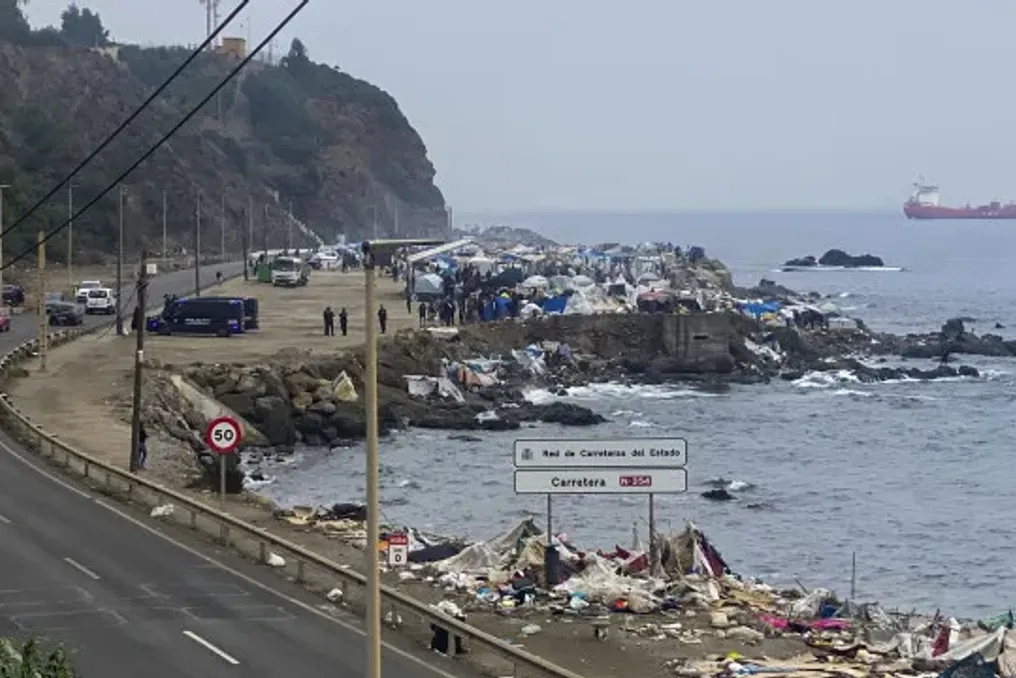
The Spanish Civil Guard released an estimate that approximately 88,146 migrants returned to Morocco after entering Ceuta at the end of July, according to a report dated October 27, which the news agency EFE obtained.
The judge of the National Court, María Tardón, who is leading the investigation into the massive entry of migrants into Ceuta on July 30 and 31, has already analyzed various documents requested weeks ago from several entities, including the Civil Guard, the National Police, and the National Intelligence Center (CNI), seeking clarification on the events.
On a previous Thursday, it was reported that the police had identified two high-ranking Moroccan commanders in videos related to the entries, giving instructions near the Bab Sebta border crossing in Fnideq (Morocco), near the Tarajal border. Subsequently, the Civil Guard's report emerged, raising the number of people who returned to the Maghreb country after illegal entry into Ceuta to over 80,000.
This number is higher than what the Government had disclosed until then. The Civil Guard's report, focusing on the deployment of personnel and material resources mobilized since the incident, indicates that 862 rescues were carried out in national waters and there were 90 deaths.
When questioned about the volume of repatriations, the National Police informed the judge that they could only count the migrants who expressed to their agents the desire to return. This number is considered 'minimal compared to the global figure,' which covers all those who returned voluntarily through the entry kept open by the Civil Guard since the July migration crisis.
The Police explained in its document that only the armed institute has knowledge of this data, given that the massive entry, described as an 'invasion,' occurred in an area 'under the protection of the Civil Guard.'
In a previous report, at the beginning of July, before the mass entry, the Guardia Civil had already warned that the Supreme Court's new doctrine could increase irregular immigration by sea in the autonomous cities of Ceuta and Melilla. A possible 'pull effect' was suggested, proposing the reinforcement of the provincial maritime service of the autonomous city responsible for preventing beachgoers' access, the increase in the staff of the Special Underwater Activities Group in Melilla, the enhancement of early detection and coastal surveillance technological systems, and the regulation of the application of the rejection regime at the border for any attempt at irregular entry outside authorized posts, regardless of the means used.
Other documentation sent to the judge included a CNI report from July 30, analyzing 'the situation and perspective' of what intelligence classifies as 'the largest mass displacement of migrants in Spain's history in the Autonomous City of Ceuta.' However, this report pointed out that 'a deep distortion became evident between King Mohammed VI's vision during his annual speech to the nation' held on July 29 and 'the reality experienced on the ground, at a time when Morocco tries to assert itself as a stable actor and a reliable security partner.'
Additionally, the Government Delegation in Ceuta announced that starting November 17, works to expand the border jetties of Tarajal and Benzú will begin. The Government Delegate, David de la Encina, communicated these works and stressed that on this date, the vessel scheduled to begin drilling to install stakes on the seabed will arrive.
David de la Encina mentioned that the Ministry of the Interior managed 'the important quantity of authorizations' necessary for this work during August, September, and October. He stated: 'After this complicated process, on November 17 we will have in Ceuta the vessel to start this very important work with a budget of about 5 million euros.' The works will involve strengthening the jetties by about 150 meters in the sea, starting from the baseline of the current 50-meter jetty, and will subsequently be complemented by a floating barrier, which, according to the delegate, 'we could be talking about almost 500 meters of barrier that will prevent swimming entries.'