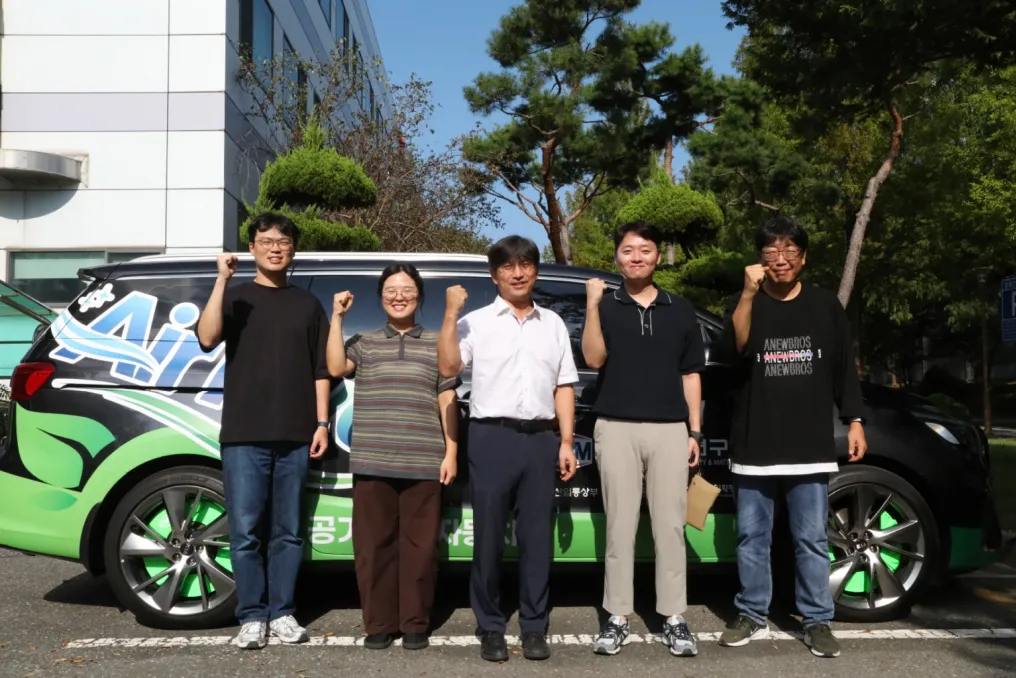
Researchers from South Korea have developed a kit that allows standard cars to be converted into urban air purification devices. The Korea Institute of Machinery and Materials (KIMM) created this system, which is capable of removing fine particles from the air while driving and collecting brake dust directly at the source.
The system was tested on two models: the Hyundai Sonata sedan and the Kia Carnival minivan. It utilizes existing vehicle components such as the front grille, braking system, and radiator fan.
The front grille functions as an electrostatic precipitator. Carbon filaments charge incoming particles, and plates with an opposite charge retain them. According to KIMM data, this system removes at least 95% of fine PM2.5 particles and 99% of particles between 2.5 and 10 micrometers at speeds of 30 km/h and 50 km/h. Each car can filter approximately 1800 cubic meters of air per hour.
Because the movement of the car itself pushes air through the grille, the kit does not require an additional road ventilator, and fuel consumption during tests changed by less than 1%. When the car is stationary at a wireless charging base, the radiator fan performs the function.
It is important to note that the 95% figure refers to the air passing through the grille; the system's impact on overall street air quality has not yet been measured.
The second component is designed to collect dust generated by the friction of pads and discs. Since these particles are already electrically charged, a collector installed behind the caliper uses charged plates to attract them, requiring no suction pump.
During standardized WLTC testing, the device collected 22.2 mg of dust per kilometer, achieving an average capture efficiency of about 61%.
In Europe, Euro 7 regulations come into effect on November 29th, which for the first time sets limits on brake dust for new models: 7 mg/km PM10 for internal combustion engine and hybrid vehicles, and 3 mg/km for electric vehicles.
Currently, this kit remains a research and development project, and information regarding partners, timelines, or cost has not been disclosed. The team plans to conduct further durability testing of the system under real road conditions.