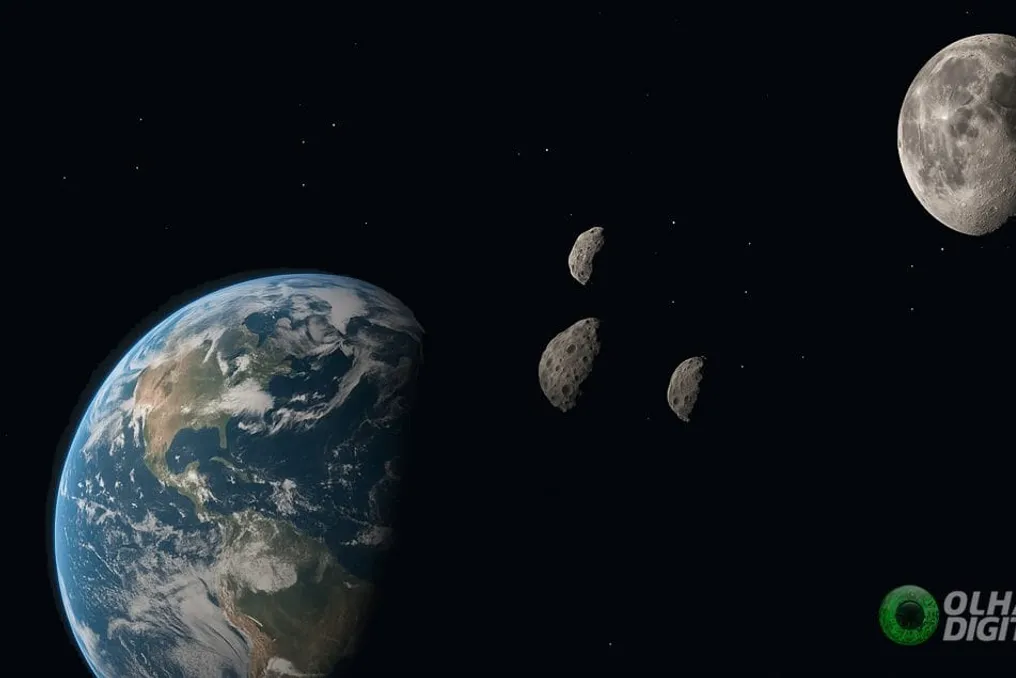
Earth has acquired a new temporary moonlet—asteroid 2026 QQ8, which was temporarily captured by the planet's gravity. This object, with a diameter of only 1 meter, could initially have been mistaken for space debris but was later identified as a natural body.
The Hungarian astronomer, Krisztián Szarnéczki, discovered this asteroid on August 20. According to calculations, the object will remain near Earth for about a month before leaving the planet's gravitational influence on December 13.
Last week, the Minor Planet Center at the International Astronomical Union confirmed the object's natural origin. It approached Earth in April, passed by the planet on May 1, and was captured by Earth's gravity.
There is no collision risk. The minimum distance recorded during the flyby was 537 thousand kilometers on August 18, which is approximately 1.5 times greater than the distance between the Earth and the Moon. The asteroid is not expected to approach closer during this current passage. When it leaves Earth's vicinity, it will be at a distance of about 1.35 million kilometers from the planet.
In a statement, the Minor Planet Center reported that orbital calculations indicate a temporary connection of the object with Earth. Furthermore, the institution stated that it found no connection between this body and any known artificial object, and recommended further observation and study of its trajectory.
The Moon is Earth's only permanent natural satellite, but other small bodies also pass through the planet's vicinity. Depending on their trajectory, they can be classified as moonlets or quasi-moons.
Moonlets are small asteroids or comets temporarily captured by the planet's gravity. They may complete one or more orbits around the planet before breaking free and continuing their journey in the Solar System. Quasi-moons follow a different dynamic: although they appear to orbit Earth, they are not gravitationally bound to the planet. They also orbit the Sun, following our planet on its annual journey. Earth's gravity influences their trajectories but does not hold them in orbit.
Examples of these two categories help to understand their differences. Moonlets provide an opportunity to study asteroids close to Earth at relatively short distances. Through such observations, researchers can better characterize these celestial bodies and study their properties. These studies also contribute to understanding the formation of the Solar System. This knowledge has another application—planetary defense. Observing asteroids passing near Earth can contribute to research on objects that might eventually come too close to the planet.
The history of 2026 QQ8 is also attracting attention. According to the EarthSky website, astronomers were able to reconstruct some of its previous approaches, which apparently occur every ten years. In 1965, the asteroid passed close to Earth but not close enough to be captured. It is predicted to approach again in 2058, again without reaching the distance required to become a moonlet.