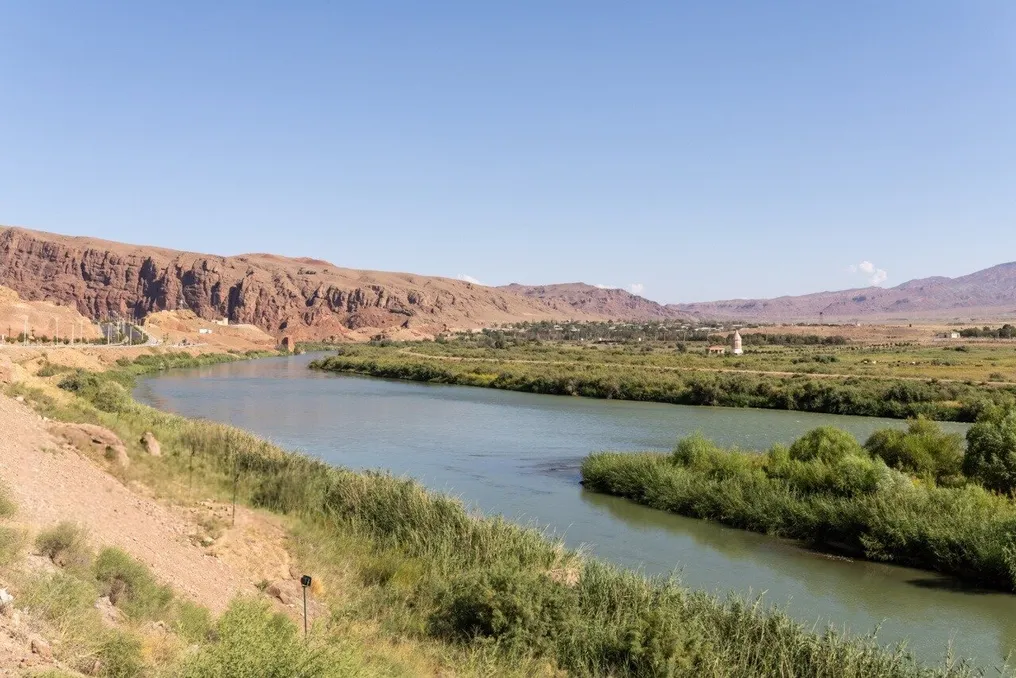
Officials from Iran and Armenia have reached an agreement to strengthen joint measures to address the pollution problem of the Aras River, which serves as the common border between the two states and faces environmental damage.
The meeting took place during the 17th Conference of the Parties (COP17), held in Armenia from October 19 to 30. It was emphasized that relevant bodies and authorities will continue to resolve the river's environmental issues through coordinated national efforts, according to IRNA.
Ahmad Reza Lahidjandzadeh, Deputy Head of the Department of Environment (DOE), highlighted the strategic importance of the Aras River from economic, social, and cultural perspectives. He stated that preserving the river's ecology and improving water quality are necessary conditions for the region's sustainable development, as well as for protecting the health of residents along its banks.
This official also called for strengthening bilateral ties to prevent pollutants from entering the rivers and to improve the river's environmental management.
The Iranian delegation presented a report on the measures and actions taken by the country to limit the discharge of pollutants into the Aras River.
Furthermore, Hamid Zohrabee, Deputy Head of the Iranian Department of Environment (DOE), met with his Armenian counterpart Aram Meymaryan during COP17. Zohrabee proposed establishing a joint park of peace and friendship with Armenia to strengthen cross-border cooperation in biodiversity conservation and wildlife protection in the Caucasus region.
The proposed cross-border park would facilitate joint efforts to conserve biodiversity in northwestern Iran and the Caucasus region while simultaneously protecting critical wildlife habitats, including those used by the Persian leopard.
Both officials also discussed ways to expand environmental cooperation and address common issues, including the protection of the Aras River. Meymaryan welcomed this proposal and highly praised the active participation of the Iranian delegation at COP17.
It was decided to establish a working group to monitor the agreements reached after the summit.
COP17 was conducted in two stages: first technical discussions, followed by the ministerial segment. The leaders' summit took place on October 16, during which President Masoud Pezeshkian addressed the conference. This marked the first time the President of the Islamic Republic of Iran attended the Convention on Biological Diversity Conference of the Parties.
Speaking at the summit, Pezeshkian called for 'peace diplomacy' to protect biodiversity, condemning the destructive impact of aggressive wars as ecocide, and strongly urged the international community to create effective, transparent, and enforceable mechanisms for protecting natural heritage during military operations.
Shina Ansari, Head of the Department of Environment, also spoke at the meeting, stating that environmental diplomacy can be a tool of peace diplomacy, and that the link between biodiversity, peace, and security must be viewed as a bilateral process.
Ansari added that the connection between biodiversity and peace is not merely an ethical or political issue, but a fundamental problem in the field of environmental management, international law, and human security.
According to the Convention on Biological Diversity, the main causes of biodiversity loss, as is generally accepted, include land-use change, habitat destruction, pollution, unsustainable exploitation of natural resources, and climate change.
The Iranian delegation also met with Vivek Menon, Chairman of the Species Survival Commission (SSC) of the International Union for Conservation of Nature (IUCN). They discussed ways to strengthen cooperation in developing programs for the management and conservation of endangered species. Special attention was paid to conservation and restoration programs for the Asiatic cheetah, great bustard, and Persian onager in their natural habitats, as well as the reintroduction of the Persian red deer into its natural ranges.
The parties also discussed increasing technical and scientific cooperation and providing funding under sanctions. Menon expressed hope that the current interaction between IUCN staff and Iranian experts would ensure the survival of endangered species such as the Asiatic cheetah in Iran.
During this summit, Iran officially joined the Coalition Actions for Endangered Species Recovery (CARES), whose goal is to strengthen international cooperation for the conservation and recovery of the country's wildlife. CARES was introduced at COP17 in Yerevan on October 16. Colombia and Armenia launched this initiative with the participation of 17 founding countries: Armenia, Belize, Brazil, Canada, China, Colombia, Costa Rica, Ecuador, Fiji, Indonesia, Madagascar, Mexico, Panama, Papua New Guinea, Peru, the United Kingdom, and Vanuatu. Iran became a member of the coalition as the 18th country.
The coalition is supported by the Reverse the Red Action partnership as its secretariat. The membership document was signed by Zohrabee on October 26. Speaking at the event, Zohrabee emphasized the need for fair distribution of resources and technologies to save endangered species. Iran's name will be listed on the coalition's website as a country that has developed action plans to conserve 40 species of wildlife to receive technical, scientific, and financial support from CARES.