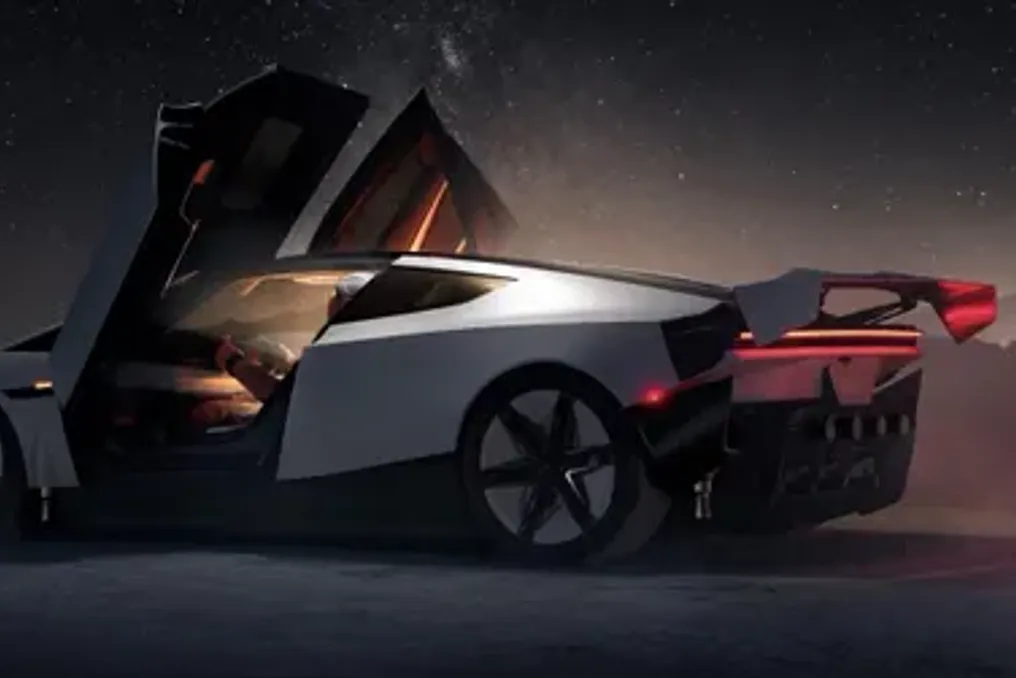
Tesla plans to gradually decrease the manufacturing of the Cybertruck at its plant located in Austin, Texas, with an expected timeline for mid-2027. This change aims to free up production capacity to intensify the manufacturing of the Cybercab, a two-seater vehicle designed to operate as an autonomous taxi.
Currently, there is no official confirmation regarding whether the pickup truck's production will be relocated to another factory unit or permanently discontinued. The Austin factory is currently the only known unit responsible for producing this model.
The Cybertruck was introduced by Elon Musk in 2019 with the goal of competing with pickups from established manufacturers. At that time, the executive estimated annual sales close to 250,000 units; however, over the last three years, Tesla has recorded the sale of only a few tens of thousands of units in total.
The discrepancies between initial projections and observed results are also evident in the technical specifications and cost. During the presentation, the company promised an entry-level version costing less than US$40,000 (equivalent to about R$218,000) and offering a range of up to 500 miles (approximately 805 kilometers). Both goals were not met.
The launch suffered a two-year delay, partially attributed to the Covid-19 pandemic. When it finally reached the market at the end of 2023, the initial price had already increased to around US$60,000 (R$327,000), and the range of the most expensive version was reduced by more than 100 miles.
Furthermore, the model faced commercial challenges due to its controversial design, coupled with occurrences of recalls and quality control issues.
Wes Morrill, Chief Engineer of the Cybertruck, commented on this production shift in a post made on X, stating: 'The Cybertruck was an incredible platform for technological development and lives on in the Cybercab.'
The reduction in pickup production aligns with Elon Musk's strategy to reorient Tesla into a company focused on artificial intelligence, robotics, and autonomous driving. In this context, the two-seater Cybercab is featured as one of the automaker's central projects.
In the last two months, the company began circulating the vehicle on the streets of Austin. Tesla plans to extend its operations to other locations, starting with Dallas this November.
The automaker's participation in the driverless vehicle sector also includes autonomous versions of the Model Y. Currently, these cars are operating in Austin, Houston, and Dallas, Texas, as well as Miami, Orlando, and Tampa, Florida, and the San Francisco area, California.
This modification in Cybertruck production is not the first decision by Tesla to make room for robotics initiatives. At the beginning of 2026, the company opted to cease the manufacturing of the Model S sedans and Model X SUVs. The industrial space previously dedicated to these two models will be allocated to the production of the Optimus humanoid robots.