Nubank lays off employees after implementing AI that reduced fraud queue
Read more
Tecnoblog
tecnoblog.net

Nubank lays off employees after implementing AI that reduced fraud queue

Nubank laid off approximately 30 employees from the team dedicated to investigating financial fraud claims as part of an internal sector restructuring after automating various tasks using artificial intelligence. These layoffs occurred on Tuesday, November 3rd.

According to reports from former and current employees, the introduction of AI managed to decrease the accumulation of complaints related to financial scams by 80% over the last six months. The company itself justified these cuts as a result of internal changes.

The affected team, known internally as 'investigations', belonged to Nubank's anti-fraud operations area. Their responsibilities included analyzing accounts suspected of involvement in financial crimes. The cuts affected professionals who investigated shell accounts used by criminals to move funds and hinder tracking, a practice that has previously been the subject of actions by the Federal Police.

As reported by Folha, the AI tools were implemented about six months ago, starting with the analysis of less complex cases. Initially, some employees were responsible for reviewing the conclusions generated by the systems. This additional work served both to detect potential failures and to improve language models with examples of corrected responses. Thanks to this automation, the backlog of pending issues and complaints saw a sharp decline.

The workers were dismissed without cause and were informed that the restructuring was linked to the reduction in workload. Nubank reportedly communicated that the reorganization of an administrative area led to personnel reallocation and job closures.

The laid-off employees are entitled to a benefits package, which includes salary supplementation and temporary extension of the health plan. Before these dismissals, about 40 members of the investigations team had already been transferred to other areas. The analysts who remained will focus on combating fraud, concentrating on the most intricate cases.

Nubank has not disclosed new layoff plans related to this restructuring. In July, Ellen Kiss, director of the Design Excellence Center, informed Tecnoblog that the company would not halt hiring due to AI.

Similar stories

What to do if money is debited from a bank account without notification: RBI refund rules and norms
Read more
www.aajtak.in

What to do if money is debited from a bank account without notification: RBI refund rules and norms

In the era of digital banking, cases of online fraud and unauthorized withdrawal of funds from bank accounts have become more frequent. Recently, an incident occurred in Greater Noida where millions of rupees disappeared from the accounts and fixed deposits (FDs) of one branch of Punjab National Bank (PNB), increasing concerns about the safety of depositors' funds.

If your accumulated funds are withdrawn without your knowledge, the question arises regarding compensation from the bank. The Reserve Bank of India (RBI) has established rules regarding client liability and the procedure for refunding funds in cases of unauthorized electronic banking transactions. If money is debited from your account without permission, you can minimize the damage by taking several immediate steps.

If a debit occurs from your bank account that you did not make, you must immediately notify the bank. This can be done using the bank's official customer support numbers, mobile application, website, or by visiting a branch.

There are three primary actions that should be taken:

  • File a complaint with the bank: You must inform the bank about the unauthorized transaction and register a complaint. If necessary, request the blocking of online debit and card operations to prevent further debits.
  • Save the complaint number: Be sure to obtain a reference number for the complaint from the bank. Also, save SMS messages, emails, bank statements, and transaction screenshots, as these documents will be needed for further investigation and fund recovery.
  • Report to cyber police: If the fraud is related to online payments or digital transactions, immediately file a complaint at the helpline number 1930. Additionally, a complaint can be filed through the Ministry of Home Affairs cybercrime portal at cybercrime.gov.in.

According to RBI rules, the client's liability in case of unauthorized electronic transactions depends on how the fraud occurred and how quickly the client notified the bank.

If the fraud was due to the bank's fault

If the unauthorized transaction resulted from negligence, error, or a systemic flaw on the part of the bank, the client's liability is zero. In such cases, the client does not need to prove the speed of filing the complaint; the bank bears all the loss.

In case of third-party fraud within 3 days

If the funds were debited due to interference by a third party or system hacking, and not due to the fault of either the bank or the client, the client must inform the bank about the transaction within three working days of receiving the information. If this condition is met, the client's liability will also be zero, and the bank will bear the entire loss.

What is the liability when reporting fraud after 4–7 days?

If the client reports the fraud to the bank within four to seven working days, their liability will be limited. This limit is determined by the type of account. The client may incur losses equal to the lesser of two amounts: the amount of the fraudulent operation or the established maximum limit. For Basic Savings Bank Deposit Accounts (BSBDA), the maximum liability is ₹5000, and for other regular savings accounts, it is ₹10000. For some current and other specified accounts, this limit can reach ₹25000.

What happens if OTP or PIN is shared?

If the fraud occurred due to the client's own carelessness, by sharing an OTP, PIN, password, or other payment information with someone, the client may bear the entire loss until they contact the bank. However, any additional unauthorized losses incurred after the bank receives the complaint will become the bank's responsibility.

What happens if more than 7 days pass?

If the client informs the bank about the fraud after seven working days, their liability will be determined according to the policy approved by the bank's board of directors. Therefore, the safest approach is to report the fund withdrawal immediately.

The RBI has set timeframes for refunds in cases of zero or limited liability. The bank is obligated to make a provisional credit of the unauthorized amount within 10 working days of receiving the complaint. This must happen regardless of the waiting period for insurance claim settlements. The amount must correspond to the value on the day of the debit.

The bank is given a maximum period of 90 days to fully investigate the complaint and determine the client's liability. If the bank cannot resolve the complaint or determine the liability within this period, it must pay compensation to the client in accordance with RBI rules.

Furthermore, the bank must ensure that the client does not suffer losses in the form of interest on savings or debit cards. No additional interest charges should be applied to the client's credit card.

If you have filed a complaint with the bank but it refuses to resolve your issue, you can approach the RBI's Complaint Management System (CMS) at https://cms.rbi.org.in. A complaint regarding banking services can be filed through the integrated RBI Ombudsman scheme.

Layoff Methods: From Voluntary Departure to Performance Review
Read more
www.aajtak.in

Layoff Methods: From Voluntary Departure to Performance Review

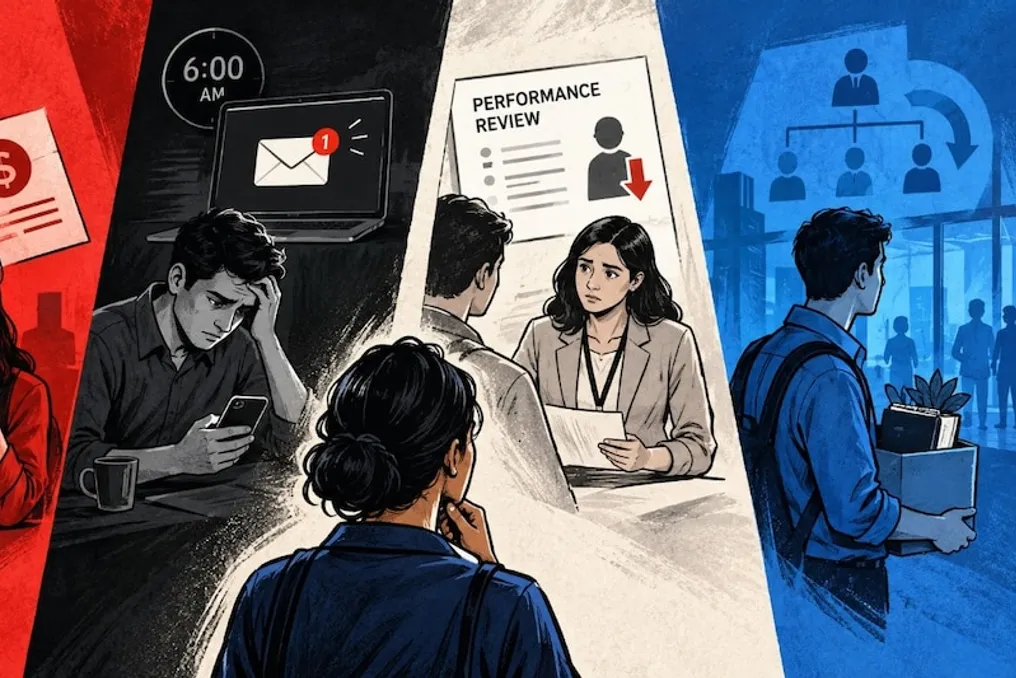
Uncertainty in the workplace remains unnoticed by an employee until the company notifies them via message or email. Receiving a termination letter immediately upon waking up raises serious career concerns. However, companies are developing increasingly new methods of downsizing.

These methods can take the form of an early morning termination notice, a decision made during an appraisal, or an HR offer of a financial package in exchange for leaving the job. In some cases, the employee has the right to choose to leave, while in others, the company makes the decision independently.

Microsoft offered around 60,000 eligible employees in India, the US, the UK, and Canada the option of a voluntary buyout. Through this program, employees can leave the company while receiving financial support. This step was taken during a period when Microsoft is actively investing in artificial intelligence infrastructure and adapting its workforce to business needs.

A question people often ask is whether all 60,000 employees will be laid off. The answer is no. A voluntary departure differs from a forced reduction. Nevertheless, this offer reignites familiar workplace anxiety: what happens when a company decides it needs a different workforce composition?

Downsizing can take various forms—from early morning termination letters and buyouts to performance-related reductions and major organizational changes. Each reduction has its own solutions, uncertainties, and consequences for the people involved. It is necessary to understand four aspects of layoffs that every employee should know.

A reduction does not mean the company suddenly fires employees. Sometimes it offers them the chance to leave by providing a financial package. Other steps are taken under the guise of a performance review or organizational transformation. Recent events in the tech sector show that layoff methods are diverse, and each situation presents unique challenges for employees.

Different forms of downsizing include Microsoft's voluntary departure offers, termination letters received by Oracle employees early in the morning, potential layoffs following performance reviews at Qualcomm, and changes within Adidas' technology division. Therefore, it is crucial for employees to understand the differences between all these situations and how they might affect their careers.

Microsoft offered a voluntary exit proposal to its eligible employees in 2026. Under this program, employees meeting criteria in certain internal levels 70 or below, in selected departments of the company, were offered the opportunity to leave in exchange for financial assistance. This offer applies to certain organizations in India, the US, the UK, and Canada, but not all Microsoft employees are candidates. This is significantly different from standard company layoffs. With a buyout, the employee gets the option to leave under contract terms, whereas in a forced layoff, the company itself decides on the end of employment.

Before accepting such an offer, an employee should carefully consider several points. These include the size of the package, the likelihood of finding new employment, health insurance, future financial needs, and the time required to find a new position. Receiving a financial package does not guarantee that the decision to leave will be easy.

Furthermore, some employees are suddenly informed of a company reduction. In Oracle's case in September 2026, some employees were sent an email early in the morning notifying them of the termination of their positions due to company changes. The company also provided information about the last working day in the letter. The company did not disclose the total number of affected employees to the public during this period.

In such a situation, an employee may face many questions after being let go. They need to find out the severance pay amount, when the debt payment will be made, when access to company systems will be closed, and how to start looking for a new job.

The main difference between a buyout and such a termination notice is that with a buyout, the employee may have a choice, whereas with receiving a termination letter, the decision to end employment has already been made by the company.

There is also a form of reduction that takes into account employee performance evaluations. Reports have emerged regarding global job cuts at Qualcomm following the annual employee review in 2026. According to reports, CEO Cristiano Amon spoke about the need to strengthen a culture of performance and attention to areas that consistently fail to meet expectations. The company has not disclosed the number of positions that will be affected by the proposed reduction.

However, it is important to understand that a performance-based reduction and general organizational changes are not the same thing. In organizational changes, an employee's position may be eliminated even if their performance was high. Whereas in performance-based decisions, the employee...


Popular