Uzbekistan plans to create a unified digital transport platform integrating metro and bike rental
Read more
Podrobno.uz [uz]
podrobno.uz

Uzbekistan plans to create a unified digital transport platform integrating metro and bike rental

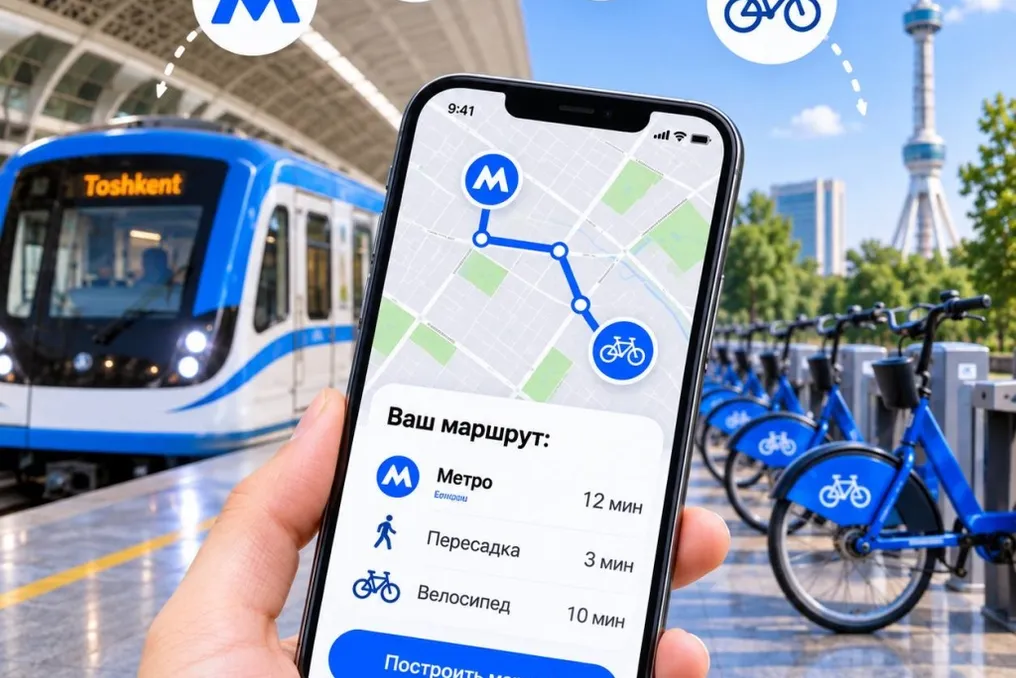
A proposal has been put forward in Uzbekistan to launch a digital transport platform that will allow passengers to organize their journeys using various modes of transport. Among the schemes under consideration are combined routes such as 'metro plus bicycle,' allowing travelers to cover part of the journey by public transport and the remainder by using bike rentals.

According to the Ministry of Transport's presented strategy project, a unified digital platform named 'Bir Yul' is scheduled to be commissioned by 2028. This system should consolidate information on schedules, ticket prices, and availability for trains, airplanes, and buses. This will enable passengers to form complete 'door-to-door' routes, selecting necessary transfers and purchasing tickets within a single order.

Simultaneously, starting from September 1, 2027, there is a proposal to gradually expand the bike rental network in populated areas of Uzbekistan. It is planned to install rental stations near major transport hubs and public transport stops, which will facilitate the use of bicycles for covering short distances after exiting the metro or bus.

However, the details of integrating bike rental with the developing platform remain uncertain. Currently, it is unknown whether bicycle booking will be possible through the application, what the cost of this service will be, and which cities will be the first to join this system. The strategy project is undergoing a public discussion phase until November 11.

It was previously also reported that there are plans to connect Tashkent's new airport to the Northern Railway Station via a railway line.

Similar stories

Uzbekistan plans to introduce bicycle rental services starting in September 2027
Read more
uzdaily.uz

Uzbekistan plans to introduce bicycle rental services starting in September 2027

Uzbekistan intends to gradually begin placing bicycle rental stations near major public transport stops and in high-traffic passenger areas, starting from September 1, 2027. This is stipulated by a draft presidential decree that outlines the strategy for developing the country's local passenger transport until 2030.

Responsibility for Service Organization

According to the draft document, the organization of bicycle rental services will be handled by the Council of Ministers of the Karakalpakstan Republic, regional administrations, and the Tashkent city administration.

The main goal of this initiative is to improve last-mile connectivity, allowing passengers to use bicycles for short trips between public transport stops and their final destination.

Authorities aim to solve the problem known as the last-mile problem, which refers to the final segment of the journey from a public transport stop to the passenger's destination.

Current Notes on the Project

However, an appendix to the draft decree notes that a specific list of locations for placing bicycle rental stations has not yet been compiled. Furthermore, the document acknowledges that the infrastructure required to ensure last-mile connections around transport hubs remains insufficiently developed.

Uzbekistan plans to create a unified passenger transport system by 2030
Read more
uzdaily.uz

Uzbekistan plans to create a unified passenger transport system by 2030

The government of Uzbekistan has developed a strategy for the development of domestic passenger transport until 2030, which provides for the integration of railway, air, and road transport into a single system. The goal is to increase the volume of domestic passenger traffic to almost 2 billion trips annually.

According to the plan, in 2025, domestic routes transported 1.6281 billion passengers. By 2030, it is expected that public transport will carry 1.9775 billion passengers per year, air transport will carry 2.5 million, while rail transport will increase from the current 9.9 million to 20 million. The cost of transport services is projected at 320 trillion sums, compared to 188 trillion sums currently.

The strategy includes the creation of six transport hubs in cities such as Tashkent, Samarkand, Bukhara, Urgench, Nukus, and Fergana. Additionally, the opening of twenty public transport routes is planned, which will connect stations, airports, and bus terminals. The construction of three railway lines connecting stations with airports in major settlements is also provided for.

Modernization and expansion of the transport fleet are planned. It is expected that the number of electric trains on domestic routes will increase from seven to 30, and the passenger carriage fleet will increase from 537 to 650. In Tashkent, Nukus, and regional centers, the share of electric buses in public transport should increase from 15% to 30%. Between 2026 and 2030, Uzbekistan intends to build or renovate 58 bus terminals and stations, and the number of objects managed under public-private partnerships should increase from one to eight.

Starting January 1, 2028, the Ministry of Transport and the Ministry of Digital Technologies will launch a national platform called Bir Yol. This system will allow passengers to check schedules, fares, seat availability, and routes for trains, flights, buses, and urban transport, as well as plan door-to-door journeys and purchase a single electronic ticket and transfers. The government aims to achieve a 25% share of passengers using this platform.

A pilot project for unified tickets, covering the route from Tashkent Airport to Urgench Airport and the Khiva railway station, is scheduled to begin on July 1, 2027. Schedules for trains, flights, and buses will be completely revised using artificial intelligence and coordinated among themselves. By January 1, 2028, the Tashkent State Transport University must develop a passenger flow forecasting system.

Within the Tashkent agglomeration, integrated transport communication is planned to connect Tashkent North and Tashkent South railway stations, the international airport, and the central bus station, starting from July 2027. It is expected that the number of suburban electric trains serving Chirchik, Yangiyul, Angren, and Almalyk will increase by 50%, with the possibility of direct transfer to the metro.

In Samarkand, tourist shuttles connecting the airport, railway station, and main attractions are scheduled to start operating by the end of 2027. In Bukhara, express buses linking the railway station with the airport, Old City, and hotels are planned to start operating in February 2028. In the Fergana Valley, the number of electric trains on the Kokand–Pop–Namangan–Andijan–Margilan–Kokand ring route is expected to double by the end of 2028.

In Nukus, the implementation of a high-speed bus line along E. Alakuz Street is planned by the end of 2027.

From 2027 to 2029, passengers purchasing electronic tickets for suburban trains and suburban and intercity buses will receive a discount of at least 20%. Starting January 1, 2030, payment on these routes will be made exclusively by cashless methods. Holders of electronic tickets for long-distance trains will be able to use suburban trains free of charge for 12 hours before departure and after arrival.

New buses and electric buses meeting Euro 5 standards or higher and imported by the end of 2027 will be exempt from vehicle disposal fees. From 2027 to 2030, railway stations, bus terminals, and airports will be exempt from property tax and land tax. Starting July 1, 2027, large terminals are also planned to provide at least one hour of free Wi-Fi, official taxi ordering services, and free baggage storage for up to 24 hours.

The volume of capital investments under the strategy for the period 2026–2030 is estimated at 4.5743 billion US dollars. Private partners participating in public-private partnership projects are predicted to account for the largest share, contributing 2.2291 billion US dollars, as well as state partners who will contribute 1.2545 billion US dollars. The document notes that these figures are preliminary and will be adjusted after the completion of feasibility studies. The Ministry of Transport will be responsible for overall coordination and will begin annual monitoring of implementation progress starting in 2027.
Uzbekistan plans full transition to cashless payment for suburban transport by 2030
Read more
podrobno.uz

Uzbekistan plans full transition to cashless payment for suburban transport by 2030

A plan is being developed in Uzbekistan for a complete abandonment of cash payments for travel on suburban passenger trains, as well as on routes of suburban and intercity buses, which is set to happen by 2030. In the future, passengers will have to use exclusively cashless payment methods.

This change is enshrined in the draft strategy for the development of passenger transport until 2030. According to this document, currently approximately 70% of passengers prefer to pay for travel with cash.

Furthermore, the project proposes providing a discount of at least 20% on electronic tickets for trips on suburban trains and buses starting from 2027. This benefit, according to the plan, should be valid until December 31, 2029. However, there are discrepancies in the project regarding the start date of the discount: the main text indicates January 1, 2027, while the action plan specifies March 1, 2027.

Another proposal concerns owners of electronic tickets for long-distance trains: they will be allowed to use suburban trains free of charge within the relevant region. This option will be available within 12 hours before the departure of the long-distance train specified in the ticket and within 12 hours after its arrival. It is planned that the procedure for providing this free travel will be developed and implemented before September 1, 2027.

It is important to note that all stated proposals are presented as a draft document, which is currently undergoing public discussion, so these measures have not yet received official approval and may be changed.

Popular