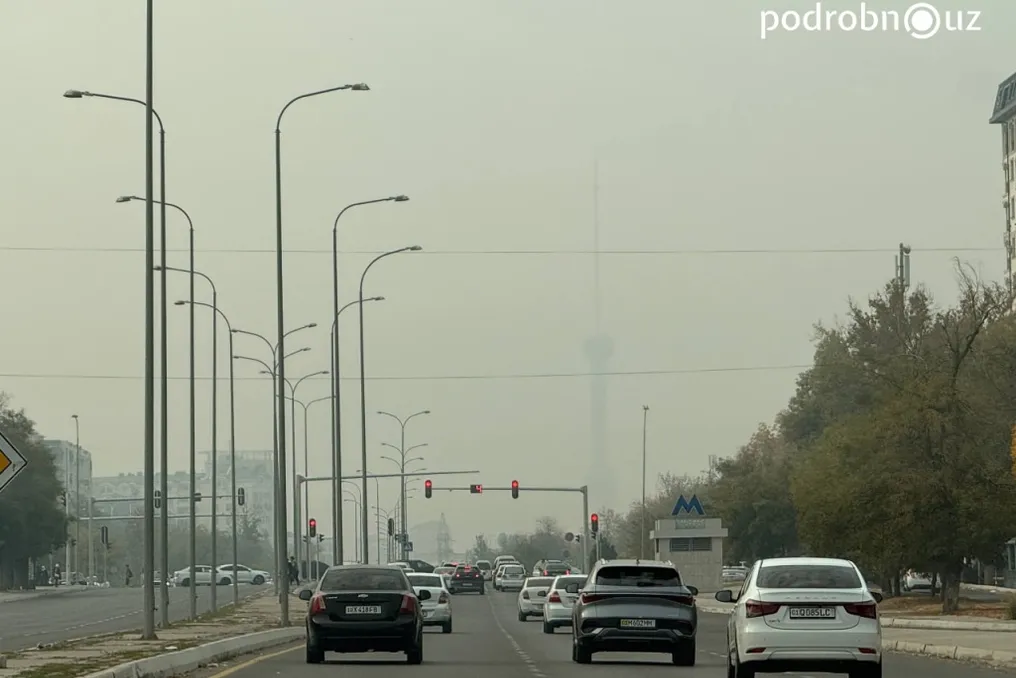
According to data from the National Committee on Ecology and Climate Change, air quality in Tashkent showed some improvement in October compared to the same period last year. Nevertheless, the situation in the capital has not become entirely favorable.
An analysis of data tracked by Podrobno.uz via IQAir shows that in most morning measurements, the air was in the orange or red zones. Furthermore, the average daily pollution index significantly increased during the final week of October.
Official Air Quality Statistics
On November 5, the National Committee on Ecology and Climate Change announced that the average monthly air quality indicator in Tashkent, according to the international AQI, decreased from 138 to 115 relative to October 2025. At the same time, the concentration of fine particulate matter PM2.5 decreased by 19%, and PM10 by 37%.
According to the agency, the number of days when air quality met national 'green' standards increased from three to fourteen. Simultaneously, the number of days with 'orange' and 'red' levels decreased from sixteen to four.
The Committee acknowledged that the observed improvement was uneven. During the first twenty days of the month, indicators were significantly better than the previous year, but from October 25 to 31, air quality began to deteriorate. The agency attributed this decline to lower temperatures, weak winds, temperature inversions, and lack of precipitation.
Morning Air Quality Readings
The editorial team of Podrobno.uz published IQAir data on the state of air in Tashkent throughout October, recording readings at eight in the morning on weekdays and ten in the morning on Saturdays. Out of twenty-seven days when publications were made, only one time did the index meet the 'green' level.
The 'yellow' level was recorded eight times, the 'orange' level ten times, and the 'red' level another eight times. Thus, in eighteen out of twenty-seven cases, the morning air quality was in zones posing a health risk, especially for highly sensitive individuals.
The Most Difficult Period of the Month
Analysis of the average daily IQAir indicators also allowed tracking the situation's dynamics throughout the month. From October 8 to 24, the average AQI remained around 103. However, during the period from October 25 to 31, this indicator rose to approximately 170.
The highest registered reading during this period was 187 AQI, recorded on October 28. On the other days of the last week, the average daily index fluctuated between 156 and 182 AQI.
Conclusions on Pollution Issues
Although the committee's data and IQAir data cannot be directly compared—as the agency provides monthly averages comparing them to the previous October, while Podrobno.uz publishes daily and morning values for parts of the month—the overall picture remains clear. Despite the declared improvement, air quality in Tashkent in October was not consistently favorable, and the situation noticeably worsened at the end of the month.
Residents of the capital continued to be exposed to air that repeatedly fell into unhealthy categories according to IQAir assessments. The increase in 'green' days does not negate the fact that the air pollution problem in Tashkent persists.