During the week at IIT Delhi, investor Gaurav Dalmia shared twelve stories with students on how fortunes are built. One of these stories was particularly memorable for illustrating how easily wealth could have gone to another person.
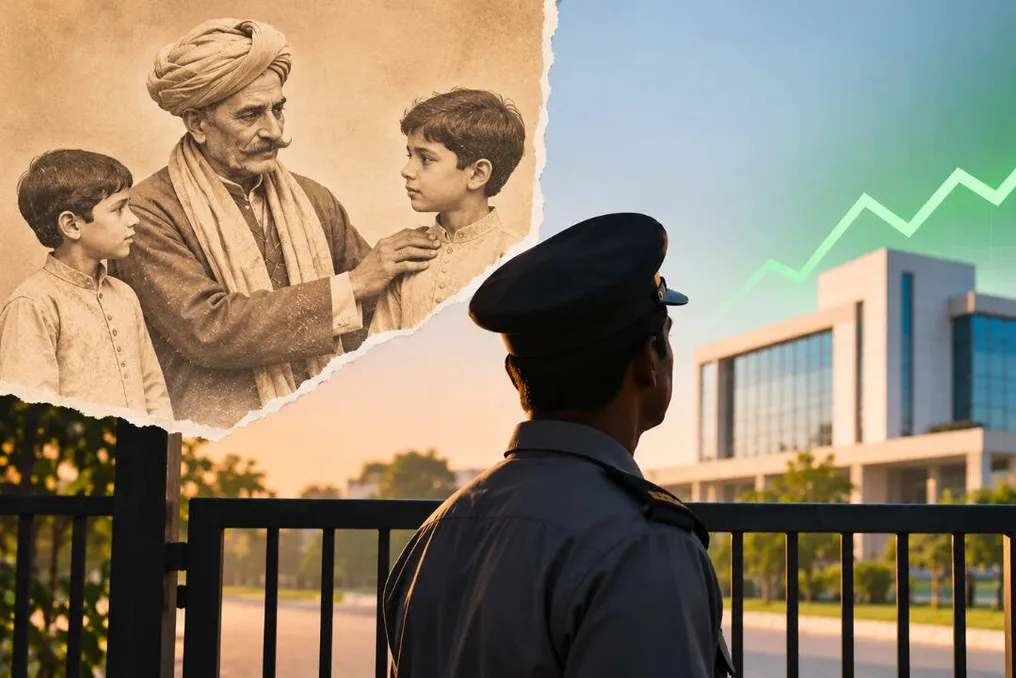
Several years ago, Rajiv Bajaj was in Sikri, Rajasthan, in his great-grandfather's village, filming a documentary about his family. Among those gathered, he noticed a familiar face—a security guard from Bajaj Auto. When Bajaj asked him about his presence, the man replied that it was his home because his family and the Bajaj family were neighbors.
The destinies of these two families diverged due to a single decision. In 1894, a wealthy merchant named Seth Bachhraj took a young boy from that area, Jamnalal, to raise him as his grandson and heir. Later, Bajaj mentioned that he was grateful for his luck and wondered what would have happened if the merchant had chosen a boy from the neighboring house. Perhaps the guard's family would have run the company, and Rajiv Bajaj might have been the one standing outside on duty.
Dalmia recounted this story on Wednesday evening at a meeting with the Economics and Finance Club at IIT Delhi. He included it at the end of his first case study, almost as an aside. The audience of students striving to build their fortunes could forgive such a charming digression.
Dalmia heads Dalmia Group Holdings, which invests in private equity, real estate, and public markets. He is characterized as someone who constantly reads and prefers to speak about what he has read rather than what he owns. The theme of the evening might have seemed dry: 'The Indian Business Landscape: Selected Case Studies.' Twelve companies were presented, most of which were Indian, and most were accompanied by graphs plotted on a logarithmic scale.
A logarithmic scale is an unromantic tool. Each equal step up the page means the number has multiplied by the same factor, so the growth from 1 to 2 takes up as much space as the growth from 1000 to 2000. The drama of any specific year diminishes. What remains is the rate of growth stretched over decades. By studying enough such graphs, one begins to see business as Dalmia apparently sees it: slowly and in ratios.
He started with an example of a mistake. In 1991, India's foreign reserves dropped to about $1 billion, barely covering two to three weeks of imports, forcing the country to open up due to lack of choice. Rahul Bajaj and the so-called Bombay Club advocated for a gradual transition, fearing that Indian companies would be destroyed before they could adapt. Dalmia's verdict was brief: Bajaj was wrong. Only since 2002 has Bajaj Auto's revenue grown nearly 16 times, and its market capitalization—about 50 times, or roughly 100 times when including the spun-off Bajaj Finserv. The company whose patriarch feared foreign competition now sells products in 100 countries.
Next came long periods where nothing seems to generate profit. Nvidia, currently valued at $5 trillion, is considered a foregone conclusion today. According to Dalmia's calculations, between 2004 and 2008, its profit grew by more than 16 times, while its market value increased by only 3.6 times, and profit jumped by 82 percent in one year while the stock remained flat. Such years, he noted, place a heavy burden on the CEO.
Infosys, whose market capitalization grew from 191 billion rupees in 1994 to over 5 lakh crore rupees, illustrates a similar point: private equity firms are often sold upon listing, assuming the best years are behind them, while buyers often find the party has just begun.
Berkshire Hathaway provided the arithmetic. A thousand dollars in 1965, compounded at an S&P 500 rate of 10.6% with dividends, turned into approximately $455,000. At Warren Buffett's company, with a 19.8% rate, this amount reached nearly $61 million. The difference would be negligible in the first five years. But from 2020 to 2025, in the era of tech stocks, Berkshire outperformed Nasdaq, 2.2 to 1.8. 'Many techies will find this very humbling,' he told the IIT audience.
His second habit is distrust of categories. Lakshmi Mittal, facing capital shortages in the early years, acquired failing steel mills ignored by large corporations—so-called 'rag assets'—at prices below their replacement cost, starting with an unprofitable plant in Trinidad and Tobago. His fortune grew from $1.5 billion in 1996 to $45 billion in 2008. Varun Beverages, a Pepsi bottler, became a Dalmia example of how old Western business can become new Indian business. He argued that if salaries grow by 9–11 percent annually, what happens to millions of Indians after food, clothing, and housing costs rise by 20 percent or more. Next come soft drinks. Varun's annual revenue grew from 42 billion rupees in 2016 to over 3,000 billion rupees.
Cement is a boring commodity unless you are Alico Dangote in Nigeria, where poor infrastructure limits competition, and a ton yields about $24 in profit compared to about $6 in India for UltraTech. An automotive company is low-margin routine unless you are Ferrari, which limits production to about 14,000 cars and advertises almost not at all. Its revenue is around $8 billion versus Volkswagen's $364 billion. Its market cap exceeds Volkswagen's.
In Dalmia's narrative, the industry is the average, and averages hide interesting people. The third thing he looks for is harder to represent in graphs. Dalmia invested early in the lender Incred in 2017, so he is not entirely neutral on this, and he claims it attracted him due to the absence of a certain quality. Non-banking lending was a trendy topic then. Many founders attracted money based on the trend, having little of their own stake, taking a free bet on someone else's capital. He calls this the 'bubble audacity,' and it is a phrase worth remembering during any funding boom, including the current one.
The founder of Incred put in significant personal capital. He also tried to save a forgotten word. Growth, he told future founders, requires both innovation and bureaucracy, by which he meant not laziness, but procedure: the discipline of managing something at scale after an experiment proves successful. And what is the true cost of building a global business? Not money, not great products, not excellent management. Jet lag.
There is an objection to all of this, and the opening story illustrates it. Twelve winners are twelve survivors. There was no graph for many lenders in 2017 who, in his opinion, failed, and there was no slide for the troubled plant that remained in crisis. The most complex thesis was stated at the end. Describing Adani Green's vast renewable energy park in Hawda, Gujarat, on land allocated by the state to six developers, Dalmia argued that outsiders overestimate government relations, and the real value lies in building the project. Adani's speed is recorded: foundation laid in 2023, 4.1 gigawatts by the end of 2025. But a skeptic might argue that one does not exclude the other. The transcript cuts off where questions begin, so I cannot say whether anyone in the hall raised this issue.
Acknowledging this, he notes the limits of his own certainty. He points out that his view on Infosys is based on the period before any AI shock. He views Berkshire's cash cushion of about $350 billion as a warning sign of overheated markets, then adds that time will tell. After praising Buffett in detail, he advises students to read George Soros, who holds almost the opposite view on markets, to achieve balance. People who sell the system rarely recommend its rivals.
His final word to the students was 'junoon' (passion). Passion, he said, is what, in his experience, matters more than anything else, again and again. It is a beautiful thought for twenty-year-olds, and he hopes it is true. But he also told them about Sikri and left the two stories side-by-side, without trying to reconcile them. I am not sure they can be reconciled. Every line on his graphs starts after someone has already been chosen. No logarithmic scale can show the morning of 1894 when the merchant looked at two neighboring families and chose one. Or the guard who is still on duty more than a century later.
[ ]