AI Bubble Burst Causes Economic Crisis in the US and China, Affecting Global Markets
Read more
Aaj Tak
www.aajtak.in

AI Bubble Burst Causes Economic Crisis in the US and China, Affecting Global Markets

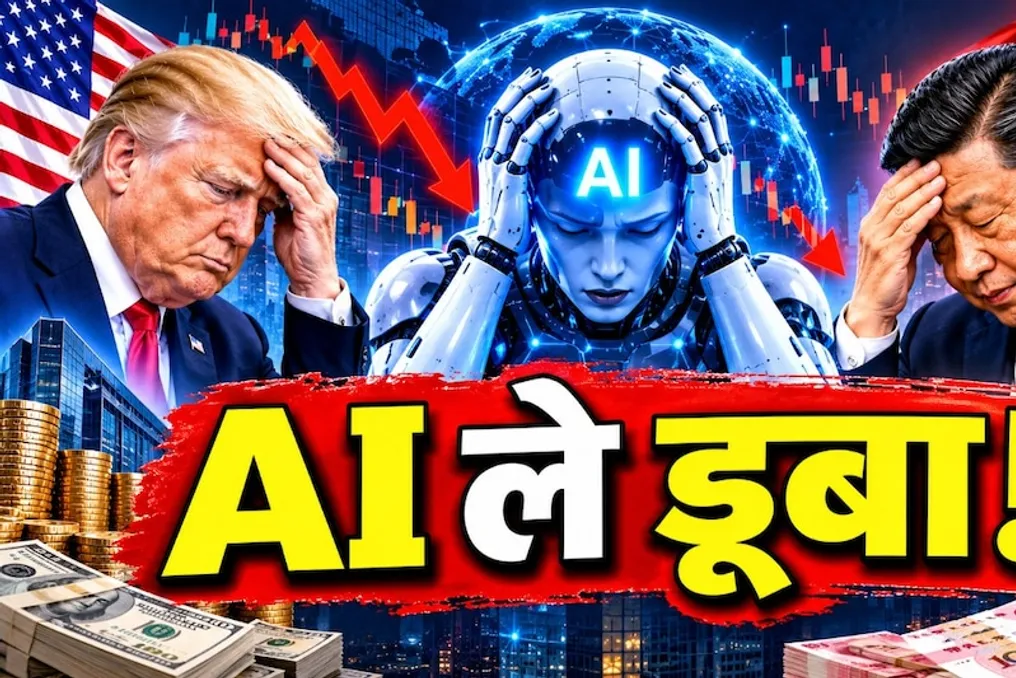
Previous notions that artificial intelligence (AI) would lead to a new global revolution and change all aspects of life are beginning to crumble. Large companies that bet on AI are facing serious difficulties, and this phenomenon is not limited to one country; the more a country focused on AI, the greater the economic damage it incurs.

Currently, AI is on the verge of bursting its 'bubble.' This threatens a serious blow to both technological superpowers and countries dependent on technology and finance. Although no one knows the final outcome, the current situation is causing concern as leading countries in AI have already suffered significant financial losses. Meanwhile, countries that lagged in the AI race faced smaller risks.

The reasons for this sharp turn remain unclear. Was an AI structure created that is now collapsing under its own weight? It was previously claimed that AI would become the greatest technological revolution in human history, transforming industries and making people's lives high-tech and simple. In anticipation of this world, global tech giants and investors invested billions of dollars without properly accounting for risks.

However, this brilliant image is starting to fade. Technological leaders participating in this mad AI race look depressed and are under pressure. The main problem is that, despite huge investments, a clear and sustainable plan for profiting from AI has not yet been developed. Since the return received from the market does not match the colossal costs of creating models, investor confidence has begun to weaken, which is reflected in global markets.

The International Monetary Fund (IMF) and the World Bank have also begun assessing the potential damage to various countries. Experts point out that the biggest economic blow will likely fall on America, as this is where the center of the global AI revolution is concentrated. Giants such as Microsoft, Google, OpenAI, Nvidia, and Meta are actively concentrating on AI, and currently, the greatest chaos is observed in the American stock market.

Similar stories

MIT Study: Young Mathematicians Concerned About Job Extinction Threat Due to Growing Influence of Artificial Intelligence
Read more
www.aajtak.in

MIT Study: Young Mathematicians Concerned About Job Extinction Threat Due to Growing Influence of Artificial Intelligence

The speed of artificial intelligence (AI) development has changed the pace of life worldwide. After AI attracted the attention of software developers and researchers, concerns about AI have now reached young mathematicians globally. Many young specialists are forced to question whether they should continue working in this complex field.

A recent and highly interesting study conducted by the Massachusetts Institute of Technology (MIT) presented data that could shock any academic specialist. These findings explain why young mathematicians live in the shadow of AI today.

Researchers from MIT—Anna Brandenberger, Hanna Mülarzik, and Dora Wooderff—surveyed graduates of mathematics departments and postdocs to gauge their attitude toward the growing influence of AI in mathematics. The study involved 268 young mathematicians from approximately sixty institutions across five countries, including India. Among those surveyed were about 85 percent graduates and about 15 percent postdocs, but the responses received were far from encouraging.

The study's statistics show that young researchers are experiencing disillusionment in the academic environment due to AI. Approximately 70 percent of the surveyed young mathematicians stated that the probability of continuing in academic mathematics for them has significantly decreased. Conversely, only 9 percent believe that their chances of remaining in this field have increased.

Around 76.3 percent believe that obtaining a permanent teaching or research position at a university (the so-called 'tenure track' position) will become extremely difficult in the future due to AI. Furthermore, the influence of AI is affecting not only work but also the morale of researchers. About 76.5 percent of young mathematicians noted a decrease in their desire to tackle complex mathematical problems after the advent of AI.

Interestingly, these same individuals stated that if AI solves a problem they have been working on for months or years, they will feel no joy. Many researchers fear that AI will solve the puzzle they have worked on all night, making them feel less significant. Because of this fear, some researchers have become reluctant to share their unfinished work.

Sixty-nine percent of the youth deeply fear that research funding in the future will be taken away from universities and transferred directly to private AI companies. Moreover, 59 percent of researchers worry whether mathematics will remain an interesting and meaningful career for them over the next decade.

However, many of these researchers themselves use AI in their daily work, such as searching for scientific articles, editing texts, or checking mathematical errors. Nevertheless, 54.8 percent openly admitted that they strongly dislike using AI for their research.

This survey was conducted at a time when tension was brewing in the global mathematical community due to AI-assisted research. In September of the same year, OpenAI announced that one of its AI models had found a solution to the Newell-Stokes problem. This well-known problem related to fluid dynamics had been a headache for mathematicians for a whole century.

According to the company, its system found this solution by launching about 10,000 AI agents over 88 hours. Following this announcement, dissatisfaction spread among mathematicians worldwide. Two mathematicians from New York University, who were working on this problem, expressed concern about whether OpenAI had used their unpublished research. Although OpenAI categorically denies this, even the 'Clay Mathematics Institute,' which awards a $1 million prize for solving this problem, has not recognized the solution claimed by OpenAI.

Expert explains why AI productivity gains are not leading to business growth
Read more
iol.co.za

Expert explains why AI productivity gains are not leading to business growth

Despite the undeniable influence of artificial intelligence (AI) on modern society, there remains a sharp debate over whether its overall impact is positive or negative. Just a year or two ago, the internet was flooded with AI-generated images that quickly entered corporate advertising. Soon after, social media platforms like YouTube were filled with AI-generated thumbnails—visuals that initially attracted viewer interest but now increasingly cause audience fatigue and skepticism.

However, outside of consumer social media feeds, artificial intelligence holds significant potential to transform corporate operations, provided it is implemented strategically. In an exclusive interview with IOL, Paul Banting, co-founder of growthguru.ai, analyzed the common narrative that AI has become an overrated tool that does not deliver expected productivity growth.

Banting stated that the problem is not that AI is overrated, but that it is being judged against the wrong promise. He emphasized that productivity gains are real and supported by research. According to a McKinsey survey on AI adoption in corporations, 80% of respondents noted improved individual productivity, yet only 37% claimed that AI directly contributed to increased profit for their organization—a metric that has remained virtually unchanged over the past year.

Therefore, in Banting's view, it is more accurate to say that AI is not overrated, but fundamentally misunderstood. Leaders mistakenly assume that saved time automatically translates into revenue growth. In reality, companies must actively direct the hours freed up by AI toward achieving tangible, high-return commercial opportunities.

While most public attention naturally focuses on optimizing outdated workflows, Banting warns that task efficiency should not become the primary goal of the enterprise. Around 79% of executives expect AI to drive substantial revenue growth by 2030, compared to 40% today. Nevertheless, only 24% have a clear idea of where this future revenue will originate. The true objective, Banting explained, is using AI to identify urgent commercial gaps and capture high-value market opportunities ahead of competitors.

The Growthguru.ai platform was developed precisely to bridge this strategic gap, focusing on business development rather than general workflow automation. Instead of offering a single universal assistant, their platform utilizes specialized AI agents targeting specific commercial levers: Perky helps partners access relevant incentives, discounts, and co-financing from suppliers; Maya develops go-to-market strategies and co-marketing initiatives; Alex guides partners through certifications and supplier tiers; and Lexi tracks important enterprise updates, such as critical Microsoft platform releases.

Nevertheless, alongside the commercial potential lies a darker side—AI-enabled crime, where issues of accountability and legal liability remain unresolved. Banting argues that criminals using AI for financial fraud must be held responsible for their actions, regardless of the tools they employ. However, if proprietary or third-party enterprise AI causes operational or financial damage, the responsibility lies directly with the business that implemented it. Legal liability cannot simply be shifted to the model provider. While software developers must create secure and compliant architectures, the choice of implementation rests entirely with the enterprise. BCG confirmed this finding in its applied AI benchmark.

Company offers high salary for writing texts, raising questions about the influence of artificial intelligence
Read more
www.aajtak.in

Company offers high salary for writing texts, raising questions about the influence of artificial intelligence

Amid the growing use of automation, many large companies are investing in artificial intelligence and conducting staff reductions. Nevertheless, the company Anthropic is ready to offer 32.5 million rupees for text-writing related work. This is surprising because what a person does in an hour, AI can do in mere seconds.

Artificial intelligence can write an email in a few seconds or create a blog draft in minutes, helping companies produce content on a scale that previously required an entire team. Because of this, many authors are questioning the value of their work if machines start writing.

Despite the emergence of AI, Anthropic has opened a special vacancy. For this position, the company offers an annual salary ranging from $295,000 to $345,000 USD, which is equivalent to approximately 2.5 to 3.25 crore rupees. However, this position is not intended for ordinary writers. The candidate must have at least eight years of experience in executive communication, working with senior management.

A natural question arises: why would Anthropic pay such money if AI can perform the job? The answer lies in the fact that the employee in this position will work directly with the company's top management. They will be responsible for preparing messages to convey the company's position to the public at important moments and explaining complex issues in simple terms. This requires not only good writing skills but also the ability to think strategically and provide balanced answers when necessary.

This job goes beyond simply writing articles for websites or product descriptions. It requires a specialist capable of deeply analyzing problems, predicting the impact of a message on the audience, and helping leaders decide what and how to communicate.

Anthropic is not the only AI company offering high salaries to writing and communications specialists. In September 2025, OpenAI also announced a vacancy related to content strategy, with an annual package of around $400,000. The employee in this role was tasked with improving the brand awareness of ChatGPT, creating content, and collaborating with engineers and designers.

However, this does not mean that salaries in the writing field are rising everywhere. It only indicates that some AI companies value experienced specialists who possess strategic planning skills, an understanding of people's needs, and the ability to simplify complex topics, in addition to good writing.

There is another side to the coin. In June 2023, one content writer reported that after the appearance of ChatGPT, some of his clients stopped commissioning him work. He specialized in writing content for websites and product descriptions, which can now be quickly created using AI tools, intensifying pressure on such tasks.

Thus, on one hand, experienced communications specialists are offered high-paying positions, while on the other hand, some freelancers involved in general content find it harder to find work. However, this does not mean that all entry-level writing positions are disappearing or that any senior author's job is guaranteed protection. The influence of AI depends on the type of work performed and the client's willingness to pay for it.

The author's task is not only to create content but also to verify the accuracy of information, identify missing details, and assess the material's suitability for readers. A report for September 2025 mentioned work related to correcting errors and improving AI-generated content.

This shows that humans may still be needed to check and refine AI-generated drafts. However, it cannot be assumed that the professions of editor and fact-checker are completely safe, as AI tools can assist in these tasks as well. Consequently, it becomes critically important for authors not only to write drafts but also to find errors, confirm information, and add necessary context.

The Anthropic vacancy is not suitable for all authors, as it is a high-level position requiring many years of experience. Therefore, it cannot be concluded that everyone can earn such a salary in the writing field. For those aiming to build a career in journalism, copywriting, or corporate communications, not only good writing skills but also research abilities, fact-checking, subject matter understanding, and critical thinking are important. Mastering the proper use of AI tools may also prove useful.

Authors who can use AI to speed up their work while simultaneously verifying information, performing quality editing, and applying their own original thinking will be able to adapt to the changing work environment.

Popular