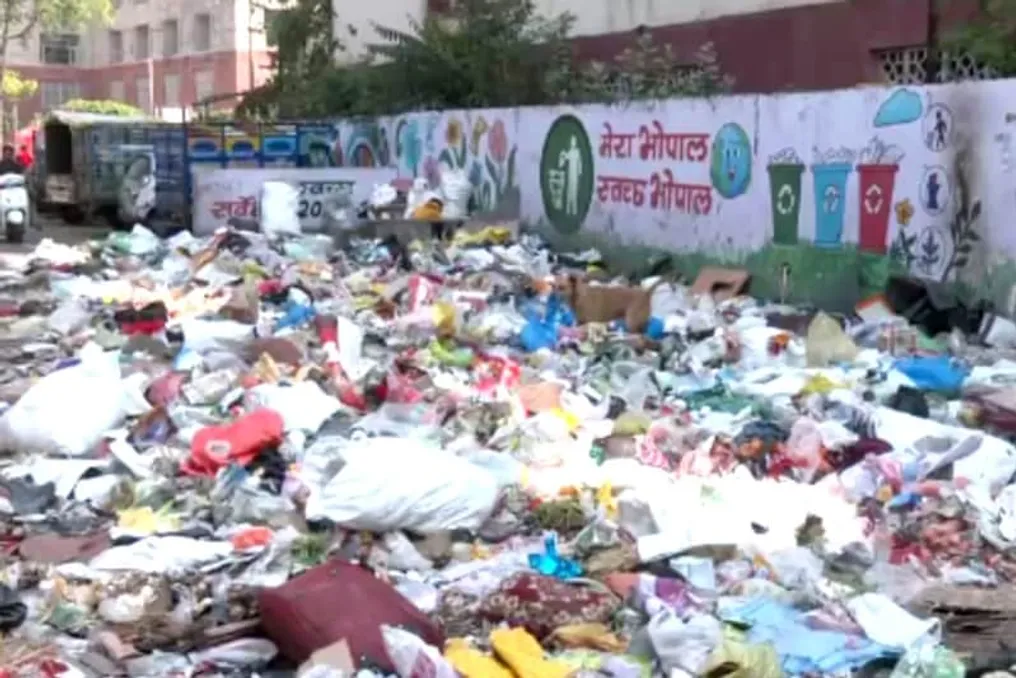
Garbage accumulation in Bhopal, Madhya Pradesh capital, due to strike halts cleaning ahead of Dhanteras festival
Read more
Aaj Tak
www.aajtak.in

Garbage accumulation in Bhopal, Madhya Pradesh capital, due to strike halts cleaning ahead of Dhanteras festival

Despite expectations of festive bustle and cleanliness ahead of Diwali, a completely different picture has emerged in Bhopal, the capital of Madhya Pradesh. Huge piles of garbage have accumulated on streets, in residential areas, and in markets, including the Ministry premises. This situation is the result of a three-day indefinite strike by sanitation workers, which has completely paralyzed the city's sanitation system. The cessation of door-to-door waste collection has turned Bhopal into a city overwhelmed with refuse.

On the day of a major festival like Dhanteras, New Market in Bhopal should have been filled with an atmosphere of consumer activity and business hustle, but the widespread garbage and foul odor caused significant concern among traders and citizens. The problem is not limited to markets; a massive garbage mound has also formed in front of the Madhya Pradesh government Ministry building, where the offices of the Chief Minister and various government departments are located, raising serious questions about the region's sanitary system.

The sanitation system in Bhopal's 85 wards, covering 21 zones and over 7,000 employees, depends on the operation of more than 400 garbage trucks, which were also affected by the strike. Approximately 850 metric tons of waste are generated daily in the capital. Therefore, during the three days of stoppage, an estimated 2,550 metric tons of garbage are expected to accumulate. Since household waste collection has stopped, the amount of garbage on streets and public places is constantly increasing.

Dirt is also visible in the elite area for ministers and officials, known as 4 Imli. Despite the residence of Deputy Chief Ministers, ministers, former ministers, and high-ranking IAS-IPS officials here, the streets remain littered with garbage. Photographs of cows searching for food among the trash highlight the critical state of sanitation in the capital during festivals.

The cause of the sanitation workers' strike is demands related to wages and working conditions. Employees, who earn about 10,500 rupees per month, insist on increasing this amount to 25,000 rupees. Furthermore, they demand the abolition of the outsourcing system, guaranteed permanent employment, granting them the status of civil servants, and providing a death benefit to one of their spouses. According to Ashok Verma, Vice President of the Madhya Pradesh Sanitation Workers Union, the strike continues due to these demands.

Meanwhile, Chief Minister Mohan Yadav has assured the public and sanitation workers that he will closely monitor the issues related to worker dissatisfaction and public discomfort. While workers protest over their demands, the public, traders, and residents of the city suffer from unsanitary conditions. A natural question arises regarding what steps the government and municipal services will take to end the strike and whether Bhopal can clear the garbage before Diwali begins.


Similar stories

Tips for Cleaning Kitchen Cabinets: An Effective Way to Remove Grease and Dirt
Read more
www.aajtak.in

Tips for Cleaning Kitchen Cabinets: An Effective Way to Remove Grease and Dirt

With the approach of Diwali, a general house cleaning begins. People polish fans, clean cabinets, windows, and floors. However, kitchen cleaning is considered one of the most difficult tasks, especially removing grease, dust, and sticky dirt accumulated on kitchen cabinets. Often, even after wiping with a cloth multiple times, the cabinets still look unclean.

In such cases, people buy expensive cleaning agents, but some of them may damage the shine and coating of the cabinets. If you are looking for a simple and inexpensive way to clean up for Diwali, dish soap can help. With it, you can prepare a homemade cleaning solution that will help remove grease and dirt from the cabinets without requiring much effort.

No special cleaning product is required to clean a kitchen cabinet. You will need a bowl of water, a few drops of dish soap, a clean spray bottle, and a microfiber cloth. These items can be used to clean both the exterior and interior surfaces of the cabinet.

First, take a small bowl of water. Then, add a few drops of dish soap to it and mix well. It is important not to add too much soap, otherwise, foam and stickiness may remain on the cabinet. After this, fill the solution into a clean spray bottle. Your simple cleaning solution is ready.

  1. Light spraying on the cabinet: First, remove the dust accumulated on the cabinet with a dry cloth. Then, lightly spray the prepared solution. Be careful not to let the cabinet get excessively wet.

  2. Wiping with microfiber: Take a clean microfiber cloth and gently wipe the cabinet. This will help remove grease, dust, and dirt. Also, thoroughly clean the corners and the area around the handles.

  3. Wiping again with a clean cloth: To remove soap particles, wipe the cabinet with a slightly damp cloth. Then, thoroughly dry it with a dry cloth. This will reduce the likelihood of water spots appearing on the cabinet.

Many people use vinegar and baking soda to remove stubborn grease in the kitchen. However, using these agents is not always suitable for all types of cabinets. They may affect the lacquer or coating of some cabinets. Therefore, you should choose the cleaning method depending on the material of the cabinet.

Note: Before using any cleaning solution, test it on an inconspicuous small area of the cabinet. The requirements for wooden, laminated, and painted cabinets may differ. It is safer to apply the solution to a cloth rather than spraying it directly onto the cabinet, especially if you are unsure about the coating.

First cafe opened in Bhopal, India, where trash is exchanged for food
Read more
thebetterindia.com

First cafe opened in Bhopal, India, where trash is exchanged for food

A unique concept has been implemented in the city of Bhopal, India, presented by Kachra Café. Here, people can exchange plastic and other types of waste for food products and essential items. This initiative gives value to collected materials, motivating people to collect waste instead of throwing it on the street.

The main idea is that waste is not always useless. When the population is encouraged to separate and recycle discarded items, daily habits contribute to larger environmental transformations.

Kachra Café functions not just as an eating place; it serves as a reminder that creative community projects can make waste management more accessible while encouraging people to take responsibility for the environment. Next time you feel like throwing away plastic, remember that trash retains its value when handled responsibly.

Popular